
Vessel Tide | A Guide to Essential Maritime Data Analytics Systems » Ship Management System Fundamentals
Ship Management System Fundamentals
Start here before choosing a ship management system. The decisions that matter most rarely come down to a feature list — they come down to how the system should be deployed, how to evaluate the vendors offering it, what the budget should realistically cover, and the mistakes that derail implementations that looked solid on paper. This page collects the foundational guides on these topics, with more added here as new decision points come up for fleets evaluating a system.
Key Takeaways
- Deployment model comes first: whether a system is cloud-native, hybrid, or on-premise determines your cost structure and connectivity requirements before any vendor comparison matters.
- Vendor evaluation isn't a feature checklist — fleet fit, support model, and data ownership predict a multi-year relationship better than a spec sheet does.
- Budget conversations move faster once you can explain the cost structure (license, implementation, training, support) rather than quoting a single unverified number.
- The same handful of implementation mistakes — skipped requirements, excluded crews, unchecked references — account for much of the rework fleets encounter after go-live.
Cloud vs On-Premise Ship Management Systems: Which Deployment Fits Your Fleet?
Start here if you haven't settled on a deployment model yet. This guide breaks down the differences between hosted legacy, hybrid, and cloud-native deployment models, and explains how satellite connectivity at sea changes the calculus compared to land-based fleet software.
Vendor Evaluation Criteria: How to Choose the Right Ship Management System Partner
Once you know which deployment model fits, this guide covers the eight criteria that actually predict whether a vendor relationship works over a multi-year contract — fleet fit, support model, data ownership, and total cost, not just the feature list on the sales deck.
Ship Management System Implementation Cost: What Should You Budget?
Before requesting quotes, this guide explains how ship management software pricing actually works — the difference between per-vessel subscriptions, quote-based modular platforms, and enterprise contracts — so you can build a defensible budget case instead of guessing at a number.
7 Common Mistakes in Ship Management System Implementation
Even with the right vendor and budget in place, implementation can still stall. This guide covers the seven mistakes that repeatedly derail implementations — from undefined requirements to skipped reference checks — along with a checklist to run through before signing.
Retrofit vs Newbuild: How to Install a Ship Management System on an Existing Fleet
Vessel age alone doesn't determine whether a retrofit is viable — what matters is whether existing power, sensors, wiring, and network infrastructure can be reused. This guide walks through an eight-point feasibility checklist covering power capacity, sensor inventory, cabling routes, network setup, class/flag requirements, and cybersecurity, plus the questions to ask vendors before committing to a retrofit timeline and budget.
Open vs. Closed Data Platforms: Why Vendor Lock-In Matters in Ship Management
Vendor lock-in isn't just a contract issue — it's an architectural one, since data ownership on paper doesn't guarantee the technical ability to export and reuse that data. This guide explains the difference between data ownership and data portability, breaks down where lock-in can occur across the hardware-to-application stack, and lists what to verify — including how ISO 19847/19848 standards are supported — before signing.
API Integration in Ship Management: Connecting Third-Party Maritime Applications
Having an API isn't the same as having a working integration — the underlying data architecture determines whether engine OEM monitoring systems, weather routing, emissions reporting, or crewing systems actually connect in production, not just on a roadmap. This guide covers the systems ship management platforms most commonly need to integrate with and a nine-point checklist for confirming what is available in production today versus what is only demonstrated as a possibility.
Ship Management System Installation Timeline: What to Expect From Survey to Go-Live
Installation length depends far more on how much onboard hardware and data integration work is involved than on the software itself, so a proposal built around a self-configured dashboard and one that includes sensors and shipboard wiring represent different project scopes. This guide breaks the process into six phases — survey, hardware and network setup, data integration, training, sea trial, and post-go-live stabilization — so vendor schedules can be checked phase by phase rather than against a single end date.
How to Test a Ship Management System Before Fleet-Wide Commitment
Specifications alone provide an incomplete picture — issues with sensor integration, data quality, crew workload, and vendor support tend to surface once real vessel data starts flowing. This guide covers how to pick a representative pilot vessel, define measurable success criteria up front, address cybersecurity from the start, and structure the handoff from pilot to fleet-wide rollout.
[Advertisement]
3 Recommended
Marine Fleet Management Software
3 Recommended
Marine Fleet Management Software
Advertiser Disclosure:
We receive compensation from some of the companies listed below.This compensation may affect which companies are included and the order in which they appear.
For Frequent Hazardous
or Long-Distance
Voyages
For Marine Fleet
Management Companies
or Long-Distance
Voyages
For Marine Fleet
Management Companies
MaSSA-One

* Image source: BEMAC Official
Website
(https://www.massa-one.com/english/)
(https://www.massa-one.com/english/)
Core Capabilities
Condition monitoring and anomaly detection
- Enables early detection of anomalies using data-driven automatic thresholds and expert-defined multi-condition detection.
- In the event of a failure, real-time data helps speed up root-cause identification, reducing downtime.
- This supports the prevention of future accidents and issues, contributing to reduced damage and losses involving vessels and cargo.
For Companies with
Frequent Business
in the EU
For Marine Shipping
Companies
Frequent Business
in the EU
For Marine Shipping
Companies
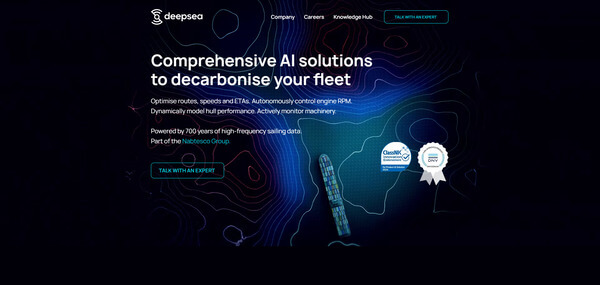
DeepSea
* Image source: DeepSea Official
Website
(https://www.deepsea.ai/)
(https://www.deepsea.ai/)
Core Capabilities
AI Fuel, CII &
Route Optimization
Route Optimization
- With the CII tracking feature, AI helps maintain and predict vessel performance.
- AI dynamically evaluates speeds and routes to suggest more fuel-efficient alternatives
- While complying with Europe-specific restrictions and regulations, it supports operations aimed at lower fuel consumption.
For Fleets with a Mix
of Older and Newly
Built Vessels
For Independent Ship
Management Companies
of Older and Newly
Built Vessels
For Independent Ship
Management Companies
Smart Ship Hub
* Image source: Smart Ship Hub Official
Website
(https://smartshiphub.com/)
(https://smartshiphub.com/)
Core Capabilities
Data integration across a mixed fleet
- Supports aggregation of vessel data across different manufacturers and standards, as well as data from multiple vessels.
- Visualizes information distributed across onboard systems and supports building an environment for centralized management.
- Supports information sharing between shore teams and fleets with older vessels, older equipment, newly built vessels and new equipment.