
Vessel Tide | A Guide to Essential Maritime Data Analytics Systems » List of Marine Fleet Management Software Providers » METIS (METIS Cyberspace Technology)
METIS (METIS Cyberspace Technology)
Index
View All
METIS is a platform that uses high-frequency telemetry data captured from vessels as its starting point, enabling an overall view of the fleet and supporting performance management and analytics.
This webpage outlines METIS’s key features, main functions, and expected use scenarios.
What You Will Learn on This Webpage
- Strengths of the tool:
By using high-frequency telemetry data and fleet KPIs, it becomes easier to gain a bird’s-eye view of all vessels’ status. - What implementation enables:
It enables cross-functional review of fuel-consumption, operations, machinery, and emissions data, and helps assess response priorities. - Best fit companies:
It is suitable for companies with a fleet of a certain size that want to organize performance management and complex compliance with environmental regulations at the same time.
Key Features of METIS
Use KPIs to Get an Overview
of Fleet Status and Clarify Response Priorities
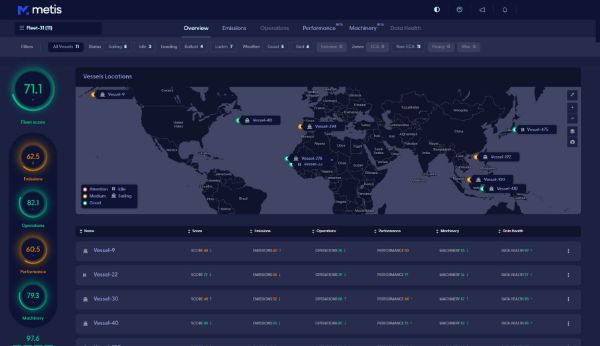
In the Fleet Overview function, the status of the entire fleet is displayed in a KPI form. By using filter and sort functions, vessels that require attention can be extracted based on selected conditions.
In the Vessel Overview function, voyage information and operating status can be reviewed in detail for each individual vessel. Even as the number of managed vessels grows, a company can use numbers to clarify which vessels should be checked first, making it easier to advance operational and technical discussions based on data.
Suitable for Companies That Need
to Organize Decisions
Across a Large Fleet
It is well suited to companies that want to visualize fleet-wide KPIs and clarify response priorities. It is designed to be practical when a company wants to link compliance with regulations—such as MRV, CII, and EU-ETS—to day-to-day operational data.
It also fits operators that, assuming high-frequency data is collected automatically, want to review information from different perspectives—operations, machinery, and the environment—on a single platform. It is useful when a company wants to organize information that tends to be siloed by department and move discussions forward with a shared understanding.
POINT
Finding the Ideal
Solution for
Your Organization
Solution for
Your Organization
As explored above, the core strengths and focus of each system vary significantly. Finding the right solution starts with assessing your fleet's specific management goals and operational scale. To simplify your choice, we have categorized top-tier vessel management software by company type. Explore our recommendations below to find the ideal fit for your organization.
Main Functions of METIS
Fleet Overview
Source: METIS Official Website
https://www.metis.tech/
https://www.metis.tech/
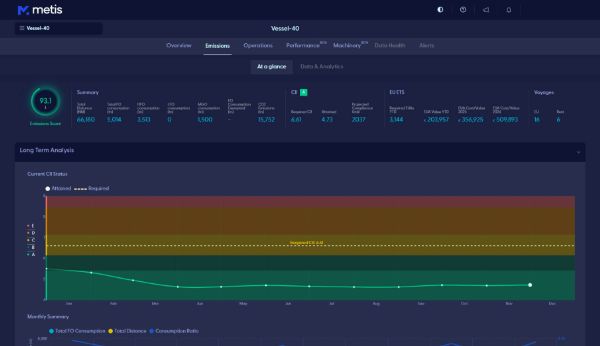
Emissions Monitoring & Reporting
Source: METIS Official Website
https://www.metis.tech/
https://www.metis.tech/
Scalability of METIS
METIS is designed on the assumption that high-frequency telemetry data is acquired automatically, but it also supports configurations that integrate and utilize existing data-collection systems.
For example, it has been integrated at the cloud level with systems such as Hoppe Marine. In addition, by using the onboard IoT solution Ship Connect, sensor data can be collected and utilized, making it possible to consider implementation without a full replacement with new hardware. Options are available to expand operations step by step while leveraging existing assets.
Regulatory Compliance and Certification of METIS
For compliance with regulations, METIS officially states that it supports IMO DCS/EU MRV, CII rating analysis, EU-ETS, and FuelEU Maritime. For CII, it is structured to support ongoing monitoring of indicators in anticipation of annual assessments.
On the other hand, official information does not provide details on specific compliance with cybersecurity or data standards, or on the status of third-party certifications. If security requirements and certifications are important, it is advisable to confirm these points with the vendor during the evaluation process.
Implementation Costs and Pricing of METIS
No uniform pricing information, including implementation costs, is publicly available on the official website or other public sources. Because conditions vary depending on fleet size and scope of use, an individual inquiry is required to confirm an accurate estimate.
Examples of Utilizing METIS
One expected use scenario for METIS is fleet operations where post-voyage Excel-based aggregation takes time, which tends to delay root-cause analysis. By automatically collecting and visualizing data, it becomes easier to look back on in-voyage changes in key figures and obtain inputs for identifying signs such as worsening fuel efficiency.
Based on this information, it is expected to become easier to advance discussions on speed adjustments and maintenance responses, as well as to explain and share findings with relevant departments.
*The above is purely an intended use scenario and does not represent an actual implementation case.
Support and Follow-up for METIS
During implementation, a structure is in place to proceed while making adjustments in line with customer requirements. Operational conditions—such as the specific SLA details, support hours, and whether support is available in Japanese—need to be confirmed individually during the evaluation process.
Company Overview of METIS Cyberspace Technology,
the Provider of METIS
- Company name:METIS Cyberspace Technology S.A.
- Address:Isminis 59 Str., Kallithea 17675, Athens, Greece
- Phone number:+30 213 007 5000
- Official website:https://www.metis.tech/
[Advertisement]
3 Recommended
Marine Fleet Management Software
3 Recommended
Marine Fleet Management Software
Advertiser Disclosure:
We receive compensation from some of the companies listed below.This compensation may affect which companies are included and the order in which they appear.
For Frequent Hazardous
or Long-Distance
Voyages
For Marine Fleet
Management Companies
or Long-Distance
Voyages
For Marine Fleet
Management Companies
MaSSA-One

* Image source: BEMAC Official
Website
(https://www.massa-one.com/english/)
(https://www.massa-one.com/english/)
Core Capabilities
Condition monitoring and anomaly detection
- Enables early detection of anomalies using data-driven automatic thresholds and expert-defined multi-condition detection.
- In the event of a failure, real-time data helps speed up root-cause identification, reducing downtime.
- This supports the prevention of future accidents and issues, contributing to reduced damage and losses involving vessels and cargo.
For Companies with
Frequent Business
in the EU
For Marine Shipping
Companies
Frequent Business
in the EU
For Marine Shipping
Companies
DeepSea
* Image source: DeepSea Official
Website
(https://www.deepsea.ai/)
(https://www.deepsea.ai/)
Core Capabilities
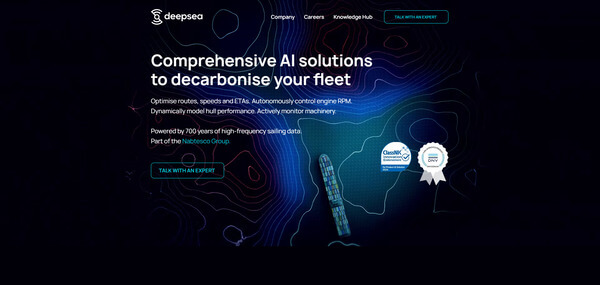
AI Fuel, CII &
Route Optimization
Route Optimization
- With the CII tracking feature, AI helps maintain and predict vessel performance.
- AI dynamically evaluates speeds and routes to suggest more fuel-efficient alternatives
- While complying with Europe-specific restrictions and regulations, it supports operations aimed at lower fuel consumption.
For Fleets with a Mix
of Older and Newly
Built Vessels
For Independent Ship
Management Companies
of Older and Newly
Built Vessels
For Independent Ship
Management Companies
Smart Ship Hub
* Image source: Smart Ship Hub Official
Website
(https://smartshiphub.com/)
(https://smartshiphub.com/)
Core Capabilities
Data integration across a mixed fleet
- Supports aggregation of vessel data across different manufacturers and standards, as well as data from multiple vessels.
- Visualizes information distributed across onboard systems and supports building an environment for centralized management.
- Supports information sharing between shore teams and fleets with older vessels, older equipment, newly built vessels and new equipment.