
Vessel Tide | A Guide to Essential Maritime Data Analytics Systems » Marine Fleet Management Software and Related Software Comparison
Marine Fleet Management Software and Related Software Comparison
Choosing between "Marine Fleet Management Software" and the related software categories vendors often associate with it is not about picking the system with the longest feature list. The right combination depends on your fleet size, how many owners or vessels you manage, your maintenance and compliance obligations, and which operational gap is causing you the most pain right now.
This page compares Marine Fleet Management Software against related maritime software categories — Vessel Management Software, PMS, CMMS, and VPMS — by scope, primary function, regulatory role, and typical buyer trigger, helping you work out which term actually matches the tool you need.
Note: Terminology, feature scope, and module boundaries vary by vendor and product tier. Always confirm directly with each vendor whether a given capability ships as a core module or a separate add-on before making an implementation decision.
Key Takeaways
- These terms overlap heavily in marketing, but the real distinction is scope: one vessel vs. an entire fleet, one function vs. the full vessel operation.
- Maintenance-specific functions like those found in PMS and CMMS are often built into fleet management platforms as modules, rather than positioned as replacements for the platform.
- Performance-specific systems like VPMS often feed data into fleet management software rather than serve as the primary system of record for vessel operations.
- Compare on scope and regulatory role — not the vendor's chosen label — to work out which combination of systems your fleet actually needs.
What to Compare Before Choosing Between These Categories
| Comparison Point | What to Check |
|---|---|
| Scope | Whether the system is built to manage one vessel's records or roll up data across every vessel in the fleet. |
| Primary Function | Whether the system centers on maintenance scheduling, performance/fuel efficiency data, or the full operational picture — crew, compliance, procurement, and voyages. |
| Regulatory Role | Which requirements or workflows it's designed to support — ISM Code maintenance procedures under SOLAS Chapter IX, CII monitoring, or EEXI-related analysis. |
| Data Granularity | Whether it tracks job-, certificate-, or equipment-level detail for one ship, or rolled-up, cross-vessel benchmarks. |
| Integration and Overlap | Whether the system is meant to feed into a broader fleet management platform, or stand alone as the system of record. |
| Typical Buyer Trigger | What operational pain point — missed certificates, fuel cost, multi-owner reporting, scattered maintenance logs — is pushing you toward each category. |
Compare Marine Fleet Management Software with Related Terms
Ship management companies encounter these terms for different reasons. Some are trying to decide whether they need ship-level detail or fleet-wide visibility. Others already have a maintenance system in place and want to know whether it's actually a PMS, a CMMS, or something that should be replaced by a full platform. Others are looking at performance monitoring systems because of CII-related requirements, fuel costs, or efficiency targets.
The comparison pages below break down how Marine Fleet Management Software relates to each of these adjacent categories, so you can work out which one — or which combination — fits your fleet.
Marine Fleet Management Software vs Vessel Management Software
This comparison looks at fleet management software's cross-vessel, portfolio-wide visibility alongside vessel management software's ship-specific technical file, maintenance history, and compliance depth for a single hull.
Fleet Management Software vs PMS Software
This comparison covers fleet management software's fleet-wide maintenance, spare parts inventory, procurement, and crew coordination alongside PMS's core function: scheduling and documenting maintenance jobs against a single vessel's equipment register.
Marine Fleet Management Software vs CMMS
This comparison explains fleet management software's full vessel-operation scope — maintenance, crew, compliance, and voyage tracking — alongside CMMS's cross-industry, asset-focused maintenance management built for any physical equipment, not just ships.
Marine Fleet Management Software vs VPMS
This comparison reviews fleet management software's breadth across maintenance, crew, and compliance This comparison reviews fleet management software's breadth across maintenance, crew, and compliance alongside a vessel performance monitoring system's specialized focus on fuel, engine, hull, and overall vessel performance data used for CII monitoring and EEXI-related analysis.
Marine Fleet Management Software vs EAM
This comparison explains fleet management software's focus on running vessel operations across a fleet — maintenance, crew, compliance, and voyage tracking — alongside EAM's broader scope managing the full lifecycle of any physical asset an enterprise owns, from acquisition through disposal.
Marine Fleet Management Software vs VMS
This comparison explains fleet management software's role running internal vessel operations — maintenance, crew, compliance, and voyage tracking — alongside VMS's narrower role of reporting a vessel's position and movement data to a regulatory authority where required.
Marine Fleet Management Software vs TMS
This comparison explains fleet management software's full operational scope — technical, crew, procurement, commercial, and compliance — alongside TMS's narrower focus on the technical superintendent's work of maintenance, defect reporting, and dry-docking.
Marine Fleet Management Software vs Automated Voyage Reporting Software
This comparison explains fleet management software's full vessel-operation scope — maintenance, crew, compliance, and voyage tracking — alongside automated voyage reporting software's specialized focus on digitizing noon reports and related voyage data for CII, EU ETS, IMO DCS, and EU MRV reporting and compliance workflows.
Marine Fleet Management Software vs Predictive Maintenance Software
This comparison explains fleet management software's full vessel-operation scope — maintenance scheduling, crew, compliance, and voyage tracking — alongside predictive maintenance software's specialized role forecasting machinery failure from sensor data trends.
ClassNK CMAXS vs MaSSA-One
This comparison covers ClassNK CMAXS’s machinery diagnosis, planned maintenance, spares, logs, and ship-shore visibility alongside MaSSA-One’s ship-data platform, CBM support, onboard and shore-side applications, and reusable vessel data foundation.
MaSSA-One vs Wärtsilä Expert Insight
This comparison explains MaSSA-One's role as a broader vessel data platform for collecting and using data across multiple onboard systems, alongside Wärtsilä Expert Insight's more focused role in predictive maintenance for eligible Wärtsilä engines with support from Wärtsilä specialists.
e-GICS Advance Alternatives
This guide compares alternatives to e-GICS Advance based on engine compatibility, diagnostic capabilities, retrofit requirements, and support. It also explains when an OEM-backed service may be the better fit and when an OEM-agnostic platform makes more sense for a mixed fleet.
[Advertisement]
3 Recommended
Marine Fleet Management Software
3 Recommended
Marine Fleet Management Software
Advertiser Disclosure:
We receive compensation from some of the companies listed below.This compensation may affect which companies are included and the order in which they appear.
For Frequent Hazardous
or Long-Distance
Voyages
For Marine Fleet
Management Companies
or Long-Distance
Voyages
For Marine Fleet
Management Companies
MaSSA-One

* Image source: BEMAC Official
Website
(https://www.massa-one.com/english/)
(https://www.massa-one.com/english/)
Core Capabilities
Condition monitoring and anomaly detection
- Enables early detection of anomalies using data-driven automatic thresholds and expert-defined multi-condition detection.
- In the event of a failure, real-time data helps speed up root-cause identification, reducing downtime.
- This supports the prevention of future accidents and issues, contributing to reduced damage and losses involving vessels and cargo.
For Companies with
Frequent Business
in the EU
For Marine Shipping
Companies
Frequent Business
in the EU
For Marine Shipping
Companies
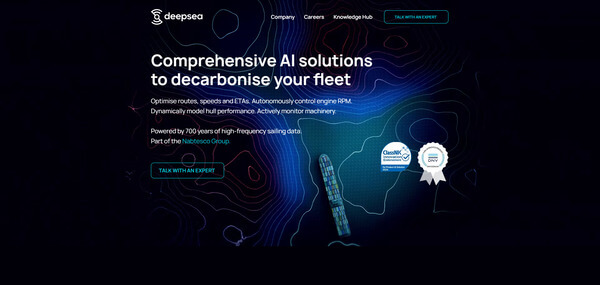
DeepSea
* Image source: DeepSea Official
Website
(https://www.deepsea.ai/)
(https://www.deepsea.ai/)
Core Capabilities
AI Fuel, CII &
Route Optimization
Route Optimization
- With the CII tracking feature, AI helps maintain and predict vessel performance.
- AI dynamically evaluates speeds and routes to suggest more fuel-efficient alternatives
- While complying with Europe-specific restrictions and regulations, it supports operations aimed at lower fuel consumption.
For Fleets with a Mix
of Older and Newly
Built Vessels
For Independent Ship
Management Companies
of Older and Newly
Built Vessels
For Independent Ship
Management Companies
Smart Ship Hub
* Image source: Smart Ship Hub Official
Website
(https://smartshiphub.com/)
(https://smartshiphub.com/)
Core Capabilities
Data integration across a mixed fleet
- Supports aggregation of vessel data across different manufacturers and standards, as well as data from multiple vessels.
- Visualizes information distributed across onboard systems and supports building an environment for centralized management.
- Supports information sharing between shore teams and fleets with older vessels, older equipment, newly built vessels and new equipment.