
Vessel Tide | A Guide to Essential Maritime Data Analytics Systems » Marine Fleet Management Software and Related Software Comparison » Marine Fleet Management Software vs VPMS: Key Differences Explained
Marine Fleet Management Software vs VPMS: Key Differences Explained
Marine fleet management software and vessel performance monitoring systems both pull data from the same ships, which is why buyers frequently treat them as interchangeable. They aren't. Fleet management software runs the operational side of a vessel's life — maintenance, crew, compliance, and voyage records — while a performance monitoring system answers one narrower question: how efficiently is this ship burning fuel and moving through the water. Which one you need depends on which of those two problems you're actually trying to solve.
Key Takeaways
- Fleet management software runs the vessel's full operating life — maintenance, crew, compliance, and voyage tracking — while a performance monitoring system focuses specifically on fuel, engine, and hull efficiency data.
- A performance monitoring system often complements fleet management software rather than replacing it — many fleets use both.
- If the immediate driver is CII performance, EEXI-related efficiency requirements, or fuel cost, start with a performance monitoring system; if it's maintenance, crew, or regulatory paperwork across the fleet, start with fleet management software.
- Before shortlisting either, confirm whether the platform is standalone or a module bundled inside a larger suite — pricing and integration effort differ significantly.
What is Marine Fleet Management Software?
Marine fleet management software centralizes the tasks needed to keep an entire fleet operating safely and legally: it tracks maintenance schedules across every vessel, manages crew certificates and rotations, manages compliance with the ISM Code, ISPS Code, and SOLAS requirements, and logs voyage and port call data in one system instead of scattered spreadsheets.
Most platforms are organized around a handful of modules an operator uses daily. Planned maintenance scheduling flags inspections and overhauls before they become breakdowns. Crew management handles rotations, certifications, and payroll-adjacent records. Compliance modules track survey due dates and regulatory filings. Voyage and reporting modules pull AIS tracking and port data into dashboards that ops managers use to spot delays or cost overruns across the fleet.
Because it sits at the center of daily operations, fleet management software typically integrates with ERP systems, procurement platforms, and IoT sensors elsewhere in the fleet — functioning as a central source of operational data rather than one more standalone tool.
What is Vessel Performance Monitoring System?
A vessel performance monitoring system exists to answer one question in detail: how much fuel is this ship using relative to what it should be using, given its speed, load, weather, and hull condition. It pulls continuous readings from shaft power meters, speed logs, draft and trim sensors, and weather instruments, then calculates engine and hull efficiency KPIs against the vessel's baseline performance curve.
The output is usually a set of efficiency trend charts and alerts rather than an operational checklist: hull fouling estimates that help identify when cleaning may be economically justified, speed-power curves that show whether a vessel is underperforming its design specification, fuel and efficiency reports that support CII monitoring and EEXI-related analysis.
Because the scope is narrow, these systems are often designed to integrate with existing fleet management or ERP software rather than replace it — the performance data becomes one input into a broader operational picture, not the picture itself.
Key Differences
Fleet management software gives you breadth across every vessel function; a performance monitoring system gives you depth on one efficiency metric with regulatory weight attached to it.
| Dimension | Marine Fleet Management Software | Vessel Performance Monitoring System |
|---|---|---|
| Primary scope | Entire vessel operating lifecycle: maintenance, crew, compliance, voyage | Fuel, engine, hull, and overall vessel performance |
| Core question answered | Is the fleet running safely, legally, and on schedule? | Is this ship performing as efficiently as expected? |
| Typical user | Fleet managers, technical superintendents, crewing teams | Performance managers, energy efficiency officers |
| Deployment | Usually a central platform other tools feed into | Often a specialist add-on or sensor-driven module |
| Regulatory tie-in | ISM, ISPS, SOLAS compliance tracking | CII monitoring, EEXI-related analysis, and efficiency benchmarking |
Overlapping Features
Both systems pull from the same onboard sensors and feed dashboards fleet managers check daily, which is where the overlap actually shows up. Fuel consumption data appears in both: fleet management software logs it for cost reporting, while a performance monitoring system analyzes it against speed and weather to judge efficiency. IoT and AIS sensor integration is shared infrastructure — many performance monitoring systems tap the same data feed a fleet management platform already collects. Compliance-related data can overlap too, since CII metrics generated by a performance monitoring system may feed into broader fleet reporting and regulatory workflows rather than being maintained in a separate spreadsheet.
Which One Do You Need?
Start with fleet management software if you're running multiple vessels without a single system tracking maintenance, crew certificates, and compliance deadlines — that operational gap can lead to missed surveys, crew scheduling conflicts, and other avoidable problems. Add a dedicated performance monitoring system when fuel cost or CII/EEXI rating is the immediate pressure, particularly on older tonnage where declining hull and engine efficiency can have a significant impact on carbon intensity performance. Fleets already running fleet management software with basic fuel logging may only need a performance monitoring upgrade if that existing module can't produce hull-fouling estimates or reports suitable for CII monitoring and reporting. Before signing with either vendor, confirm whether their platform ingests data from your existing sensors or requires new hardware — the cost of retrofitting instrumentation is often greater than the software license itself.
Conclusion
Fleet management software and vessel performance monitoring systems solve different problems even though they draw on the same vessel data. One keeps the fleet's operations, crew, and compliance running on schedule; the other helps determine whether each ship is using fuel efficiently enough to control operating costs and meet carbon targets. Most fleets end up needing both, connected rather than duplicated — the decision is less about picking a winner and more about sequencing which gap to close first.
[Advertisement]
3 Recommended
Marine Fleet Management Software
3 Recommended
Marine Fleet Management Software
Advertiser Disclosure:
We receive compensation from some of the companies listed below.This compensation may affect which companies are included and the order in which they appear.
For Frequent Hazardous
or Long-Distance
Voyages
For Marine Fleet
Management Companies
or Long-Distance
Voyages
For Marine Fleet
Management Companies
MaSSA-One

* Image source: BEMAC Official
Website
(https://www.massa-one.com/english/)
(https://www.massa-one.com/english/)
Core Capabilities
Condition monitoring and anomaly detection
- Enables early detection of anomalies using data-driven automatic thresholds and expert-defined multi-condition detection.
- In the event of a failure, real-time data helps speed up root-cause identification, reducing downtime.
- This supports the prevention of future accidents and issues, contributing to reduced damage and losses involving vessels and cargo.
For Companies with
Frequent Business
in the EU
For Marine Shipping
Companies
Frequent Business
in the EU
For Marine Shipping
Companies
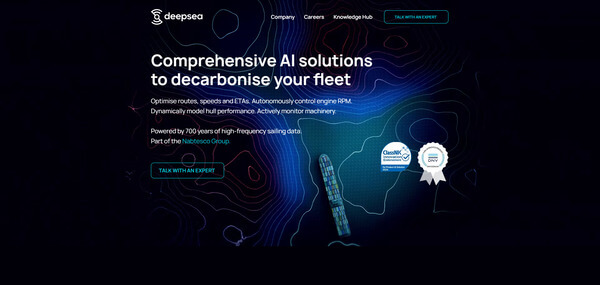
DeepSea
* Image source: DeepSea Official
Website
(https://www.deepsea.ai/)
(https://www.deepsea.ai/)
Core Capabilities
AI Fuel, CII &
Route Optimization
Route Optimization
- With the CII tracking feature, AI helps maintain and predict vessel performance.
- AI dynamically evaluates speeds and routes to suggest more fuel-efficient alternatives
- While complying with Europe-specific restrictions and regulations, it supports operations aimed at lower fuel consumption.
For Fleets with a Mix
of Older and Newly
Built Vessels
For Independent Ship
Management Companies
of Older and Newly
Built Vessels
For Independent Ship
Management Companies
Smart Ship Hub
* Image source: Smart Ship Hub Official
Website
(https://smartshiphub.com/)
(https://smartshiphub.com/)
Core Capabilities
Data integration across a mixed fleet
- Supports aggregation of vessel data across different manufacturers and standards, as well as data from multiple vessels.
- Visualizes information distributed across onboard systems and supports building an environment for centralized management.
- Supports information sharing between shore teams and fleets with older vessels, older equipment, newly built vessels and new equipment.