
Vessel Tide | A Guide to Essential Maritime Data Analytics Systems » What Is Vessel Management Software? How to Choose » The Future of Green Shipping Technology and VMS
The Future of Green Shipping Technology and VMS
Index
View All
The maritime shipping industry is at a major turning point, driven by the need to reduce its environmental impact and embrace digitalization. To remain competitive and build a sustainable future, companies must integrate the latest technologies into their daily operations. This article explores the growing importance of green shipping, examines the limitations of traditional management methods, and highlights how next-generation systems can help overcome these modern challenges.
Why Green Shipping Matters
Green shipping has become a strategic priority as the maritime industry faces growing environmental concerns, stricter international regulations, and evolving customer expectations.
Global maritime transport generates approximately 1 billion tons of carbon dioxide (CO2) annually, accounting for about 3% of all global emissions. In response, the International Maritime Organization (IMO) has set highly ambitious targets: a 40% reduction in CO2 emissions by 2030 (compared to 2008 levels) and net-zero greenhouse gas emissions by around 2050. Additionally, strict frameworks like the Carbon Intensity Indicator (CII) and the Energy Efficiency Existing Ship Index (EEXI) now mandate the tracking and reduction of emissions.
Failing to comply with these environmental regulations exposes shipping companies to hefty penalties, rising operational costs, and reputational damage. Simultaneously, shippers and other clients are strictly evaluating the environmental impact of their entire supply chain, increasingly favoring cleaner transportation partners. Consequently, minimizing environmental footprints through alternative fuels and cutting-edge technology is no longer optional—it is a requirement for business survival.
The Shortcomings of Traditional Vessel Management
The greatest weaknesses of legacy Vessel Management Systems (VMS) are manual data entry and the lack of real-time visibility. These limitations make it increasingly difficult to operate efficiently in today's complex shipping environment.
For years, traditional systems have forced chartering, operations, and finance departments to work in isolated silos. Without automated data synchronization, updates to fuel costs and port expenses must be entered manually. This creates operational bottlenecks and leaves room for costly calculation errors.
For instance, if fuel prices spike during a voyage, conventional systems struggle to capture that cost change in real time. Often, a financial loss is only discovered after the voyage ends and the finance team reconciles the accounts. Furthermore, outdated user interfaces and poor mobile accessibility hinder swift decision-making for globally dispersed teams. These limitations highlight why many shipping companies are transitioning away from legacy systems.
The Role of Modern Systems in Driving Sustainability
Modern digitally enabled vessel management systems play an important role for optimizing fuel efficiency and reducing emissions through real-time data collection and continuous performance monitoring.
By integrating IoT sensors and AI-driven monitoring, operators can track engine health, fuel consumption, and hull efficiency 24/7. This helps shift operational decision-making from intuition toward data-driven insights.
In practice, this begins with "speed optimization," which eliminates unnecessary speed fluctuations based on system recommendations. Next, "route optimization" leverages AI-based weather forecasting to plot the safest and most fuel-efficient paths. Finally, "predictive maintenance" detects minor engine anomalies early, preventing mid-voyage breakdowns and helping reduce unnecessary fuel consumption. By adopting these data-driven strategies, companies can automate environmental compliance while significantly slashing voyage costs.
Conclusion: The Future of Next-Generation Systems
To meet the maritime industry's sustainability targets while maintaining profitability, companies should transition from traditional management methods and transition to digitized, next-generation vessel management platforms.
Moving forward, competitive advantage will increasingly depend on the size of their fleets, but by their ability to harness data for smarter, faster, and more eco-conscious management. By adopting systems that seamlessly integrate real-time profitability tracking with environmental performance monitoring, companies can build a transparent, sustainable, and more competitive shipping operations.
POINT
Find the Right System for Your Data Strategy
This site introduces vessel management systems by technical focus, including solutions that help reduce the risk of unexpected downtime and equipment damage, tools that support data-driven analysis of fuel consumption, CII performance, and voyage planning, and platforms that bring fragmented fleet data together in one place.
[Advertisement]
3 Recommended
Marine Fleet Management Software
3 Recommended
Marine Fleet Management Software
Advertiser Disclosure:
We receive compensation from some of the companies listed below.This compensation may affect which companies are included and the order in which they appear.
For Frequent Hazardous
or Long-Distance
Voyages
For Marine Fleet
Management Companies
or Long-Distance
Voyages
For Marine Fleet
Management Companies
MaSSA-One

* Image source: BEMAC Official
Website
(https://www.massa-one.com/english/)
(https://www.massa-one.com/english/)
Core Capabilities
Condition monitoring and anomaly detection
- Enables early detection of anomalies using data-driven automatic thresholds and expert-defined multi-condition detection.
- In the event of a failure, real-time data helps speed up root-cause identification, reducing downtime.
- This supports the prevention of future accidents and issues, contributing to reduced damage and losses involving vessels and cargo.
For Companies with
Frequent Business
in the EU
For Marine Shipping
Companies
Frequent Business
in the EU
For Marine Shipping
Companies
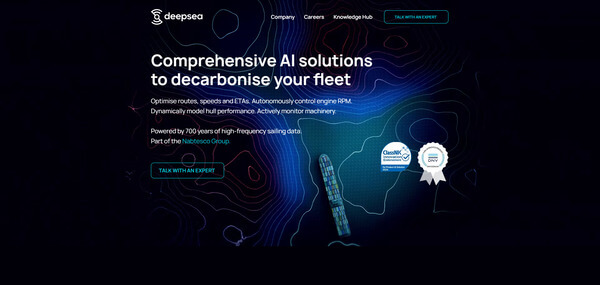
DeepSea
* Image source: DeepSea Official
Website
(https://www.deepsea.ai/)
(https://www.deepsea.ai/)
Core Capabilities
AI Fuel, CII &
Route Optimization
Route Optimization
- With the CII tracking feature, AI helps maintain and predict vessel performance.
- AI dynamically evaluates speeds and routes to suggest more fuel-efficient alternatives
- While complying with Europe-specific restrictions and regulations, it supports operations aimed at lower fuel consumption.
For Fleets with a Mix
of Older and Newly
Built Vessels
For Independent Ship
Management Companies
of Older and Newly
Built Vessels
For Independent Ship
Management Companies
Smart Ship Hub
* Image source: Smart Ship Hub Official
Website
(https://smartshiphub.com/)
(https://smartshiphub.com/)
Core Capabilities
Data integration across a mixed fleet
- Supports aggregation of vessel data across different manufacturers and standards, as well as data from multiple vessels.
- Visualizes information distributed across onboard systems and supports building an environment for centralized management.
- Supports information sharing between shore teams and fleets with older vessels, older equipment, newly built vessels and new equipment.