
Vessel Tide | A Guide to Essential Maritime Data Analytics Systems » List of Marine Fleet Management Software Providers » Kongsberg Vessel Insight(Kongsberg Maritime)
Kongsberg Vessel Insight(Kongsberg Maritime)
Index
View All
Kongsberg Vessel Insight is best understood as a vessel-to-cloud data platform for companies that need to collect, structure, and share vessel data across shipboard and shore-based operations. Rather than treating it as a general vessel management system, it is more useful to evaluate it as a data foundation for fleet visibility, system integration, and future digital applications.
What You’ll Learn in This Article
- Strengths:
How Kongsberg Vessel Insight provides a unified data platform for bringing vessel and fleet data into a more consistent ship-to-shore environment. - Benefits:
How the platform can support fleet visibility, technical analysis, reporting preparation, and future digital initiatives. - Best-Fit Companies:
Which types of companies are most likely to benefit, including operators with multiple vessels, fragmented onboard data, or phased digitalization plans.
What to Know About Kongsberg Vessel Insight Before Comparing Vessel Management Systems
Strengths
Kongsberg Vessel Insight is positioned as a unified data platform for vessel and fleet data. Its main value is not simply that it collects data, but that it helps create a more consistent ship-to-shore data environment.
Key strengths to consider include:
- Vessel-to-cloud data infrastructure
- Centralized management of vessel and fleet data
- Ship-to-shore data visibility
- Connectivity with onboard systems, devices, and interfaces
- Support for phased digitalization and future data use
What Implementation Can Help You Achieve
Companies can use Kongsberg Vessel Insight to make vessel data easier to access, compare, and use across teams. This may support fleet monitoring, operational review, technical analysis, reporting preparation, and future digital applications.
The value of the platform depends on how clearly the company defines its first implementation goal. Collecting data alone does not improve operations. The data needs to be connected to actual workflows, such as fleet monitoring, technical follow-up, maintenance planning, emissions reporting, or performance review.
Best-Fit Companies
Kongsberg Vessel Insight is likely to be a stronger fit for companies that:
- Operate multiple vessels and need clearer fleet-wide data visibility
- Manage data across several onboard systems, sensors, or equipment types
- Need shore-based teams to access vessel information more consistently
- Are planning phased digitalization rather than implementing a single-purpose tool
- Need a data foundation that can connect with external applications or future analytics
- Want to evaluate data security, access control, support, and service-level conditions as part of system selection
It may be a less suitable first choice for companies that only need a narrow standalone function, such as a simple checklist, a basic reporting form, or a single maintenance workflow.
Key Points to Confirm Before Contacting the Provider
Before contacting the provider, companies should clarify:
- Which vessels will be covered
- Which onboard systems, sensors, or equipment should be connected
- Which data interfaces are required
- Who needs access to vessel and fleet data
- What the first implementation goal is
- Whether external applications or third-party data sharing are required
- Which cybersecurity, access control, and monitoring requirements apply
- What support levels and contract conditions are needed
Kongsberg Vessel Insight should be compared not only by its functions, but by how well it fits the company’s vessel environment, data architecture, and long-term digitalization plan.
Source: Kongsberg Maritime Official Website, Vessel Insight product information (https://www.kongsbergmaritime.com/products/digital/vessel-insight/)
Key Features of Kongsberg Vessel Insight
Kongsberg Vessel Insight should be evaluated as a data platform that connects onboard vessel data with shore-based use. The key question is not how many features it offers, but whether it can create a usable data layer across the company’s fleet.
What Kongsberg Vessel Insight Is Designed For
Kongsberg Vessel Insight is designed to move vessel data from ship to cloud and make it available in a more consistent format. This differentiates it from systems focused mainly on task management, maintenance checklists, or manual reporting workflows.
For companies comparing vessel management systems, Vessel Insight may be relevant when the goal is to make vessel data easier to access, share, and use across departments.
Centralized Vessel Data Management
Vessel data is often spread across onboard machinery, sensors, navigation systems, automation systems, and manual reports. As a result, shore-based teams may find it difficult to understand vessel status or compare information across the fleet.
Kongsberg Vessel Insight helps bring vessel and fleet data into a more centralized environment, reducing data fragmentation and creating a clearer foundation for monitoring, analysis, and reporting.
Companies should still confirm the actual data scope before implementation, including which onboard systems can be connected, which data points are available, how data quality is handled, and whether the platform fits their existing data structure.
Ship-to-Shore Data Visibility
Kongsberg Vessel Insight can help onboard and shore-based teams work from a more consistent information base.
This can be useful when technical teams, fleet managers, operations teams, or performance teams need to review vessel data without relying only on separate reports or delayed communication.
However, better data visibility does not automatically lead to better decisions. Its practical value depends on who uses the data, how often it is reviewed, and whether it is connected to the company’s decision-making processes.
Connectivity with Onboard Systems and External Applications
Connectivity is one of the most important points to check when evaluating Kongsberg Vessel Insight. Kongsberg’s public product information refers to interoperability with systems, devices, and interfaces such as Modbus, NMEA, and OPC UA.
The practical question is whether those connectivity options match the actual vessel environment. Companies should ask the provider to confirm compatibility with existing onboard systems, sensors, automation equipment, data formats, and any external applications they plan to use.
Integration should not be assumed to be simple in every case. Vessel age, installed equipment, available interfaces, onboard network conditions, and data governance requirements can all affect implementation.
Source: Kongsberg Maritime Official Website, Vessel Insight product information (https://www.kongsbergmaritime.com/products/digital/vessel-insight/)
POINT
Finding the Ideal
Solution for
Your Organization
Solution for
Your Organization
As explored above, the core strengths and focus of each system vary significantly. Finding the right solution starts with assessing your fleet's specific management goals and operational scale. To simplify your choice, we have categorized top-tier vessel management software by company type. Explore our recommendations below to find the ideal fit for your organization.
How Kongsberg Vessel Insight Differs from Other Vessel Management Systems
Kongsberg Vessel Insight differs from many vessel management systems because it is best evaluated as a vessel data foundation. Its role is to organize vessel data and make it usable across teams, rather than replace every operational workflow.
When comparing it with other systems, companies should consider:
- Primary role: Is the system mainly a data platform, a maintenance tool, a reporting tool, a remote diagnostics solution, or an OEM machinery support platform?
- Data coverage: Which onboard systems, sensors, and data types can be connected?
- Ship-to-shore visibility: Can shore-based teams access the data in a usable format?
- Application ecosystem: Can the data support external applications, analytics, reporting, or future digital services?
- Security and access control: How are users, permissions, monitoring, and data sharing managed?
- Support structure: What support, training, and service-level conditions are included?
- Fleet fit: Does the platform fit the company’s vessel types, onboard equipment, and level of digital maturity?
For Kongsberg Vessel Insight, the strongest comparison points are data integration, ship-to-shore visibility, and scalability. Companies that mainly need OEM-specific machinery diagnostics or a narrow maintenance workflow should also compare more specialized systems.
Main Functions
Core Functions at a Glance
| Function | What it means for evaluation | What to check before implementation |
|---|---|---|
| Vessel data collection | Data can be collected from relevant onboard sources and used beyond the vessel. | Which systems, sensors, and equipment can be connected? |
| Vessel-to-cloud data management | Vessel data can be moved into a cloud-based environment for broader operational use. | How is data transferred, stored, accessed, and governed? |
| Data visualization | Teams can review vessel or fleet information more easily. | Can the right users understand vessel status quickly enough for daily use? |
| Data analysis | Data can serve as a basis for operational review or technical follow-up. | Which questions should the data help answer first? |
| Interface and system integration | The platform can be assessed for compatibility with existing onboard systems and external applications. | Which interfaces, data formats, and integration points are required? |
| Ship-to-shore data sharing | Onboard and shore-based teams can work from a more consistent data view. | Who needs access, and what permissions should each user group have? |
| Security and monitoring | Security structure and monitoring are critical because operational vessel data is involved. | What access control, monitoring, data sharing, and support conditions apply? |
| Support and SLA | Long-term use depends on the scope of support and the service conditions included. | What is included in the support agreement, and what may require a separate contract? |
What These Functions Mean for Vessel Operators
The practical value of Kongsberg Vessel Insight depends on how well its functions connect to the company’s daily operations. A platform can collect and display data, but the company still needs a clear process for using that data.
For fleet visibility, the key question is whether shore-based teams can access relevant vessel information in a consistent way. For maintenance planning, it is whether the required equipment and condition data can be captured and interpreted. For future digitalization, it is whether the data structure can support additional applications, reporting, or analytics over time.
Companies should avoid judging the system only by the number of functions listed. A smaller set of well-connected functions may be more valuable than a broad function list that does not match the company’s first implementation goal.
Scalability and Future Potential
Scalability is one reason to evaluate Kongsberg Vessel Insight as a data platform. Companies do not need to start with a full-fleet implementation. A practical approach may be to begin with selected vessels, selected data sources, or one priority use case, then expand after the initial phase has been validated.
Potential expansion areas include:
- Additional vessels
- Additional sensors or onboard systems
- Additional data types
- Manual input sources
- External applications
- Reporting workflows
- Analytics or performance review
- Partner or third-party data sharing
The expansion path should be confirmed with the provider. Vessel configuration, onboard equipment, communication infrastructure, cybersecurity requirements, and internal data governance can all affect how far and how quickly the system can scale.
Source: Kongsberg Maritime Official Website, Vessel Insight product information (https://www.kongsbergmaritime.com/products/digital/vessel-insight/)
Compliance with Industry Regulations and Standards
Kongsberg Vessel Insight should not be described as a system that automatically ensures regulatory compliance. It is more accurately evaluated as a data platform that may help companies organize and use information for reporting, internal governance, environmental review, or technical decision-making.
Kongsberg’s public product information states that Vessel Insight uses class-certified technology certified by DNV and ABS. This may be relevant for companies that need confidence in the platform’s technical basis.
Regulatory requirements still depend on vessel type, flag state, operating region, business activity, reporting framework, and company policy. Companies should confirm how Vessel Insight fits their compliance, cybersecurity, environmental reporting, and data governance requirements before implementation.
The system may help prepare and organize data used in compliance-related work, but it should not be presented as a guarantee of compliance.
Source: Kongsberg Maritime Official Website, Vessel Insight product information (https://www.kongsbergmaritime.com/products/digital/vessel-insight/)
Pricing and Cost Structure
A standard public price list for Kongsberg Vessel Insight was not found in the reviewed product information. Kongsberg’s legal information also indicates that access to and use of Kognifai Maritime services are governed by subscription-related agreements and fees.
Pricing and total implementation cost may depend on:
- Number of vessels
- Vessel type and equipment configuration
- Required onboard hardware
- Connected systems and sensors
- Number of users and access rights
- Required data interfaces
- External application or third-party data sharing needs
- Support and service-level conditions
- Training requirements
- Implementation scope and rollout plan
Before requesting a proposal, companies should prepare a basic implementation brief covering the target vessels, systems to be connected, required data, expected users, first-phase goal, support needs, and future expansion plans.
This makes the pricing discussion more practical and helps companies compare Vessel Insight with other vessel management systems based on implementation requirements, not just product descriptions.
Source: Kongsberg Maritime Official Website and related legal information (https://www.kongsberg.com/maritime/)
Who Kongsberg Vessel Insight Is Best Suited For
Kongsberg Vessel Insight is likely to be a stronger fit for companies that need a vessel data foundation before expanding their digital operations.
It is especially relevant for companies that:
- Manage vessel data across multiple onboard systems
- Need shore-based teams to view vessel or fleet information more consistently
- Want to reduce fragmented data handling
- Plan to expand into analytics, reporting, performance review, or external application use
- Need scalable data infrastructure rather than a narrow single-function tool
- Want to evaluate security, access control, data sharing, and support as part of system selection
When a Specialized Tool May Be Easier to Compare
A specialized tool may be easier to compare and implement when the company only needs lightweight task management, a simple reporting template, or a narrow equipment-specific support service.
The best fit depends on the company’s starting point. If the first goal is to build a consistent vessel-to-shore data environment, Vessel Insight is worth evaluating. If the goal is limited to one operational task, companies should confirm whether a broader data platform is necessary.
Use Cases
Kongsberg Vessel Insight can be considered when vessel data needs to be collected, shared, or used beyond the ship. These use cases should be treated as evaluation scenarios, not guaranteed outcomes.
Fleet Data Monitoring
Companies may use Kongsberg Vessel Insight to support shore-based fleet data monitoring, especially when multiple vessels need to be reviewed through a consistent data environment.
For operators managing different vessel types or data sources, centralized visibility can make it easier to understand what information is available and how it can be used. Its actual value depends on data quality, connected systems, and how the monitoring process is managed internally.
Ship-to-Shore Collaboration
Kongsberg Vessel Insight may support collaboration between onboard and shore-based teams by giving both sides access to a more consistent view of vessel data.
This can help technical teams, fleet managers, and onboard crews discuss vessel status with fewer information gaps. It does not eliminate all communication issues, but it can provide a clearer basis for review and follow-up.
Operational Improvement and Maintenance Planning
Vessel data can support operational improvement and maintenance planning when it is reliable, accessible, and connected to internal decision-making. Kongsberg Vessel Insight may help companies organize the data needed to review condition, performance, or operational trends.
The system should not be described as automatically optimizing maintenance. Maintenance planning still depends on technical judgment, internal processes, data interpretation, and operating priorities.
Data Foundation for Future Digital Applications
Some companies may use Kongsberg Vessel Insight as a starting point for broader digitalization. Initial use may focus on data collection and visibility, while later phases may involve analytics, reporting, application integration, or data sharing with selected partners.
This use case is most relevant when the company wants to build a long-term data environment rather than solve a short-term reporting need.
What to Check Before Considering Kongsberg Vessel Insight
Before contacting Kongsberg Maritime, companies should clarify the scope and conditions of implementation. This helps avoid comparing systems based only on general feature lists.
Key points to prepare include:
- Target vessels
- Vessel types and equipment configuration
- Onboard systems and sensors to be connected
- Required interfaces and data formats
- Cloud, network, and communication requirements
- Internal users and access permissions
- External applications or third-party data sharing needs
- First-phase implementation goal
- Security and monitoring requirements
- Support, training, and SLA expectations
- Pricing and contract conditions
System and Data Integration Requirements
Companies should start by identifying which onboard systems, sensors, equipment, and manual data sources need to be connected.
They should also confirm whether the relevant interfaces and data formats are supported in their specific vessel environment. Public interface examples are useful starting points, but actual compatibility should be checked vessel by vessel.
Fleet Scope and Vessel Compatibility
Implementation scope affects technical planning, cost, support, and rollout speed. Companies should decide whether they are evaluating Vessel Insight for one vessel, selected vessels, a specific vessel type, or the entire fleet.
Compatibility may depend on vessel age, onboard equipment, automation systems, available data, network conditions, and the company’s existing digital infrastructure.
Operational Goals for the First Phase
A clear first-phase goal makes comparison easier. Companies should decide whether the initial priority is:
- Fleet visibility
- Ship-to-shore data sharing
- Technical follow-up
- Maintenance planning
- Reporting support
- Performance review
- Data standardization
- Future application integration
Without a clear first goal, it can be difficult to judge whether the platform is the right fit or whether a narrower system would be sufficient.
Security and Support Requirements
Because Kongsberg Vessel Insight involves operational vessel data, companies should review security, access control, monitoring, user permissions, and data sharing conditions.
They should also review contractual documents related to the Kognifai Maritime Ecosystem, including how customer data is handled, how authorized users are managed, whether data can be shared with third parties, and which service-level conditions apply.
Pricing and Contract Conditions
Companies should ask how pricing is calculated and what is included in the proposal. Important points include vessel count, connected systems, onboard hardware, user access, support level, training, contract term, application access, API usage, and future expansion.
If third-party applications or external data sharing are part of the plan, companies should confirm whether additional fees, limits, or contract terms apply.
Source: Kongsberg Maritime Official Website and related legal information (https://www.kongsberg.com/maritime/)
Support and After-Sales Service
Global Technical Support
Kongsberg Maritime provides global customer support, including 24/7 technical support. For vessel operators, support availability matters because vessels operate across different time zones, regions, and technical environments.
Companies should confirm which support channels apply to Vessel Insight, which regions are covered, what response expectations are included, and whether support terms vary by contract.
Training and Operational Support
Training may be important when both onboard and shore-based teams use the platform. Companies should confirm who needs training, what is included, and whether additional training is required for administrators, technical users, or data users.
A vessel data platform is only useful if the relevant teams know how to interpret and act on the information it provides. Training and operational support should therefore be part of implementation planning, not an afterthought.
Service-Level Agreement and Long-Term Support
Kongsberg provides legal documents for the Vessel Insight ecosystem, including terms of use and support/service-level information. Companies should review these documents before implementation.
Important points to confirm include:
- Support scope
- Service availability
- Response and escalation process
- User responsibilities
- Data ownership and permitted data use
- Third-party data sharing conditions
- Update and maintenance responsibilities
- Contract term and fees
- Onboard hardware responsibilities
Long-term support should be evaluated together with the company’s internal technical capabilities. The provider may offer support, but responsibility for data use, workflows, and decision-making still remains with the company.
Source: Kongsberg Maritime Support (https://www.kongsberg.com/maritime/support/)
Frequently Asked Questions About Kongsberg Vessel Insight
What is Kongsberg Vessel Insight used for?
Kongsberg Vessel Insight is used to collect, organize, and share vessel and fleet data through a vessel-to-cloud platform. It is most relevant for companies that need clearer vessel data visibility across shipboard and shore-based operations.
Is Kongsberg Vessel Insight a vessel management system or a data platform?
It is more useful to evaluate Vessel Insight as a vessel data platform. It can support vessel management activities, but its core role is to create a consistent data foundation for vessel and fleet information.
What types of companies should consider Kongsberg Vessel Insight?
Companies with multiple vessels, fragmented onboard data, ship-to-shore visibility needs, or long-term digitalization plans may find it relevant. It is likely to be most useful when data integration is a central requirement.
What should companies check before implementation?
Companies should check vessel scope, onboard system compatibility, required interfaces, data access needs, cybersecurity requirements, support conditions, contract terms, and pricing structure.
Is pricing publicly available?
A standard public price list was not found in the reviewed product information. Companies should contact Kongsberg Maritime directly and prepare details such as vessel count, connection scope, user access, support requirements, and implementation goals.
Does Kongsberg Vessel Insight ensure regulatory compliance?
No system should be treated as automatically ensuring compliance. Vessel Insight may help organize data relevant to reporting, governance, or technical review, but actual compliance depends on vessel type, operating region, applicable regulations, company policy, and implementation details.
How should Kongsberg Vessel Insight be compared with other vessel management systems?
It should be compared by its role as a vessel-to-cloud data foundation. Key comparison points include data integration, ship-to-shore visibility, connectivity with existing systems, scalability, security, support structure, and fit with the company’s fleet environment.
Company Overview
- Company Name Kongsberg Maritime AS
- Headquarters Kongsberg, Norway
- Address Kirkegårdsveien 45, 3616 Kongsberg, Norway
- Official Website https://www.kongsberg.com/maritime/
- Main Business Area Maritime technology, vessel systems, digital solutions, lifecycle support, and related services
- Relevant Product Kongsberg Vessel Insight
Kongsberg Maritime provides maritime technology, services, and digital solutions for vessel operations. Companies considering Kongsberg Vessel Insight should check the official website for the latest product information, support details, legal documents, and contact information.
Source: Kongsberg Maritime Official Website (https://www.kongsberg.com/maritime/)
[Advertisement]
3 Recommended
Marine Fleet Management Software
3 Recommended
Marine Fleet Management Software
Advertiser Disclosure:
We receive compensation from some of the companies listed below.This compensation may affect which companies are included and the order in which they appear.
For Frequent Hazardous
or Long-Distance
Voyages
For Marine Fleet
Management Companies
or Long-Distance
Voyages
For Marine Fleet
Management Companies
MaSSA-One

* Image source: BEMAC Official
Website
(https://www.massa-one.com/english/)
(https://www.massa-one.com/english/)
Core Capabilities
Condition monitoring and anomaly detection
- Enables early detection of anomalies using data-driven automatic thresholds and expert-defined multi-condition detection.
- In the event of a failure, real-time data helps speed up root-cause identification, reducing downtime.
- This supports the prevention of future accidents and issues, contributing to reduced damage and losses involving vessels and cargo.
For Companies with
Frequent Business
in the EU
For Marine Shipping
Companies
Frequent Business
in the EU
For Marine Shipping
Companies
DeepSea
* Image source: DeepSea Official
Website
(https://www.deepsea.ai/)
(https://www.deepsea.ai/)
Core Capabilities
AI Fuel, CII &
Route Optimization
Route Optimization
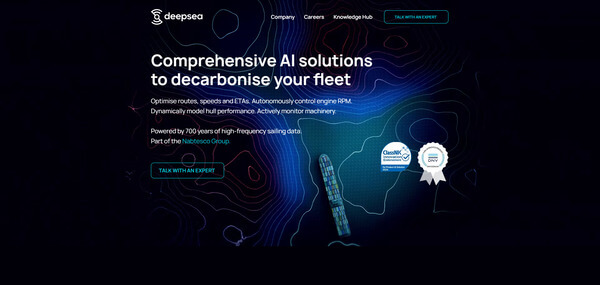
- With the CII tracking feature, AI helps maintain and predict vessel performance.
- AI dynamically evaluates speeds and routes to suggest more fuel-efficient alternatives
- While complying with Europe-specific restrictions and regulations, it supports operations aimed at lower fuel consumption.
For Fleets with a Mix
of Older and Newly
Built Vessels
For Independent Ship
Management Companies
of Older and Newly
Built Vessels
For Independent Ship
Management Companies
Smart Ship Hub
* Image source: Smart Ship Hub Official
Website
(https://smartshiphub.com/)
(https://smartshiphub.com/)
Core Capabilities
Data integration across a mixed fleet
- Supports aggregation of vessel data across different manufacturers and standards, as well as data from multiple vessels.
- Visualizes information distributed across onboard systems and supports building an environment for centralized management.
- Supports information sharing between shore teams and fleets with older vessels, older equipment, newly built vessels and new equipment.