
Vessel Tide | A Guide to Essential Maritime Data Analytics Systems » Marine Fleet Management Software and Related Software Comparison » Fleet Management Software vs PMS Software: Key Differences Explained
Fleet Management Software vs PMS Software: Key Differences Explained
A Planned Maintenance System typically schedules and records service jobs for the equipment on a vessel — the main engine, pumps, generators, and everything else on the maintenance register. Marine fleet management software handles that same maintenance work, then extends it to spare parts inventory, procurement, compliance documentation, and crew management across every vessel an operator runs.
Both terms get used interchangeably because they both revolve around keeping a ship running safely. The difference isn't what they protect against — it's how much of the operation they cover: one piece of equipment on one ship, or every function across an entire fleet.
Key Takeaways
- A PMS schedules and documents maintenance for the equipment on one vessel. Marine fleet management software covers that same maintenance work plus inventory, procurement, compliance, and crew across every vessel in the fleet.
- Most fleet management platforms build their maintenance module on PMS logic, so moving to fleet software doesn't mean giving up planned maintenance capability.
- A standalone PMS can support ISM Code maintenance and documentation requirements under SOLAS Chapter IX for a single vessel or a small operation.
- Once spare parts, purchasing, or crew certifications need to be coordinated across more than one ship, a standalone PMS may no longer be enough on its own.
What is Marine Fleet Management Software?
Marine fleet management software centralizes maintenance, spare parts inventory, procurement, compliance documentation, and crew management for every vessel an operator runs, in a single system connecting ship and shore.
The platform is typically organized into modules:
- Maintenance — plans and tracks servicing across the fleet, usually built on the same equipment-register logic as a standalone PMS.
- Inventory — tracks spare parts stock, reorder thresholds, and critical spares across vessels and shore warehouses, so a part identified as needed during maintenance can be sourced without checking each ship separately.
- Procurement — manages requisitions, quotation requests, and purchase orders raised from any vessel in the fleet.
- Compliance — logs inspections, audits, incident reports, and safety documentation across the fleet, not just one ship.
- Crew — manages certifications, rotations, and training records for personnel across multiple vessels.
Because every module draws from the same fleet-wide database, a shore-based technical superintendent can see maintenance status, parts availability, and compliance records for the whole fleet without switching between vessel-specific systems. Most platforms also connect to ERP and financial systems, so maintenance and procurement data aligns with the rest of the business.
What is a Planned Maintenance System (PMS)?
A Planned Maintenance System keeps a register of every piece of equipment on board a vessel, links each item to a recurring maintenance job, and tracks when that job comes due — based on running hours, calendar intervals, or both.
A PMS isn't optional paperwork. The ISM Code, made mandatory under SOLAS Chapter IX, requires the Company responsible for a ship to establish procedures for maintaining the ship and its equipment, and a PMS is one of the tools operators commonly use to manage those requirements.
For each maintenance job, the system records what work was carried out, who carried it out, and which spare parts were used. Those records are among the documents surveyors and auditors review during class and flag State inspections, so the quality of the PMS data directly affects how smoothly those inspections go.
A traditional PMS is typically focused on a vessel's equipment. A basic PMS may not cover spare parts purchasing, crew certifications, or fleet-wide compliance reporting — functions that typically sit outside its core maintenance role.
Key Differences
| Aspect | Planned Maintenance System (PMS) | Marine Fleet Management Software |
|---|---|---|
| Primary function | Maintenance scheduling and job completion records | Maintenance, plus inventory, procurement, compliance, and crew coordination |
| Scope | One vessel's equipment | Every vessel across the operator's fleet |
| Data managed | Equipment register, job intervals, completion history | Fleet-wide maintenance data, spare parts stock, purchase orders, audit records, crew certifications |
| Compliance role | Supports ISM Code maintenance procedure requirements | Adds fleet-wide tracking of inspections, audits, and incident reporting |
| Typical user | Technical superintendent or chief engineer managing one or a few vessels | Fleet or technical manager overseeing multiple vessels and shore-side operations |
The practical difference shows up first in scale, not in complexity. A PMS answers "is this pump's maintenance up to date?" for one ship. Fleet management software answers "which vessels are due for maintenance this month, do we have the parts in stock, and is the purchase order already raised?" across the whole fleet.
Overlapping Features
Most fleet management platforms build their maintenance module directly on PMS logic — the same equipment register, job intervals, and completion records, just extended across every vessel in the fleet rather than confined to one.
Both categories also share the same underlying goal: effective planned maintenance can help reduce unplanned downtime compared with a primarily reactive approach, and both can produce the maintenance records that class societies and flag administrations may review during inspections.
This overlap is why the two terms get used interchangeably in practice. If you're evaluating a platform that markets itself as a PMS, it's worth asking whether it also handles procurement and inventory — some standalone PMS products have added exactly those modules over time, effectively becoming fleet management software under a different name.
Which One Do You Need?
If you operate a single vessel, or a small handful of ships, and your main need is maintaining records and procedures for ISM-compliant maintenance, a standalone PMS usually covers what you need. You get the equipment register, job scheduling, and completion history that surveyors check, without paying for modules you may not need.
If you're coordinating spare parts across more than one vessel, routing purchase orders through a shore-based team, or tracking crew certifications fleet-wide, a PMS alone won't cover procurement, inventory, or crew management — those are functions that a broader fleet management platform is designed to bring together in one system.
If your fleet is growing, it's worth checking upfront whether your current PMS can scale into (or sync with) a fleet management platform later, rather than migrating everything from scratch once a second or third vessel joins the fleet.
Conclusion
A PMS helps keep one vessel's equipment maintenance organized and its records audit-ready. Marine fleet management software runs that same maintenance discipline across an entire operation, tied to spare parts, purchasing, and crew. Neither term is inherently better — the right choice depends on how many vessels you're managing and how much of the surrounding workflow needs to sit in the same system.
If you're comparing shortlisted platforms and the category isn't clear from the name, ask the vendor directly whether procurement, inventory, and crew management are included as core modules or need to be added separately. That answer tells you which category you're actually looking at.
[Advertisement]
3 Recommended
Marine Fleet Management Software
3 Recommended
Marine Fleet Management Software
Advertiser Disclosure:
We receive compensation from some of the companies listed below.This compensation may affect which companies are included and the order in which they appear.
For Frequent Hazardous
or Long-Distance
Voyages
For Marine Fleet
Management Companies
or Long-Distance
Voyages
For Marine Fleet
Management Companies
MaSSA-One

* Image source: BEMAC Official
Website
(https://www.massa-one.com/english/)
(https://www.massa-one.com/english/)
Core Capabilities
Condition monitoring and anomaly detection
- Enables early detection of anomalies using data-driven automatic thresholds and expert-defined multi-condition detection.
- In the event of a failure, real-time data helps speed up root-cause identification, reducing downtime.
- This supports the prevention of future accidents and issues, contributing to reduced damage and losses involving vessels and cargo.
For Companies with
Frequent Business
in the EU
For Marine Shipping
Companies
Frequent Business
in the EU
For Marine Shipping
Companies
DeepSea
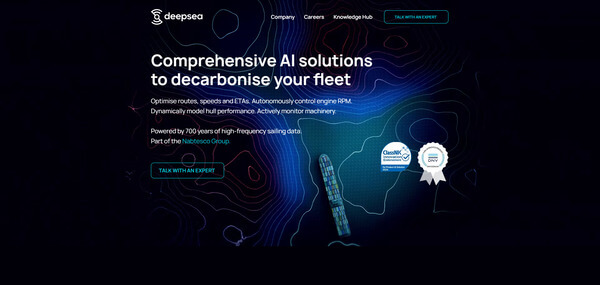
* Image source: DeepSea Official
Website
(https://www.deepsea.ai/)
(https://www.deepsea.ai/)
Core Capabilities
AI Fuel, CII &
Route Optimization
Route Optimization
- With the CII tracking feature, AI helps maintain and predict vessel performance.
- AI dynamically evaluates speeds and routes to suggest more fuel-efficient alternatives
- While complying with Europe-specific restrictions and regulations, it supports operations aimed at lower fuel consumption.
For Fleets with a Mix
of Older and Newly
Built Vessels
For Independent Ship
Management Companies
of Older and Newly
Built Vessels
For Independent Ship
Management Companies
Smart Ship Hub
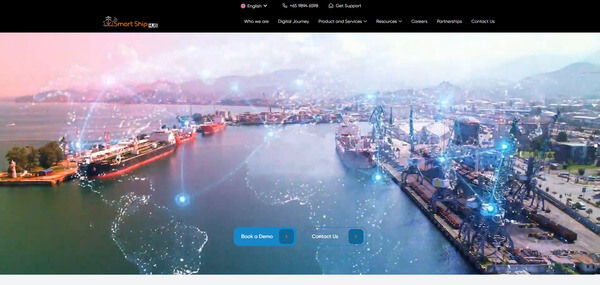
* Image source: Smart Ship Hub Official
Website
(https://smartshiphub.com/)
(https://smartshiphub.com/)
Core Capabilities
Data integration across a mixed fleet
- Supports aggregation of vessel data across different manufacturers and standards, as well as data from multiple vessels.
- Visualizes information distributed across onboard systems and supports building an environment for centralized management.
- Supports information sharing between shore teams and fleets with older vessels, older equipment, newly built vessels and new equipment.