
Vessel Tide | A Guide to Essential Maritime Data Analytics Systems » List of Marine Fleet Management Software Providers » ABB Ability™ Remote Diagnostic System(ABB)
ABB Ability™ Remote Diagnostic System(ABB)
Index
View All
ABB Ability™ Remote Diagnostic System (RDS) is a remote diagnostics solution designed to monitor marine equipment and support vessel operations from shore. Through secure satellite communications, it helps shipowners and operators troubleshoot issues faster and receive ongoing technical support when problems occur.
By connecting onboard systems with ABB’s shore-based experts, RDS can help support safer, more reliable operations at sea.
What You’ll Learn in This Article
- Strengths: How RDS supports remote diagnostics, faster troubleshooting, and condition monitoring through secure satellite communications.
- Benefits of Implementation: How it may help reduce maintenance costs and onboard service visits while supporting safety and lower CO2 emissions.
- Companies That May Benefit: Shipowners, vessel operators, and ship management companies operating in harsh environments or managing passenger vessels where rapid response to unexpected failures is critical.
Key Features of RDS
Improved Uptime and Enhanced Safety
RDS collects data from across the propulsion chain and creates a cloud-based “digital replica” of the vessel’s electrical system. ABB experts can use this data to run simulations, review trends, and support technical analysis from shore.
This helps crews and operators investigate potential faults and identify root causes more quickly, so they can take appropriate action without waiting for a technician to board the vessel. By helping reduce repair time and prevent unplanned equipment downtime, RDS supports safer and more continuous vessel operations.
Significant Cost Reduction
RDS uses a predictive approach to help identify equipment issues and maintenance needs earlier, reducing reliance on reactive maintenance. According to ABB, shipowners and operators may be able to reduce maintenance costs by up to 50%. ABB also states that physical onboard attendance by specialist engineers can be reduced by up to 70%, helping companies make better use of limited technical resources.
Source: ABB Official Website (https://new.abb.com/marine/systems-and-solutions/digital/smart-asset-management/Smart-Asset-Management-services---connected-vessels)
Lifecycle Management and Reduced Environmental Impact
Because RDS supports remote data collection and equipment monitoring, it can help reduce CO2 emissions by limiting the need for technician travel. The operational data collected over time may also support long-term electrical system performance improvement and more accurate maintenance planning.
POINT
Finding the Ideal
Solution for
Your Organization
Solution for
Your Organization
As explored above, the core strengths and focus of each system vary significantly. Finding the right solution starts with assessing your fleet's specific management goals and operational scale. To simplify your choice, we have categorized top-tier vessel management software by company type. Explore our recommendations below to find the ideal fit for your organization.
Core Functionalities
- Rapid fault finding supported by high-sampling-rate data collection
- Cloud-based data storage and trend analysis by ABB technical experts
- Fleet Intelligence dashboards that provide detailed insight into operational data
- Weekly system reviews by experts at ABB’s Collaborative Operations Center
Scalability and Future Potential
RDS is a fully modular system. Depending on operational requirements, companies can add functions such as Fleet Intelligence and system security update services. ABB is also advancing analytical algorithms and predictive analytics to support faster and more reliable remote assistance over time.
Compliance with Industry-Specific Regulations and Standards
As the maritime industry works to meet greenhouse gas (GHG) emissions regulations, operators need clearer visibility into vessel performance and equipment condition. RDS supports continuous monitoring and efficiency improvement by making operational data and system status easier to understand. These capabilities may help companies support more sustainable vessel operations.
Pricing and Plans
RDS is available in two service levels: Preventive Light and Preventive. Both include 24/7 technical support, standard monitoring, data consistency checks, and remote services. Additional services can be added to the Preventive Light level as needed, but companies should contact ABB directly for a detailed quotation.
Use Cases
ABB’s related marine technologies are being adopted in next-generation vessels designed for more sustainable operations.
- Clean-energy vessels: Samskip’s hydrogen-fueled container ships and hybrid-electric passenger ferries operating in the Baltic Sea
- Exploration and research vessels: PONANT polar expedition cruise ships and Chinese polar research vessels
- Specialized industrial vessels: Eneti’s next-generation offshore wind turbine installation vessels and CO2 carriers for the Northern Lights project
Support and After-Sales Service
RDS is supported by ABB’s 24/7 Care Technical Support. When an incident occurs, ABB’s global technical support network can coordinate with experts at its Collaborative Operations Centers. Through online support and related services, ABB provides faster troubleshooting and round-the-clock technical assistance.
Company Overview
- Company name: ABB Ltd
- Location: 22F ThinkPark Tower, 2-1-1 Osaki, Shinagawa-ku, Tokyo
- Phone number: +81-3-4523-6170
- Official website: https://new.abb.com/jp
[Advertisement]
3 Recommended
Marine Fleet Management Software
3 Recommended
Marine Fleet Management Software
Advertiser Disclosure:
We receive compensation from some of the companies listed below.This compensation may affect which companies are included and the order in which they appear.
For Frequent Hazardous
or Long-Distance
Voyages
For Marine Fleet
Management Companies
or Long-Distance
Voyages
For Marine Fleet
Management Companies
MaSSA-One

* Image source: BEMAC Official
Website
(https://www.massa-one.com/english/)
(https://www.massa-one.com/english/)
Core Capabilities
Condition monitoring and anomaly detection
- Enables early detection of anomalies using data-driven automatic thresholds and expert-defined multi-condition detection.
- In the event of a failure, real-time data helps speed up root-cause identification, reducing downtime.
- This supports the prevention of future accidents and issues, contributing to reduced damage and losses involving vessels and cargo.
For Companies with
Frequent Business
in the EU
For Marine Shipping
Companies
Frequent Business
in the EU
For Marine Shipping
Companies
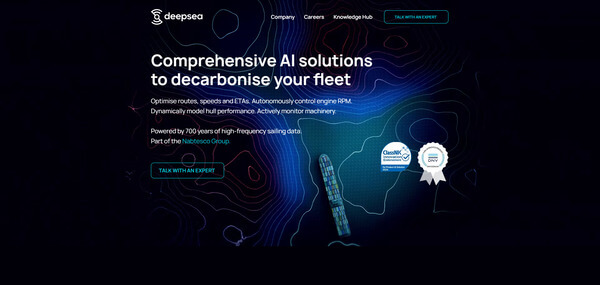
DeepSea
* Image source: DeepSea Official
Website
(https://www.deepsea.ai/)
(https://www.deepsea.ai/)
Core Capabilities
AI Fuel, CII &
Route Optimization
Route Optimization
- With the CII tracking feature, AI helps maintain and predict vessel performance.
- AI dynamically evaluates speeds and routes to suggest more fuel-efficient alternatives
- While complying with Europe-specific restrictions and regulations, it supports operations aimed at lower fuel consumption.
For Fleets with a Mix
of Older and Newly
Built Vessels
For Independent Ship
Management Companies
of Older and Newly
Built Vessels
For Independent Ship
Management Companies
Smart Ship Hub
* Image source: Smart Ship Hub Official
Website
(https://smartshiphub.com/)
(https://smartshiphub.com/)
Core Capabilities
Data integration across a mixed fleet
- Supports aggregation of vessel data across different manufacturers and standards, as well as data from multiple vessels.
- Visualizes information distributed across onboard systems and supports building an environment for centralized management.
- Supports information sharing between shore teams and fleets with older vessels, older equipment, newly built vessels and new equipment.