
FOP (FURUNO ELECTRIC)
Index
View All
FURUNO ELECTRIC’s FURUNO Open Platform (hereinafter, FOP) is a data platform that aggregates a wide range of onboard data and enables sharing and visualization onshore. It provides a baseline environment for operations management, technical teams, and environmental teams to review the same data both onboard and onshore when assessing conditions and considering next steps.
This webpage introduces the key features of FURUNO ELECTRIC’s FOP and expected use scenarios.
What You Will Learn
on This Webpage
- Strengths of the tool:
Aggregates onboard data from equipment made by various manufacturers and enables its use as a common data platform. - What implementation enables:
Through onshore visualization and analysis, it helps provide inputs for understanding operating conditions and equipment conditions. - Best fit companies:
Companies that face challenges in fleet-wide visibility and in organizing data for compliance with environmental regulations.
Key Features of FOP
Review Aggregated
Onboard Data
as the Same
Indicators Onshore
The FOP unit collects engine data, navigation-instrument information, and data from cargo-handling-related equipment, then sends it to shore (an FOP server or cloud environment, depending on the configuration). Onshore managers can review conditions while referencing the same indicators as those collected onboard.
By organizing information that was previously scattered across verbal reports, Excel files, and checks of individual systems, it becomes easier to align the basis for situational awareness.
Suitable for Companies
That Want
a Shared View
Across Multiple Vessels
It is suited to shipping companies and marine fleet management companies that own many vessels and want to organize fleet-wide fuel consumption, equipment condition, and voyage information in a common format.
It can also use detailed data made available through manufacturer integration as inputs for considering maintenance actions and reviewing operating conditions. It also fits environmental teams that want to review the burden of data collection and organization for compliance with environmental regulations, such as GHG emissions reporting. Where an existing platform (such as TMIP) is already in place, expanding data utilization through integration can also be considered.
POINT
Finding the Ideal
Solution for
Your Organization
Solution for
Your Organization
As explored above, the core strengths and focus of each system vary significantly. Finding the right solution starts with assessing your fleet's specific management goals and operational scale. To simplify your choice, we have categorized top-tier vessel management software by company type. Explore our recommendations below to find the ideal fit for your organization.
Main Functions of FOP
Onboard Data Collection
and Aggregation (FOP Unit)
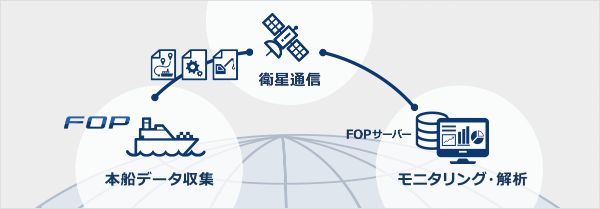
Source: FURUNO ELECTRIC Official Website
https://www.furuno.com/jp/marine-dx/data/
https://www.furuno.com/jp/marine-dx/data/
Scalability of FOP
In addition to data sharing with Ship Data Center, advanced hull-performance analysis can be performed by integrating with NAPA applications. Collaboration with equipment manufacturers and integration with TMIP are also progressing, enabling the system to be expanded by combining necessary functions without relying on a specific vendor.
Regulatory Compliance and
Certification of FOP
In environmental initiatives, it supports collecting the data needed for GHG reduction and improving the efficiency of reporting work. Schemes such as CII ratings and EU-MRV require accurate operational performance data, and FOP can serve as a foundation for that purpose.
From a security perspective, it has obtained Lloyd’s Register’s Cyber Security certification*. From a data-standardization perspective, standards for onboard data servers such as ISO 19847 exist, so it is advisable to confirm with the vendor whether the system aligns with the company’s standardization policy.
*Source: FURUNO ELECTRIC Official Website (https://www.furuno.co.jp/news/general/general_category.html?dispmid=1017&itemid=1304)
Implementation Costs
and Pricing
Pricing information is not publicly available on the official website. Because conditions vary depending on implementation scale and configuration, an individual inquiry is required for detailed costs.
Examples of Utilizing FOP
One expected use scenario is fleet management where staff are tied up collecting information via phone calls and Excel data, making it easy for troubleshooting and situation review to fall behind. By implementing FOP, onboard data can be reviewed onshore in a common format, serving as a foundation for organizing information for troubleshooting, fuel-consumption status, and environmental reporting.
A key feature is that it provides inputs for moving decisions forward while sharing the situation among stakeholders.
*The above is purely an intended use scenario and does not represent an actual implementation case.
Support and Follow-up for FOP
During the evaluation process, system design—including onboard network configuration and the communication environment—can be discussed.
After operations begin, support is also available through FURUNO ELECTRIC’s global service network. Because the solution is designed for integration with related solutions and supports remote assistance, there is a setup for consulting on questions related to implementation and operations.
Company Overview
of FURUNO ELECTRIC,
the Provider of FOP
- Company name: FURUNO ELECTRIC CO., LTD.
- Address: 9-52 Ashihara-cho, Nishinomiya City, Hyogo Prefecture
- Phone number:0798-65-2111
- Official website:https://www.furuno.co.jp/
[Advertisement]
3 Recommended
Marine Fleet Management Software
3 Recommended
Marine Fleet Management Software
Advertiser Disclosure:
We receive compensation from some of the companies listed below.This compensation may affect which companies are included and the order in which they appear.
For Frequent Hazardous
or Long-Distance
Voyages
For Marine Fleet
Management Companies
or Long-Distance
Voyages
For Marine Fleet
Management Companies
MaSSA-One

* Image source: BEMAC Official
Website
(https://www.massa-one.com/english/)
(https://www.massa-one.com/english/)
Core Capabilities
Condition monitoring and anomaly detection
- Enables early detection of anomalies using data-driven automatic thresholds and expert-defined multi-condition detection.
- In the event of a failure, real-time data helps speed up root-cause identification, reducing downtime.
- This supports the prevention of future accidents and issues, contributing to reduced damage and losses involving vessels and cargo.
For Companies with
Frequent Business
in the EU
For Marine Shipping
Companies
Frequent Business
in the EU
For Marine Shipping
Companies
DeepSea
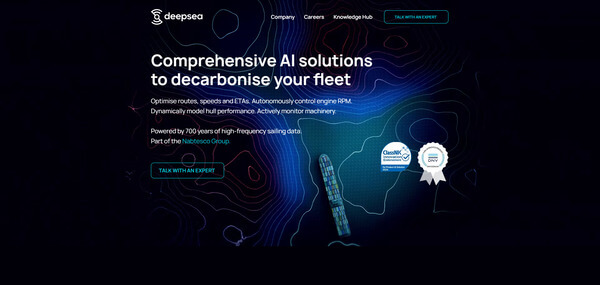
* Image source: DeepSea Official
Website
(https://www.deepsea.ai/)
(https://www.deepsea.ai/)
Core Capabilities
AI Fuel, CII &
Route Optimization
Route Optimization
- With the CII tracking feature, AI helps maintain and predict vessel performance.
- AI dynamically evaluates speeds and routes to suggest more fuel-efficient alternatives
- While complying with Europe-specific restrictions and regulations, it supports operations aimed at lower fuel consumption.
For Fleets with a Mix
of Older and Newly
Built Vessels
For Independent Ship
Management Companies
of Older and Newly
Built Vessels
For Independent Ship
Management Companies
Smart Ship Hub
* Image source: Smart Ship Hub Official
Website
(https://smartshiphub.com/)
(https://smartshiphub.com/)
Core Capabilities
Data integration across a mixed fleet
- Supports aggregation of vessel data across different manufacturers and standards, as well as data from multiple vessels.
- Visualizes information distributed across onboard systems and supports building an environment for centralized management.
- Supports information sharing between shore teams and fleets with older vessels, older equipment, newly built vessels and new equipment.