
Vessel Tide | A Guide to Essential Maritime Data Analytics Systems » What Is Vessel Management Software? How to Choose » Marine Fleet Management Software for Safety Management
Marine Fleet Management Software for Safety Management
Index
View All
Safe vessel operations and environmental protection are key management priorities in the maritime industry. This webpage explains—through an FAQ format—how to choose marine fleet management software with safety management functions, the benefits of implementation, and specific examples of utilizing it, including support for regulatory compliance such as the ISM Code and smoother information sharing between ship and shore.
Selecting Marine Fleet Management Software for Safety:
FAQ Guide
Ship Safety Management in Fleet Software
It refers to IT tools that digitize the Safety Management System (SMS) based on the ISM Code and support efficient operations. It helps identify and address risks through procedure management, accident and near-miss reporting, and internal audits. By digitizing workflows, it enables smoother information sharing between ship and shore and supports regulatory compliance.
Benefits of Ship Safety Management Software
To help address increasingly complex regulations and encourage a move toward preventive safety management. It also makes it easier to comply with the ISM Code, SIRE 2.0, and other requirements. By analyzing accumulated data, it helps make risks visible—supporting accident prevention, crew safety, and preserving vessel value.
Challenges Solved by Ship Safety Management Software
It can address issues such as information silos and increasing workload. With centralized management of safety, maintenance, and crew data, correlation analysis becomes possible, improving how accurately risks can be identified. Digitizing reporting workflows reduces the burden on crew members and enables real-time information sharing between ship and shore. This enables faster instructions and decision-making, improving safety across the organization.
Choosing Ship Safety Management Software
Ease of use in the field and scalability are important selection criteria. It is important to confirm whether it supports offline use when connectivity is unstable at sea, and whether it can be operated on mobile devices. An integrated system that can link with maintenance management can help prevent duplicated work. Support for standards such as SIRE 2.0—and the ability to adapt to future regulatory changes—is also an important selection point.
Use Cases for Ship Safety Management Software
By monitoring engine condition using IoT, it becomes possible to detect abnormalities early. By integrating with GIS and recreating past near-misses on nautical charts, the data can also be used for root-cause analysis and crew training. Digitizing inspection and reporting workflows is one of the most common examples of utilizing the system to advance paperless operations and improve efficiency at the same time.
POINT
Find the Right System for Your Data Strategy
This site introduces vessel management systems by technical focus, including solutions that help reduce the risk of unexpected downtime and equipment damage, tools that support data-driven analysis of fuel use, CII status, and voyage planning, and platforms that bring fragmented fleet data together in one place.
Case Studies: Marine Fleet Management Software for Safety
The webpage editorial team investigated case studies of marine fleet management software that supports safety management. Please review how each solution is used in practice and the results achieved after implementation to help guide system selection.
Case Study:
ShipIn.ai's Marine Fleet Management Software
Using Continuous VDR Data Monitoring to Support Safe Vessel Operations
Anglo-Eastern implemented FleetVision™ to strengthen safety management across the entire fleet.
Trends in safety-related KPIs show improvements after re-engagement with vessels, helping maintain a proactive safety culture.
Source: ShipIn.ai Official Website (https://shipin.ai/success-stories/ )
Case Study:
Danelec's Marine Fleet Management Software
Aiming to Reduce the Risk of Failures and Operational Stoppages
Uni-Tankers implemented Danelec's marine fleet management software as part of replacing an aging VDR.
By establishing a setup for remote management of VDR data, it supports failure prevention and reduces the risk of unexpected operational stoppages, helping advance efforts toward safe vessel operations.
Source: Danelec Official Website (https://www.danelec.com/newsroom/danelec-marine-will-upgrade-uni-tankers-vdr-fleet-facilitating-remote-management )
[Advertisement]
3 Recommended
Marine Fleet Management Software
3 Recommended
Marine Fleet Management Software
Advertiser Disclosure:
We receive compensation from some of the companies listed below.This compensation may affect which companies are included and the order in which they appear.
For Frequent Hazardous
or Long-Distance
Voyages
For Marine Fleet
Management Companies
or Long-Distance
Voyages
For Marine Fleet
Management Companies
MaSSA-One

* Image source: BEMAC Official
Website
(https://www.massa-one.com/english/)
(https://www.massa-one.com/english/)
Core Capabilities
Condition monitoring and anomaly detection
- Enables early detection of anomalies using data-driven automatic thresholds and expert-defined multi-condition detection.
- In the event of a failure, real-time data helps speed up root-cause identification, reducing downtime.
- This supports the prevention of future accidents and issues, contributing to reduced damage and losses involving vessels and cargo.
For Companies with
Frequent Business
in the EU
For Marine Shipping
Companies
Frequent Business
in the EU
For Marine Shipping
Companies
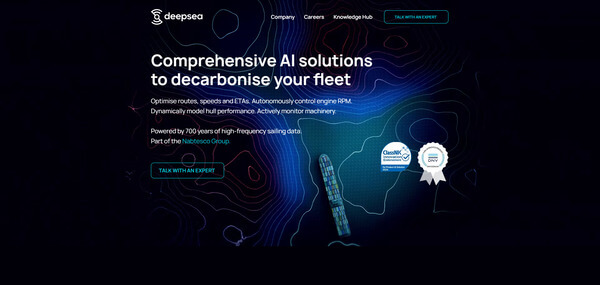
DeepSea
* Image source: DeepSea Official
Website
(https://www.deepsea.ai/)
(https://www.deepsea.ai/)
Core Capabilities
AI Fuel, CII &
Route Optimization
Route Optimization
- With the CII tracking feature, AI helps maintain and predict vessel performance.
- AI dynamically evaluates speeds and routes to suggest more fuel-efficient alternatives
- While complying with Europe-specific restrictions and regulations, it supports operations aimed at lower fuel consumption.
For Fleets with a Mix
of Older and Newly
Built Vessels
For Independent Ship
Management Companies
of Older and Newly
Built Vessels
For Independent Ship
Management Companies
Smart Ship Hub
* Image source: Smart Ship Hub Official
Website
(https://smartshiphub.com/)
(https://smartshiphub.com/)
Core Capabilities
Data integration across a mixed fleet
- Supports aggregation of vessel data across different manufacturers and standards, as well as data from multiple vessels.
- Visualizes information distributed across onboard systems and supports building an environment for centralized management.
- Supports information sharing between shore teams and fleets with older vessels, older equipment, newly built vessels and new equipment.