
Vessel Tide | A Guide to Essential Maritime Data Analytics Systems » What Is Vessel Management Software? How to Choose » Marine Fleet Management Software for Mooring Line Tension Monitoring
Marine Fleet Management Software for Mooring Line Tension Monitoring
Index
View All
By visualizing mooring line tension and embedding alerts and logs into day-to-day operations, companies can standardize on-site responses. Beyond reducing accident risk, supporting more efficient inspection and reporting workflows is also a key feature of a mooring line tension monitoring solution.
Selecting Marine Fleet Management Software
for Mooring Tension: FAQ Guide
About Mooring Line Tension Monitoring
It is a mechanism that captures tension on mooring lines and mooring equipment in real time, and sends notifications and records data when thresholds are exceeded. It continuously monitors line-by-line loads, uneven loading (when load concentrates on a specific line), and how tension changes over time.
By detecting early warning signs as numerical data, crews can quickly and appropriately take concrete safety actions, such as re-tensioning lines or pausing work.
Benefits of Mooring Line Tension Monitoring
Mooring conditions can change moment by moment due to tide levels, cargo-handling status, and weather, sometimes causing unexpected increases in tension. When tension becomes excessive, the risk of line breakage increases and may lead to snapback—serious accidents caused by recoil when a line breaks. To help prevent such incidents, introducing marine fleet management software that supports mooring line tension monitoring is effective.
In addition, as mooring safety guidelines continue to be developed, including by the IMO, visualizing, logging, and managing tension is a practical and rational approach to improving mooring safety.
Challenges Solved by Mooring Line Tension Monitoring
It can replace decisions that depend on individuals' experience and intuition with operations based on clear numerical values and alerts. Because mooring status can be checked remotely, it also helps prevent delays in the initial response when abnormalities occur.
Time-series logs make it easier to analyze root causes after near-miss events and to train crew members, which also supports organizational accountability.
Choosing a Mooring Line Tension Monitoring System
In addition to measurement accuracy and real-time performance, confirm whether threshold settings and notification methods can be configured flexibly. The ability to store historical logs and generate analysis reports is also an important selection criterion.
It is also important to choose a product that can be operated end to end—from detection through improvement—taking into account integration with existing marine fleet management software and maintainability that can withstand harsh marine conditions.
Use Cases for Mooring Line Tension Monitoring
For example, teams can monitor during cargo operations or when tension rises due to tidal changes and, after receiving an alert, immediately carry out heaving in or re-tensioning.
In strong winds, crews can check uneven loading by line and prioritize actions on higher-risk areas to help prevent accidents.
In addition, accumulated logs can be used in safety meetings and training materials, helping strengthen organization-wide measures to prevent recurrence.
POINT
Find the Right System for Your Data Strategy
This site introduces vessel management systems by technical focus, including solutions that help reduce the risk of unexpected downtime and equipment damage, tools that support data-driven analysis of fuel use, CII status, and voyage planning, and platforms that bring fragmented fleet data together in one place.
Case Studies: Marine Fleet Management Software
for Mooring Tension
The webpage editorial team investigated case studies of marine fleet management software that supports mooring line tension monitoring, but no case studies were found.
By introducing marine fleet management software with mooring line tension monitoring, companies can visualize mooring line tension in real time and receive alerts and logs when thresholds are exceeded. Because uneven loading and time-series tension trends can be logged for each mooring line, it becomes possible to standardize initial responses during abnormalities—supporting root-cause analysis after near misses, crew training, and more efficient reporting work.
[Advertisement]
3 Recommended
Marine Fleet Management Software
3 Recommended
Marine Fleet Management Software
Advertiser Disclosure:
We receive compensation from some of the companies listed below.This compensation may affect which companies are included and the order in which they appear.
For Frequent Hazardous
or Long-Distance
Voyages
For Marine Fleet
Management Companies
or Long-Distance
Voyages
For Marine Fleet
Management Companies
MaSSA-One

* Image source: BEMAC Official
Website
(https://www.massa-one.com/english/)
(https://www.massa-one.com/english/)
Core Capabilities
Condition monitoring and anomaly detection
- Enables early detection of anomalies using data-driven automatic thresholds and expert-defined multi-condition detection.
- In the event of a failure, real-time data helps speed up root-cause identification, reducing downtime.
- This supports the prevention of future accidents and issues, contributing to reduced damage and losses involving vessels and cargo.
For Companies with
Frequent Business
in the EU
For Marine Shipping
Companies
Frequent Business
in the EU
For Marine Shipping
Companies
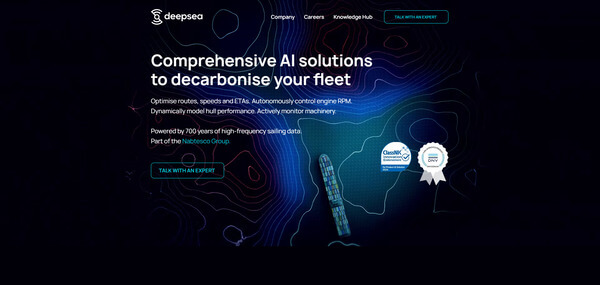
DeepSea
* Image source: DeepSea Official
Website
(https://www.deepsea.ai/)
(https://www.deepsea.ai/)
Core Capabilities
AI Fuel, CII &
Route Optimization
Route Optimization
- With the CII tracking feature, AI helps maintain and predict vessel performance.
- AI dynamically evaluates speeds and routes to suggest more fuel-efficient alternatives
- While complying with Europe-specific restrictions and regulations, it supports operations aimed at lower fuel consumption.
For Fleets with a Mix
of Older and Newly
Built Vessels
For Independent Ship
Management Companies
of Older and Newly
Built Vessels
For Independent Ship
Management Companies
Smart Ship Hub
* Image source: Smart Ship Hub Official
Website
(https://smartshiphub.com/)
(https://smartshiphub.com/)
Core Capabilities
Data integration across a mixed fleet
- Supports aggregation of vessel data across different manufacturers and standards, as well as data from multiple vessels.
- Visualizes information distributed across onboard systems and supports building an environment for centralized management.
- Supports information sharing between shore teams and fleets with older vessels, older equipment, newly built vessels and new equipment.