
Vessel Tide | A Guide to Essential Maritime Data Analytics Systems » Marine Fleet Management Software and Related Software Comparison » ClassNK CMAXS vs MaSSA-One: Vessel Data Platform Comparison
ClassNK CMAXS vs MaSSA-One: Vessel Data Platform Comparison
Index
View All
ClassNK CMAXS and MaSSA-One both help fleets use vessel and machinery data more effectively, but they serve different priorities.
CMAXS is centered on machinery diagnosis, maintenance workflows, spares, logs, and ship-shore visibility. MaSSA-One is positioned more as a ship-data platform for collecting data and using it across onboard and shore-side applications.
In short, CMAXS may fit better when the priority is machinery reliability and maintenance control. MaSSA-One may fit better when the priority is building a reusable vessel data foundation.
ClassNK CMAXS vs MaSSA-One at a Glance
| Comparison Area | ClassNK CMAXS | MaSSA-One |
|---|---|---|
| Best understood as | Machinery diagnosis and maintenance-support system family | Ship-data platform and application ecosystem |
| Core strength | Machinery condition monitoring, PMS, spares, logs, and reporting | Ship-data collection, CBM, monitoring, APIs, and application use |
| Better fit when... | The priority is machinery reliability and maintenance workflow control. | The priority is building a reusable vessel data foundation. |
| Main caution | Confirm module scope, equipment coverage, and engine-specific diagnostic fit. | Confirm application scope, integrations, and required maintenance/reporting workflows. |
What Is ClassNK CMAXS?
ClassNK CMAXS is a comprehensive software solution from PrimeTech Consulting Service, developed in cooperation with CMAXS alliance partners. It is designed to support safe ship operation, help prevent machinery trouble at an early stage, and support shipowners and ship management companies in understanding onboard machinery condition and carrying out maintenance more effectively.
It is better understood as a system family that includes machinery condition diagnosis, remote diagnostics, planned maintenance, spare-parts inventory control, web-based condition sharing, and abstract log/reporting functions.
Main ClassNK CMAXS Components
ClassNK CMAXS LC-A
LC-A is designed for machinery in the machinery space. It supports automatic anomaly analysis, condition diagnosis, troubleshooting when monitored indexes exceed thresholds, and onboard investigation/repair support.
ClassNK CMAXS e-GICSX
E-GICSX is a condition monitoring and remote diagnostic system for Mitsui MAN main engines. It uses onboard edge computing for abnormality analysis and onshore cloud computing for mechanical ability analysis.
CMAXS Web Service
CMAXS Web Service connects ClassNK CMAXS LC-A and ClassNK CMAXS e-GICSX. It allows machinery condition information to be shared across managed vessels, both onboard and onshore.
ClassNK CMAXS PMS
PMS is the planned maintenance system. It manages maintenance work schedules, monitors work progress, issues and manages work reports, and shares progress and reports between ship and shore.
ClassNK CMAXS SPICS
SPICS is the spare-parts inventory control system. It supports spare-parts inventory management, helps avoid parts shortages, issues quotation requests to suppliers, and provides visibility into inventory and ordered spare parts.
ClassNK CMAXS ABLOG
ABLOG manages deck and engine abstract log data. It can create deck and engine daily logs, noon reports, and submit monitoring data to the ClassNK MRV Portal for EU MRV and IMO DCS.
What Is MaSSA-One?
MaSSA-One offers ship support solution that collects and stores ship-related data, including data from engines, cargo handling, voyages, and other onboard systems. It shares that data with onshore offices to support monitoring, maintenance support, troubleshooting, voyage support, and application use.
MaSSA-One is best understood as a ship-data platform and application ecosystem. It provides a data foundation that can support shipboard crew applications, onshore monitoring and analysis, CBM, service collaboration, and application development.
Main MaSSA-One Components and Capabilities
Shipboard Crew Support Applications
MaSSA-One creates shipboard application environments to support crew performance. Publicly listed examples include equipment monitoring and troubleshooting support.
Onshore Monitoring and Information Analysis Applications
MaSSA-One supports onshore applications for equipment monitoring, data download, maintenance support, ship voyage support, and more advanced analysis.
IoT Data Server
The IoT Data Server collects ship-related data that can be confirmed onboard in real time. MaSSA-One states that the server complies with ISO 19847/19848 international standards for shipboard data servers, converts ship-related data into ISO 19848-compatible formats, and stores data in one-second cycles for one month.
Condition-Based Maintenance Support
MaSSA-One uses collected ship-related data to support condition-based maintenance rather than relying only on time-based maintenance.
Open Platform and API Collaboration
MaSSA-One is positioned as an open platform that shares ship-related data and provides applications. It also supports applications from other companies and service collaboration through ISO APIs.
Where ClassNK CMAXS and MaSSA-One Overlap
ClassNK CMAXS and MaSSA-One are built around different product concepts, but they overlap in several important areas. Both are relevant to shipowners, ship management companies, operators, technical teams, and organizations that want to make better use of onboard data.
Both Support Ship-Shore Visibility
Both systems help connect onboard information with shore-side teams. ClassNK CMAXS shares machinery condition information across managed vessels through CMAXS Web Service and related modules. MaSSA-One collects ship-related data and shares it with onshore offices for monitoring, analysis, maintenance support, and voyage-support applications.
Both Are Relevant to Maintenance Improvement
ClassNK CMAXS supports maintenance through condition diagnosis, PMS, work reports, spare-parts control, and abstract log management. MaSSA-One supports maintenance by using collected ship-related data for CBM, troubleshooting, and onshore analysis.
Both Use Onboard Data to Support Better Decisions
Both systems aim to turn onboard data into more useful information for operational and technical decision-making. The difference is how they frame that work. CMAXS is more centered on machinery condition and maintenance workflows. MaSSA-One is more centered on ship-data collection and application-based use.
Key Differences
1. Machinery Diagnosis vs Ship-Data Platform
ClassNK CMAXS focuses more on machinery condition diagnosis and maintenance support. Its LC-A module applies to machinery in the machinery space and supports automatic anomaly analysis, condition diagnosis, and troubleshooting when monitored indexes exceed thresholds.
MaSSA-One focuses more on collecting, storing, and sharing ship-related data. It collects data from engines, cargo handling, voyages, and other onboard systems, then uses that data to support shipboard applications, onshore monitoring, maintenance support, and voyage-support applications.
Decision point: If the immediate problem is earlier detection and response to machinery abnormalities, CMAXS may be closer to the requirement. If the immediate problem is creating a reusable data foundation for multiple applications, MaSSA-One may be closer to the requirement.
2. Maintenance Workflow vs Data-Driven Support
ClassNK CMAXS includes dedicated maintenance and inventory modules. CMAXS PMS manages maintenance schedules, work progress, and work reports. CMAXS SPICS supports spare-parts inventory management, shortage prevention, quotation requests, and inventory/order visibility. CMAXS ABLOG supports abstract logs, daily logs, noon reports, and MRV/DCS-related data submission.
MaSSA-One supports maintenance from the ship-data platform side. It uses collected ship-related data for maintenance support, condition-based maintenance, troubleshooting, and onshore analysis.
Decision point: If your team wants maintenance scheduling, work reports, spare-parts control, and reporting workflows in the same system family, CMAXS deserves close review. If your team wants to use collected vessel data to support CBM and other applications, MaSSA-One may be the stronger starting point.
3. Diagnostic Support vs Flexible Applications
ClassNK CMAXS combines automatic data collection, anomaly analysis, machine learning, engineer know-how, edge computing, cloud analysis, and ship-shore information sharing. Its e-GICSX module is specifically designed for condition monitoring and remote diagnostics for Mitsui MAN main engines.
MaSSA-One supports troubleshooting and analysis through applications. Public examples include equipment monitoring, knowledge alarms, and an electric troubleshooting application for analyzing generator malfunctions and blackout-related issues.
Decision point: CMAXS may be more suitable when the central requirement is machinery-focused diagnosis and maintenance response. MaSSA-One may be more suitable when the organization wants flexible onboard and onshore applications that use common ship data.
4. Data Standards and API Use
CMAXS Web Service connects ClassNK CMAXS LC-A and ClassNK CMAXS e-GICSX, allowing machinery condition information and measurement data to be shared across managed vessels onboard and onshore.
MaSSA-One gives more explicit public detail about shipboard data-server standards and external collaboration. Its IoT Data Server complies with ISO 19847/19848, converts data into ISO 19848-compatible formats, stores data in one-second cycles, and supports collaboration with other applications and services through ISO APIs.
Decision point: If the fleet is especially focused on standardized data collection, API-based collaboration, and a broader application ecosystem, MaSSA-One’s public positioning may be particularly relevant.
5. Logs and Compliance Workflows
ClassNK CMAXS ABLOG manages deck and engine abstract log data, creates daily logs and noon reports, and enables monitoring data submission to the ClassNK MRV Portal for EU MRV and IMO DCS.
MaSSA-One’s public product information emphasizes data collection, monitoring, maintenance support, voyage support, CBM, and application collaboration. It should not be treated as having the same abstract-log, noon-report, or MRV/DCS workflow unless the vendor confirms that functionality for the buyer’s specific use case.
Decision point: If reporting and log workflows are part of the software selection criteria, CMAXS may need to be evaluated more closely.
Best-Fit Decision Guide
In general, ClassNK CMAXS is stronger when the requirement starts with machinery reliability and maintenance control, while MaSSA-One is stronger when the requirement starts with ship-data collection and application use.
| Decision Point | ClassNK CMAXS May Fit Better When... | MaSSA-One May Fit Better When... |
|---|---|---|
| Main goal | You want to detect machinery abnormalities earlier and improve technical maintenance workflows. | You want to collect ship data and use it across onboard and onshore applications. |
| Monitoring focus | Machinery-space equipment and, where relevant, Mitsui MAN main engines are the priority. | Engines, cargo handling, voyage data, and other ship-related data need to be collected and shared. |
| Maintenance needs | You need condition diagnosis, PMS, work reports, spare-parts control, logs, or noon-report workflows. | You are moving toward CBM, monitoring applications, troubleshooting support, and onshore analysis. |
| Data strategy | You want machinery condition data shared between ship and shore through the CMAXS system family. | You need ISO 19847/19848-compatible data handling, API collaboration, and a reusable data foundation. |
| Reporting fit | Abstract logs, noon reports, EU MRV, or IMO DCS data submission are part of the requirement. | Monitoring, data download, maintenance support, voyage support, and application collaboration are the main priorities. |
| Best-fit team | Technical managers, superintendents, maintenance teams, and crew need clearer machinery-condition visibility. | Crew, onshore offices, operators, ship managers, shipyards, or equipment makers need broader data access and application use. |
| Long-term direction | You want a machinery-diagnosis and maintenance-support ecosystem. | You want a flexible ship-data platform that can support multiple applications over time. |
Questions to Ask Before Choosing ClassNK CMAXS or MaSSA-One
Before comparing feature lists, clarify the operational problem your fleet is trying to solve. The right choice depends on the vessels, onboard equipment, maintenance strategy, data environment, and shore-side workflow.
Operational Questions
- Which vessels and onboard systems need to be monitored?
- Is the main goal machinery failure prevention, maintenance planning, ship-data collection, or voyage support?
- Who needs to use the system every day: crew, superintendents, technical managers, operators, or equipment makers?
- Does the organization need shore-side diagnostic support, or mainly visibility into onboard data?
Technical Questions
- Which sensors, machinery systems, PMS, ERP, reporting tools, or onboard networks need to connect?
- Is ISO 19847/19848-compatible data handling required?
- Are APIs or third-party application connections important?
- Does the fleet need real-time onboard data confirmation, onshore data access, or both?
Maintenance and Reporting Questions
- Does the fleet need built-in planned maintenance management?
- Does spare-parts inventory need to be managed in the same system?
- Is the fleet shifting from time-based maintenance to condition-based maintenance?
- Are there engine-specific diagnostic needs, such as support for Mitsui MAN main engines?
Vendor-Fit Questions
- What proof can each vendor provide for similar vessel types or operating profiles?
- What training is required for crew and shore-side users?
- Which functions are standard, optional, or dependent on other systems?
- Are there vessel, engine, equipment, or data-format limitations?
POINT
Finding the Right
Fleet Management
Software
Fleet Management
Software
As explored above, ClassNK CMAXS and MaSSA-One support different operational priorities. CMAXS may be a stronger fit for fleets focused on machinery diagnosis, planned maintenance, spares, and reporting workflows, while MaSSA-One may be a better fit for teams building a ship-data platform for monitoring, CBM, and application use. To compare more options by fleet type and management goal, explore our recommended marine fleet management systems below.
Conclusion: Which System Should You Evaluate First?
ClassNK CMAXS and MaSSA-One both support data-informed ship management, but they are built around different operational priorities.
Evaluate ClassNK CMAXS if your fleet is focused on machinery condition diagnosis, early trouble detection, planned maintenance, spare-parts control, ship-shore technical visibility, abstract logs, noon reports, or MRV/DCS-related workflows.
Evaluate MaSSA-One if your fleet is focused on building a ship-data platform, sharing onboard data with shore-side teams, supporting CBM, using onboard and onshore applications, or connecting data with other services through ISO-compatible APIs.
The right choice depends less on which system has more features and more on which problem your fleet needs to solve first: machinery maintenance control or broader vessel data utilization.
[Advertisement]
3 Recommended
Marine Fleet Management Software
3 Recommended
Marine Fleet Management Software
Advertiser Disclosure:
We receive compensation from some of the companies listed below.This compensation may affect which companies are included and the order in which they appear.
For Frequent Hazardous
or Long-Distance
Voyages
For Marine Fleet
Management Companies
or Long-Distance
Voyages
For Marine Fleet
Management Companies
MaSSA-One

* Image source: BEMAC Official
Website
(https://www.massa-one.com/english/)
(https://www.massa-one.com/english/)
Core Capabilities
Condition monitoring and anomaly detection
- Enables early detection of anomalies using data-driven automatic thresholds and expert-defined multi-condition detection.
- In the event of a failure, real-time data helps speed up root-cause identification, reducing downtime.
- This supports the prevention of future accidents and issues, contributing to reduced damage and losses involving vessels and cargo.
For Companies with
Frequent Business
in the EU
For Marine Shipping
Companies
Frequent Business
in the EU
For Marine Shipping
Companies
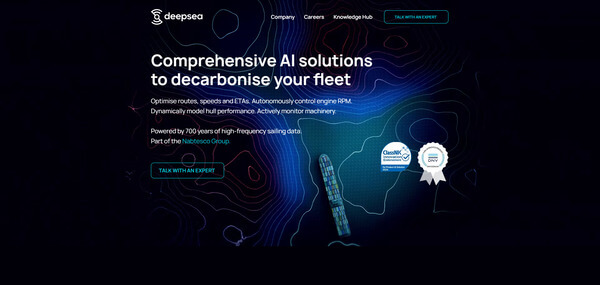
DeepSea
* Image source: DeepSea Official
Website
(https://www.deepsea.ai/)
(https://www.deepsea.ai/)
Core Capabilities
AI Fuel, CII &
Route Optimization
Route Optimization
- With the CII tracking feature, AI helps maintain and predict vessel performance.
- AI dynamically evaluates speeds and routes to suggest more fuel-efficient alternatives
- While complying with Europe-specific restrictions and regulations, it supports operations aimed at lower fuel consumption.
For Fleets with a Mix
of Older and Newly
Built Vessels
For Independent Ship
Management Companies
of Older and Newly
Built Vessels
For Independent Ship
Management Companies
Smart Ship Hub
* Image source: Smart Ship Hub Official
Website
(https://smartshiphub.com/)
(https://smartshiphub.com/)
Core Capabilities
Data integration across a mixed fleet
- Supports aggregation of vessel data across different manufacturers and standards, as well as data from multiple vessels.
- Visualizes information distributed across onboard systems and supports building an environment for centralized management.
- Supports information sharing between shore teams and fleets with older vessels, older equipment, newly built vessels and new equipment.