
Vessel Tide | A Guide to Essential Maritime Data Analytics Systems » Marine Fleet Management Software and Related Software Comparison » Marine Fleet Management Software vs CMMS: Key Differences Explained
Marine Fleet Management Software vs CMMS: Key Differences Explained
Marine fleet management software and CMMS both show up in the same conversation because both keep a vessel's engines, pumps, and safety equipment running. The confusion ends once you look at what each system is actually built to manage. A CMMS tracks maintenance for any physical asset — a compressor, a delivery truck, a ship's generator — regardless of industry. Marine fleet management software manages vessel operations: maintenance is one module inside a platform that also covers voyages, crew, compliance, and procurement.
If you're comparing the two before a purchase, the real question isn't which tool has more features. It's whether your team needs to manage vessel operations from one system, or just needs stronger control over maintenance work.
Key Takeaways
- Scope is the real difference, not feature count. CMMS manages maintenance for any type of asset. Marine fleet management software manages the whole vessel operation, with maintenance built in as one module.
- If your team wants to handle crew rotations, voyages, procurement, and compliance from one system, fleet management software is the better fit — a standalone CMMS doesn't cover those functions.
- If maintenance is the only weak spot and voyage, crew, and commercial operations are already handled elsewhere, a dedicated CMMS (or marine-specific PMS) can close that gap without a full platform switch.
- Generic, non-maritime CMMS platforms often lack offline ship-to-shore sync, class survey integration, and maritime-specific compliance reporting — confirm these before choosing one for vessel use.ons.
What is Marine Fleet Management Software?
Marine fleet management software runs a shipping company's day-to-day vessel operations from a single system, covering more ground than maintenance alone. It typically brings together:
- Voyage and vessel tracking, for real-time position and route data across the fleet
- Crew management, covering rotations, certification tracking, and payroll-related documentation
- Planned maintenance (PMS), the module that schedules servicing, inspections, and overhauls — this is where the CMMS-style functionality lives inside the platform
- Compliance and safety management (QHSE), for ISM Code, SOLAS, and class survey requirements
- Procurement and spares coordination, tied directly to maintenance and dry-docking schedules
- Fleet-wide KPI dashboards, tracking metrics such as operating cost, downtime, total cost of ownership, maintenance performance, and safety indicators
Because these modules share data, a maintenance delay can be traced to its knock-on effect on crew scheduling, compliance status, or voyage cost — something a maintenance-only system can't show.
What is CMMS?
A CMMS (Computerized Maintenance Management System) centralizes maintenance work for any physical asset — production equipment, HVAC systems, generators, or vehicles — not just ships. Core functionality includes:
- Work order management, for creating, assigning, and tracking maintenance tasks
- Preventive maintenance scheduling, based on time intervals, usage, or condition data
- Asset registry, a centralized record of equipment and its maintenance history
- Parts and inventory tracking, so spare parts are available when a job comes up
- Mobile access, letting technicians log work and pull equipment history from the field
- Compliance and audit tracking, documenting that maintenance was performed as required
CMMS platforms are deployed either on-premises or as cloud-based SaaS. In shipping, this maintenance function is commonly handled through a Planned Maintenance System (PMS). Under ISM Code Element 10, companies are required to establish procedures to ensure that ships and equipment are maintained in conformity with applicable rules and requirements; a PMS is commonly used to document and manage that maintenance.
Key Differences
The overlap in function names (both handle "maintenance") hides a difference in scope. Here's where the two systems actually diverge:
| Dimension | CMMS | Marine Fleet Management Software |
|---|---|---|
| Primary scope | Maintenance and asset upkeep | Full vessel operation: technical, crew, compliance, commercial |
| Asset range | Any equipment type, across industries | Vessels and shipboard machinery specifically |
| Regulatory alignment | Generic compliance/audit trail; needs configuration for maritime rules | Built-in maritime regulatory support, including ISM Code, class survey, and flag-state requirements |
| Connectivity | Often designed around reliable, continuous connectivity | Offline-capable, with ship-to-shore synchronization built in |
| Departments served | Maintenance and engineering teams | Technical, crew, safety, procurement, and commercial teams together |
A generic CMMS can be configured to track ship equipment, but it won't natively handle running-hour data from onboard systems, class certificate expiry, or intermittent satellite connectivity the way a maritime-built system does.
Overlapping Features
The overlap between the two is real, not just marketing language. Both systems typically include:
- Work order management, for logging and tracking maintenance tasks
- Preventive maintenance scheduling, triggered by time, usage, or condition
- Spare parts and inventory tracking, tied to upcoming maintenance jobs
- Compliance documentation, recording that maintenance was completed as required
- Mobile access, for technicians logging work from the field or vessel
- Reporting and KPIs, summarizing maintenance performance over time
This shared feature set is exactly why the two get lumped together in vendor comparisons and RFPs. It's also why scope — not the feature list — has to be the deciding factor: a marine fleet management platform typically includes these functions within its maintenance or PMS module, then adds the operational layers a standalone CMMS was never built to cover.
Which One Do You Need?
- Multi-vessel operator managing crew rotations, voyages, procurement, and compliance across the fleet → marine fleet management software. A standalone CMMS won't cover crew or voyage functions.
- Maintenance is the specific gap — missed inspections, paper-based logs, poor spare-parts visibility — and voyage, crew, and commercial operations already run on separate systems → a dedicated CMMS, ideally one built for marine use, closes that gap without replacing the rest of your stack.
- Single-vessel or small owner-operator with relatively limited fleet-wide coordination needs → a marine-specific CMMS/PMS may cover both maintenance and basic compliance without the cost of a full platform.
- Fleet expected to grow beyond a handful of vessels → factor in migration cost now. Check whether the CMMS can integrate with, or later be replaced by, a full fleet management platform.
Before deciding, confirm your ISM Code / DOC status, what systems you already have for crew and voyage management, your connectivity requirements at sea, and your fleet's growth trajectory over the next few years.
Conclusion
The choice comes down to scope, not a feature checklist. If your team needs to manage the vessel itself — crew, voyages, compliance, and procurement — alongside maintenance, marine fleet management software can serve as the system of record. If maintenance is the specific gap and everything else is already handled, a dedicated CMMS closes it without disrupting the rest of your operation. Either way, confirm the maritime-specific requirements — offline sync, class integration, IMO-related and ISM Code requirements — before signing, since not every CMMS on the market was built for shipboard use.
[Advertisement]
3 Recommended
Marine Fleet Management Software
3 Recommended
Marine Fleet Management Software
Advertiser Disclosure:
We receive compensation from some of the companies listed below.This compensation may affect which companies are included and the order in which they appear.
For Frequent Hazardous
or Long-Distance
Voyages
For Marine Fleet
Management Companies
or Long-Distance
Voyages
For Marine Fleet
Management Companies
MaSSA-One

* Image source: BEMAC Official
Website
(https://www.massa-one.com/english/)
(https://www.massa-one.com/english/)
Core Capabilities
Condition monitoring and anomaly detection
- Enables early detection of anomalies using data-driven automatic thresholds and expert-defined multi-condition detection.
- In the event of a failure, real-time data helps speed up root-cause identification, reducing downtime.
- This supports the prevention of future accidents and issues, contributing to reduced damage and losses involving vessels and cargo.
For Companies with
Frequent Business
in the EU
For Marine Shipping
Companies
Frequent Business
in the EU
For Marine Shipping
Companies
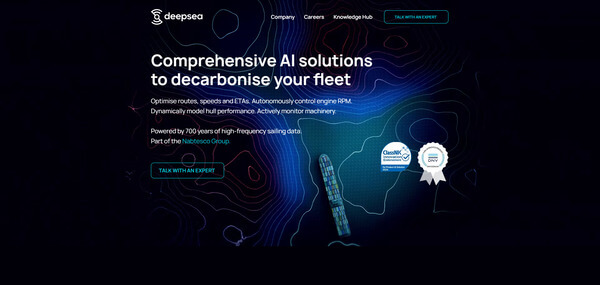
DeepSea
* Image source: DeepSea Official
Website
(https://www.deepsea.ai/)
(https://www.deepsea.ai/)
Core Capabilities
AI Fuel, CII &
Route Optimization
Route Optimization
- With the CII tracking feature, AI helps maintain and predict vessel performance.
- AI dynamically evaluates speeds and routes to suggest more fuel-efficient alternatives
- While complying with Europe-specific restrictions and regulations, it supports operations aimed at lower fuel consumption.
For Fleets with a Mix
of Older and Newly
Built Vessels
For Independent Ship
Management Companies
of Older and Newly
Built Vessels
For Independent Ship
Management Companies
Smart Ship Hub
* Image source: Smart Ship Hub Official
Website
(https://smartshiphub.com/)
(https://smartshiphub.com/)
Core Capabilities
Data integration across a mixed fleet
- Supports aggregation of vessel data across different manufacturers and standards, as well as data from multiple vessels.
- Visualizes information distributed across onboard systems and supports building an environment for centralized management.
- Supports information sharing between shore teams and fleets with older vessels, older equipment, newly built vessels and new equipment.