
Vessel Tide | A Guide to Essential Maritime Data Analytics Systems » Marine Fleet Management Software and Related Software Comparison » Marine Fleet Management Software vs Vessel Management Software: Key Differences Explained
Marine Fleet Management Software vs Vessel Management Software: Key Differences Explained
If you manage ships for a living, you've probably seen "Marine Fleet Management Software" and "Vessel Management Software" used as if they mean the same thing. Vendor websites swap the terms freely, and in practice, most platforms do overlap heavily in what they cover: maintenance, compliance, crew, and reporting.
The real difference isn't the feature list. It's the vantage point. Fleet management software gives you one view across every vessel you operate or manage, so you can compare performance and standardize processes across the fleet. Vessel management software is built around the operational reality of a single ship: its maintenance history, its certificates, its crew, its compliance record.
For a ship management company handling client vessels across different owners and flags, that distinction changes what you should be evaluating when you shop for software.
Key Takeaways
- "Marine Fleet Management Software" and "Vessel Management Software" are often used interchangeably by vendors, but the real distinction is scope: managing an entire fleet vs. managing one ship.
- Fleet management software rolls up cross-vessel data for comparison and resource allocation; vessel management software goes deep on one ship's technical, maintenance, and compliance record.
- Ship management companies overseeing vessels for multiple owners usually need both layers, not just one — a common setup for third-party ship managers.
- When comparing platforms, judge them on whether fleet-wide visibility and ship-level detail are both present and connected, not on which term the vendor uses.
What is Marine Fleet Management Software?
Marine fleet management software gives you one operating picture across every vessel in your portfolio, regardless of who owns each ship. Instead of checking maintenance status, crew certificates, or compliance records vessel by vessel, you pull it all into a single dashboard and compare across your fleet.
For a ship management company running vessels for multiple owners, that fleet-wide view answers questions individual vessel records can't: Which ships are falling behind on planned maintenance? Where are you over- or under-staffed this quarter? Which owner's fleet costs more per vessel to run, and why?
Typical capabilities include:
- Fleet-wide maintenance and compliance dashboards
- Cross-vessel benchmarking on fuel use, downtime, and cost per vessel
- Centralized crew planning and certification tracking across ships
- Consolidated reporting for owners, charterers, and regulators
- Resource and budget decisions made at the fleet level, not the ship level
This is the layer built for managing a fleet as a whole, not the technical detail of a single ship.
What is Vessel Management Software?
Vessel management software is built around a single ship's operational record — the details specific to that vessel, regardless of who's tracking the fleet above it.
Where fleet software rolls data up across many ships, vessel management software goes deep on a single vessel: its technical specifications, class certificates and survey history, maintenance jobs tied to specific machinery, the crew currently assigned to that ship, and its dry-docking and repair history.
For a technical superintendent responsible for a handful of vessels, this is the layer that answers: Is this main engine due for overhaul? Which certificates on this ship expire next month? What issues did the last class survey identify on this vessel?
Typical capabilities include:
- A vessel-specific technical file: specifications, drawings, class certificates
- Job-level planned maintenance tied to individual equipment
- Onboard crew assignment, watchkeeping, and certification for that ship
- Dry-dock and repair history specific to the hull
- Survey and inspection tracking at the vessel level
This is the layer built for the technical reality of one ship, not the portfolio view across many.
Key Differences
Both categories manage ships. The difference is in scope, the primary user, and the kind of decision the software is built to support.
| Marine Fleet Management Software | Vessel Management Software | |
|---|---|---|
| Scope | Every vessel in the fleet or portfolio | One vessel at a time |
| Primary user | Fleet managers, owners, technical directors overseeing multiple ships | Technical superintendents, shipboard staff, crew responsible for individual vessels |
| Core question it answers | How is the fleet performing, and where should resources go? | Is this specific ship compliant, maintained, and crewed correctly? |
| Data granularity | Rolled-up, cross-vessel metrics and benchmarks | Job-level, certificate-level, equipment-level detail |
| Typical trigger to buy | Managing vessels across multiple owners, flags, or contracts | Needing tighter technical control over vessel-level maintenance and compliance |
Neither one replaces the other. Fleet management software without vessel-level detail gives you dashboards with nothing solid underneath. Vessel management software without a fleet layer may give you accurate ship-by-ship records without the same ability to compare performance across your portfolio.
Overlapping Features
Here's why the terms get confused in practice: most vendors build both layers into one product. A fleet management platform usually lets you drill down into a single vessel's record. A vessel management system may also provide fleet-level dashboards once you're managing more than one ship.
Because of that, the two categories share a common core:
- Planned maintenance scheduling
- Certificate and compliance tracking
- Crew management
- Procurement and spare parts
- Reporting for owners and regulators
The label on a vendor's homepage often reflects their starting point and target buyer, not a hard technical boundary. A platform that started as a single-vessel maintenance tool for small operators may market itself as "vessel management," while the same company's enterprise tier, sold to larger fleets, gets called "fleet management."
What actually matters when comparing options isn't the label — it's whether the fleet-wide view and the vessel-level detail are both there, and how well they connect to each other.
Which One Do You Need?
For most ship management companies, this isn't a strict either/or. But knowing which layer to prioritize when you evaluate software saves you from buying the wrong shape of tool.
Lean toward vessel management software first if:
- You manage a small number of vessels for a single owner
- Your immediate pain is missed certificate renewals, scattered maintenance history, or paper-based technical records on individual ships
- You need airtight, ship-specific documentation ahead of a class survey or port state inspection
Lean toward fleet management software first if:
- You manage vessels across multiple owners, flags, or contracts — a common reality for third-party ship management companies operating out of Greece, Singapore, Hong Kong, or India
- Owners or charterers expect consolidated fleet performance reports, not ship-by-ship printouts
- You're comparing cost, downtime, or crew performance across vessels to decide where to focus resources
In practice, a small-to-medium ship management company overseeing vessels for multiple owners usually ends up needing both: vessel-level detail accurate enough to pass survey, and a fleet-wide layer to report and make decisions across everything you manage. The practical question when comparing platforms is whether they give you both — or only one, leaving the other layer for you to build later.
Conclusion
Marine Fleet Management Software and Vessel Management Software aren't competing categories — they're two views of the same operation, built to answer different questions. One asks how your whole fleet is performing. The other asks whether a specific vessel is properly maintained, compliant, and ready for its next survey.
If you're comparing options as a ship management company handling vessels for different owners, use whichever question is causing you the most pain right now — fleet-wide visibility or ship-level accuracy — as your starting point for a shortlist.
[Advertisement]
3 Recommended
Marine Fleet Management Software
3 Recommended
Marine Fleet Management Software
Advertiser Disclosure:
We receive compensation from some of the companies listed below.This compensation may affect which companies are included and the order in which they appear.
For Frequent Hazardous
or Long-Distance
Voyages
For Marine Fleet
Management Companies
or Long-Distance
Voyages
For Marine Fleet
Management Companies
MaSSA-One

* Image source: BEMAC Official
Website
(https://www.massa-one.com/english/)
(https://www.massa-one.com/english/)
Core Capabilities
Condition monitoring and anomaly detection
- Enables early detection of anomalies using data-driven automatic thresholds and expert-defined multi-condition detection.
- In the event of a failure, real-time data helps speed up root-cause identification, reducing downtime.
- This supports the prevention of future accidents and issues, contributing to reduced damage and losses involving vessels and cargo.
For Companies with
Frequent Business
in the EU
For Marine Shipping
Companies
Frequent Business
in the EU
For Marine Shipping
Companies
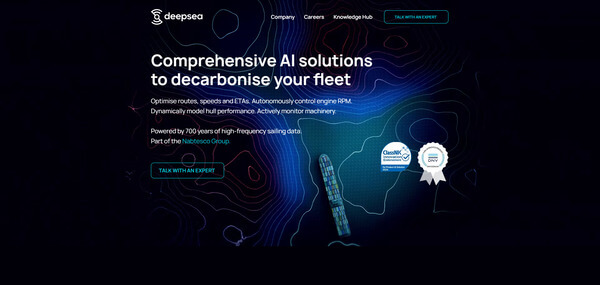
DeepSea
* Image source: DeepSea Official
Website
(https://www.deepsea.ai/)
(https://www.deepsea.ai/)
Core Capabilities
AI Fuel, CII &
Route Optimization
Route Optimization
- With the CII tracking feature, AI helps maintain and predict vessel performance.
- AI dynamically evaluates speeds and routes to suggest more fuel-efficient alternatives
- While complying with Europe-specific restrictions and regulations, it supports operations aimed at lower fuel consumption.
For Fleets with a Mix
of Older and Newly
Built Vessels
For Independent Ship
Management Companies
of Older and Newly
Built Vessels
For Independent Ship
Management Companies
Smart Ship Hub
* Image source: Smart Ship Hub Official
Website
(https://smartshiphub.com/)
(https://smartshiphub.com/)
Core Capabilities
Data integration across a mixed fleet
- Supports aggregation of vessel data across different manufacturers and standards, as well as data from multiple vessels.
- Visualizes information distributed across onboard systems and supports building an environment for centralized management.
- Supports information sharing between shore teams and fleets with older vessels, older equipment, newly built vessels and new equipment.