
Vessel Tide | A Guide to Essential Maritime Data Analytics Systems » Marine Fleet Management Software and Related Software Comparison » Marine Fleet Management Software vs Automated Voyage Reporting Software: Key Differences Explained
Marine Fleet Management Software vs Automated Voyage Reporting Software: Key Differences Explained
Marine fleet management software and automated voyage reporting software both touch the same NOON report data, which is why the two get mentioned in the same breath. The overlap is real but narrow. Automated voyage reporting exists to do one job well: digitize the vessel's voyage log, pull fuel, position, and weather data straight from onboard equipment, and package it into the formats regulators expect — CII, EU-ETS, IMO DCS, EU MRV. Marine fleet management software runs the vessel's operations end to end, of which voyage reporting is one module among several covering maintenance, crew, and compliance.
Most vendors build automated voyage reporting as a feature inside a fleet management platform, but dedicated point solutions exist too — so it's worth checking which one you're actually being sold before you buy.
Key Takeaways
- Automated voyage reporting digitizes NOON reports and consolidates fuel, position, and weather data to support CII, EU-ETS, IMO DCS, and EU MRV compliance — a narrower job than running the whole fleet.
- Most fleet management platforms include voyage reporting as a built-in module, but standalone automated voyage reporting products also exist, built specifically around emissions and NOON report compliance.
- Marine fleet management software covers that same voyage data plus the departments a reporting tool doesn't touch: maintenance, crew, compliance filings, and procurement.
- If you adopt a standalone voyage reporting tool, confirm it can share data with your maintenance and compliance systems rather than creating another disconnected data set ship and shore both have to reconcile.
What is Marine Fleet Management Software?
Marine fleet management software runs a shipping company's day-to-day vessel operations from a single system: it schedules planned maintenance across every ship, manages crew rotations and certifications, handles compliance reporting under the ISM Code, SOLAS, and flag-state requirements, and logs voyage and port call data instead of leaving it scattered across spreadsheets and separate tools.
Voyage reporting sits inside this software as one module among several — the same database that stores a NOON report also holds the maintenance job due that week and the crew certificate expiring next month, giving fleet managers one place to see how all three connect.
What is Automated Voyage Reporting Software?
Automated voyage reporting software replaces the traditional email-and-spreadsheet NOON report with a digital, largely hands-off process. It connects to onboard equipment — flow meters, GPS, weather instruments, and often the VDR — to capture fuel consumption, position, and weather data automatically, then formats that data for the specific regulatory submissions a vessel needs: CII ratings, EU-ETS allowances, IMO DCS filings, and EU MRV reports.
The goal is twofold: cut the administrative time crew spend compiling reports by hand, and remove the data inconsistencies and delays that come from manual entry, so shore-based teams and regulators are working from the same numbers the vessel is generating in real time. Some vendors sell this as a dedicated point solution focused purely on emissions and voyage data compliance; others build it as a module inside a broader fleet management suite. Either way, the core job stays the same — accurate, automated voyage data, formatted for regulatory submission and produced with less crew time.
Key Differences
Automated voyage reporting answers a specific question: is this vessel's fuel, position, and emissions data accurate, current, and in the format regulators require. Marine fleet management software answers that question plus everything else involved in running the ship.
| Dimension | Marine Fleet Management Software | Automated Voyage Reporting Software |
|---|---|---|
| Primary scope | Full vessel operation: maintenance, crew, compliance, voyage | Voyage and emissions data: NOON reports, fuel, position, weather |
| Core function | Voyage reporting as one module among several | NOON report automation as the central function |
| Regulatory focus | ISM Code, SOLAS, IMO reporting across departments | CII, EU-ETS, IMO DCS, EU MRV specifically |
| Typical user | Fleet managers, technical superintendents, crewing teams | Ship's officers logging voyage data, compliance and sustainability teams |
| Deployment pattern | Central platform integrating data from other departments | Often a built-in module; sometimes a standalone point solution |
A standalone voyage reporting tool can produce an audit-ready CII submission on its own, but it generally won't tell you that the fuel-consumption spike behind a poor CII rating traces back to an overdue maintenance job — that connection only exists inside a platform that also runs maintenance.
Overlapping Features
The overlap centers on the raw voyage data both systems consume. Both typically pull fuel consumption, vessel position, and weather data from onboard sensors and instruments; both convert that data into reports usable for CII, EU-ETS, or IMO DCS submissions; and both aim to reduce the manual entry and back-and-forth correction that paper-based or spreadsheet NOON reports create. The difference is what happens to that data next. A standalone reporting tool stops at the compliance submission; marine fleet management software carries the same data into maintenance planning, fleet-wide KPI dashboards, and crew scheduling.
Which One Do You Need?
Choose standalone automated voyage reporting software if NOON report accuracy and emissions compliance are the specific gap — your maintenance, crew, and procurement processes already run adequately elsewhere, and consolidating everything into one system isn't the current priority.
Choose marine fleet management software if you want voyage data connected to maintenance schedules, crew certifications, and compliance filings in the same system — a standalone reporting tool won't extend into any of those areas.
If you're already running a standalone voyage reporting tool and considering a fuller platform, check whether your existing voyage data can migrate or integrate directly rather than forcing crews to re-enter the same fuel and position data twice.
Before deciding, confirm which onboard equipment (flow meters, GPS, and VDR) the system can connect to, and whether it supports the specific formats — IMO DCS, EU MRV — your fleet is required to submit.
Conclusion
Automated voyage reporting and marine fleet management software aren't really competing purchases — voyage reporting is usually a compliance-facing module within a broader fleet management platform. The decision is how much of the operation beyond voyage and emissions data needs to sit in the same system. If NOON reports and CII/EU-ETS/IMO DCS compliance are the whole problem, a standalone tool covers that scope. If maintenance, crew, and procurement need to be connected to that same voyage data, marine fleet management software is built to bring all of it together.
[Advertisement]
3 Recommended
Marine Fleet Management Software
3 Recommended
Marine Fleet Management Software
Advertiser Disclosure:
We receive compensation from some of the companies listed below.This compensation may affect which companies are included and the order in which they appear.
For Frequent Hazardous
or Long-Distance
Voyages
For Marine Fleet
Management Companies
or Long-Distance
Voyages
For Marine Fleet
Management Companies
MaSSA-One

* Image source: BEMAC Official
Website
(https://www.massa-one.com/english/)
(https://www.massa-one.com/english/)
Core Capabilities
Condition monitoring and anomaly detection
- Enables early detection of anomalies using data-driven automatic thresholds and expert-defined multi-condition detection.
- In the event of a failure, real-time data helps speed up root-cause identification, reducing downtime.
- This supports the prevention of future accidents and issues, contributing to reduced damage and losses involving vessels and cargo.
For Companies with
Frequent Business
in the EU
For Marine Shipping
Companies
Frequent Business
in the EU
For Marine Shipping
Companies
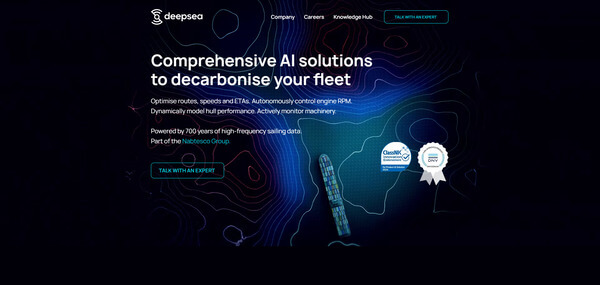
DeepSea
* Image source: DeepSea Official
Website
(https://www.deepsea.ai/)
(https://www.deepsea.ai/)
Core Capabilities
AI Fuel, CII &
Route Optimization
Route Optimization
- With the CII tracking feature, AI helps maintain and predict vessel performance.
- AI dynamically evaluates speeds and routes to suggest more fuel-efficient alternatives
- While complying with Europe-specific restrictions and regulations, it supports operations aimed at lower fuel consumption.
For Fleets with a Mix
of Older and Newly
Built Vessels
For Independent Ship
Management Companies
of Older and Newly
Built Vessels
For Independent Ship
Management Companies
Smart Ship Hub
* Image source: Smart Ship Hub Official
Website
(https://smartshiphub.com/)
(https://smartshiphub.com/)
Core Capabilities
Data integration across a mixed fleet
- Supports aggregation of vessel data across different manufacturers and standards, as well as data from multiple vessels.
- Visualizes information distributed across onboard systems and supports building an environment for centralized management.
- Supports information sharing between shore teams and fleets with older vessels, older equipment, newly built vessels and new equipment.