
Vessel Tide | A Guide to Essential Maritime Data Analytics Systems » What Is Vessel Management Software? How to Choose » Marine Fleet Management Software for Hull Stress Monitoring
Marine Fleet Management Software for Hull Stress Monitoring
Index
View All
As vessels continue to grow in size, it is increasingly important to manage hull loads numerically—loads that cannot be assessed by visual checks alone. A hull stress monitoring system measures strain during navigation and cargo operations, helping prevent structural damage. This webpage explains the basics and key selection points in an FAQ format for those responsible for evaluating implementation.
Selecting Marine Fleet Management Software
for Hull Stress:
FAQ Guide
About Hull Stress Monitoring Systems
It is a system that uses sensors installed at key points on the hull to measure strain and hull motion during navigation and cargo operations, and to estimate and monitor load indicators such as longitudinal bending stress and bending moment. When integrated with a platform, it can send alerts when thresholds are exceeded and enable fatigue analysis using accumulated data. By visualizing early signs of deterioration that are difficult to detect visually, it supports more advanced maintenance management.
Benefits of Hull Stress Monitoring Systems
The main reasons are compliance with safety standards and maintaining vessel asset value. If the system configuration meets classification society requirements, it can support obtaining and maintaining class notation. Because it enables objective tracking of impacts and strain in rough weather, it is also effective for accident prevention. Scheduling maintenance at the right time based on measurement logs can extend hull life and help preserve future resale value.
Challenges Solved by Hull Stress Monitoring Systems
It can reduce reliance on "rules of thumb" in day-to-day operations. With data-driven decisions, crews can take timely action by reducing speed and adjusting course. Logs of measured stress and hull motion can be used as input for fatigue assessment and maintenance planning. In addition, it can monitor overload caused by improper ballast adjustments during cargo operations, helping prevent hull-life reduction due to human error and supporting more stable management decisions.
Choosing a Hull Stress Monitoring System
Key selection points are flexible data integration and fit with vessel types. Confirm whether the system includes analysis algorithms suited to the company's vessel types and whether there is support for obtaining class notation. A cloud-enabled setup that allows an overview from shore can streamline information sharing among stakeholders. In addition, an intuitive interface that lets crews quickly recognize alerts is essential for successful adoption.
Use Cases for Hull Stress Monitoring Systems
A typical example is linking hull stress monitoring with route selection in rough weather. By combining weather forecasts with HSMS measurements and choosing lower-load routes, it is possible to balance safety with reduced fuel consumption. During cargo operations, it can monitor loading balance to help prevent structural damage from hogging and sagging. Accumulated measurement data can also be used to support future design improvements and to explain risks during insurance premium negotiations.
POINT
Find the Right System for Your Data Strategy
This site introduces vessel management systems by technical focus, including solutions that help reduce the risk of unexpected downtime and equipment damage, tools that support data-driven analysis of fuel use, CII status, and voyage planning, and platforms that bring fragmented fleet data together in one place.
Case Studies:
Marine Fleet Management Software for Hull Stress
The webpage editorial team investigated case studies of marine fleet management software that supports hull stress monitoring, but no case studies were found.
Hull stress monitoring is a feature designed to continuously track the loads on the hull and its stress condition during navigation. With marine fleet management software that includes hull stress monitoring, excessive loads caused by rough weather or inappropriate operating conditions can be detected early, helping reduce the risk of hull damage and structural deterioration.
3 Recommended
Marine Fleet Management Software
Marine Fleet Management Software
For Frequent Hazardous
or Long-Distance
Voyages
For Marine Fleet
Management Companies
or Long-Distance
Voyages
For Marine Fleet
Management Companies
MaSSA-One

* Image source: BEMAC Official
Website
(https://www.massa-one.com/english/)
(https://www.massa-one.com/english/)
Core Capabilities
Condition monitoring and anomaly detection
- Enables early detection of anomalies using data-driven automatic thresholds and expert-defined multi-condition detection.
- In the event of a failure, real-time data helps speed up root-cause identification, reducing downtime.
- This supports the prevention of future accidents and issues, contributing to reduced damage and losses involving vessels and cargo.
For Companies with
Frequent Business
in the EU
For Marine Shipping
Companies
Frequent Business
in the EU
For Marine Shipping
Companies
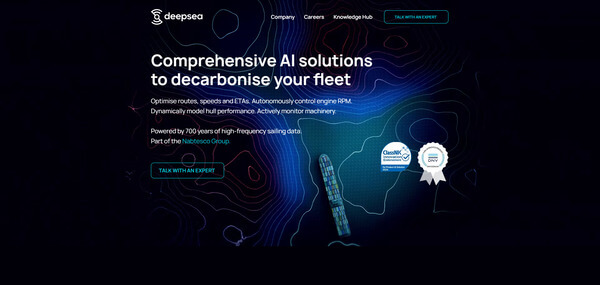
DeepSea
* Image source: DeepSea Official
Website
(https://www.deepsea.ai/)
(https://www.deepsea.ai/)
Core Capabilities
AI Fuel, CII &
Route Optimization
Route Optimization
- With the CII tracking feature, AI helps maintain and predict vessel performance.
- AI dynamically evaluates speeds and routes to suggest more fuel-efficient alternatives
- While complying with Europe-specific restrictions and regulations, it supports operations aimed at lower fuel consumption.
For Fleets with a Mix
of Older and Newly
Built Vessels
For Independent Ship
Management Companies
of Older and Newly
Built Vessels
For Independent Ship
Management Companies
Smart Ship Hub
* Image source: Smart Ship Hub Official
Website
(https://smartshiphub.com/)
(https://smartshiphub.com/)
Core Capabilities
Data integration across a mixed fleet
- Supports aggregation of vessel data across different manufacturers and standards, as well as data from multiple vessels.
- Visualizes information distributed across onboard systems and supports building an environment for centralized management.
- Supports information sharing between shore teams and fleets with older vessels, older equipment, newly built vessels and new equipment.