
Vessel Tide | A Guide to Essential Maritime Data Analytics Systems » Ship Management System Fundamentals » API Integration in Ship Management: Connecting Third-Party Maritime Applications
API Integration in Ship Management: Connecting Third-Party Maritime Applications
Index
View All
A ship management system that cannot exchange data with the tools a fleet already uses—such as engine-maker condition monitoring, weather routing, regulatory reporting, ERP, and crew management systems—risks becoming another data silo once it is deployed. How well it integrates is a key factor in whether a platform can serve as an interoperable data layer that supports additional applications over the vessel's operating life.
For owners and managers evaluating a system before signing, the vendor's answer to "Do you have an API?" is rarely the most useful question. What matters is which systems it actually connects to today, what types of data the integration exposes, how much of the connection depends on vendor professional services, and what contractual rights the customer has to access, export, and reuse its operational data.
Key Takeaways
- API access alone is not the differentiator: the data-collection and data-management architecture behind the API determines which onboard equipment and operational data can reach downstream applications.
- Ask which categories of third-party systems have live, production integrations today—such as engine-maker condition monitoring, weather routing, regulatory and emissions reporting, ERP, or crew management—rather than which integrations are merely on the roadmap.
- If a vendor does not control or verify the onboard data-collection layer, confirm exactly which equipment, signals, sampling intervals, units, timestamps, and data-quality controls are included. The scope and quality of the collected data matter more than whether the vendor performs the physical installation itself.
- Get data access, export rights, integration scope, and applicable fees written into the contract. A dashboard connection shown in a demonstration is not necessarily the same as a documented, production-supported API.
What API Integration Actually Means for a Ship Management System
An API (application programming interface) is a defined interface through which software systems exchange data or invoke functions. In a ship management environment, an API lets the platform connect with applications from other vendors, rather than requiring every function to live inside a single system.
Having an API, though, doesn't by itself mean a platform gives access to its underlying sensor data. An API may expose raw or near-raw time-series data, standardized equipment data, processed measurements, calculated KPIs, transactional records, or only a limited set of predefined fields. The scope of the API and the data architecture behind it matter as much as whether an API exists at all.
Two systems can both claim to have an API and behave very differently in practice. One may expose only selected dashboard metrics through a proprietary interface. Another may provide access to time-series equipment data, metadata, operational records, and other underlying data through documented interfaces. The latter makes it easier to connect additional applications, provided the customer has the necessary access rights and the data is well structured and documented.
A useful integration architecture lets a fleet add applications as operational requirements change, without replacing the entire ship management platform. But interoperability depends on more than the API itself: the onboard data source, gateway or data server, data model, data quality, connectivity method, access permissions, and vendor support model all affect how easily systems connect.
Systems Ship Managers Commonly Need to Connect
Common integration requirements in ship management fall into several recurring categories. The exact mix varies by fleet, vessel type, existing onboard systems, and the scope of the ship management platform.
Engine-Maker Condition Monitoring and Diagnostic Tools
Many fleets run condition-monitoring, machinery-diagnostic, or predictive-maintenance applications alongside their ship management systems. Without integration, overlapping equipment data may be maintained separately, raising the risk that an alert or measurement stays isolated in one application.
Where the architecture lets multiple applications draw on a common onboard or shore-side data source, integration can reduce duplicate data collection and manual data transfers. It won't necessarily remove the need for separate sensors, equipment interfaces, validation, or calibration, since those requirements depend on the underlying equipment and data-collection architecture.
Weather Routing and Voyage Optimization
Voyage-planning and weather-routing applications can use vessel-specific performance and consumption data alongside weather, route, and operational information. Where such data is available through an API or another supported integration method, a routing provider can factor in vessel-specific performance information instead of relying solely on generic assumptions.
The practical value depends on the quality, freshness, granularity, and context of the data supplied. Being connected to a data source is not the same as receiving everything a routing application needs for accurate performance modelling.
Regulatory, MRV, CII, and Emissions Reporting
Regulatory and emissions-reporting applications can draw on operational data collected by ship management systems, including fuel-consumption, voyage, cargo, and emissions-related information. But the underlying data requirements and calculation rules aren't identical across regulatory regimes.
IMO Carbon Intensity Indicator (CII) requirements, for example, and EU Monitoring, Reporting and Verification (MRV) and EU Emissions Trading System (EU ETS) requirements may rely on overlapping operational and fuel-consumption data, but they differ in scope, calculation methodology, reporting requirements, and verification arrangements. They should not be treated as interchangeable reporting processes.
Where the relevant data already sits in a ship management platform, integration can cut manual re-entry into separate reporting applications. The integration should still preserve the source data, units, timestamps, voyage boundaries, and other information needed to reproduce or verify the underlying calculations.
Classification and Other Maritime Data Exchanges
Ship managers may also need to exchange information with classification societies, flag-state or regulatory systems, survey and inspection platforms, and other maritime service providers. These integrations vary considerably in nature, so a vendor's generic claim of "class integration" should be clarified by identifying the specific system, the data exchanged, the workflow supported, and whether the connection is production-ready.
ERP, Procurement, and Crew Management
Purchase orders, spare-parts information, supplier records, personnel information, and other shore-side business data often sit in ERP, procurement, HR, or crew-management systems. Connecting these systems with a ship management platform can cut duplicate data entry and let operational events trigger related business workflows.
These integrations don't necessarily depend on onboard sensor data at all—an important distinction, since not every ship management integration is an IoT or equipment-data integration.
Onboard Sensors and IoT Data Collection
The onboard data-collection layer matters most for operational, machinery, and performance applications. How useful the downstream integrations are depends partly on which equipment and signals are available, how frequently they're collected, how they're timestamped and identified, and how data quality is managed.
If a platform collects data from only a limited range of equipment, less onboard operational data may be available for downstream applications. But collecting more signals doesn't guarantee better integration on its own: the data also needs appropriate units, identifiers, timestamps, metadata, quality information, and a consistent data model.
Why Integration Capability Matters Before You Sign
Fleets that skip evaluating integration requirements before implementation may discover after go-live that a promised connection actually requires a manual export-and-upload process, a custom development project, or additional professional services.
Common problems include duplicated data across systems, manual re-entry, inconsistent units or timestamps, and extra effort reconciling operational data between applications. Different systems may also represent the same equipment, event, or voyage differently, making analysis and troubleshooting harder.
Vendor changes raise another challenge. A platform may offer several ways to retrieve historical information, but the availability, format, granularity, and cost of that export can vary widely. Without documented export and access mechanisms, migrating historical data can become difficult or expensive.
These issues aren't always visible in a sales demonstration—which is exactly why integration requirements should be evaluated before signing, not after implementation.
What to Confirm Before You Trust a Vendor's API Claims
A demonstration showing one application pulling information from another proves that a data path can be demonstrated—nothing more. It doesn't establish that a documented, production-supported integration is available fleet-wide.
Before signing, confirm the following:
- Which categories of systems—such as engine-maker condition monitoring, weather routing, regulatory or emissions reporting, ERP, and crew management—have live, production integrations today, rather than pilot or roadmap integrations.
- Exactly what data the API exposes: time-series sensor data, equipment data, operational records, metadata, derived KPIs, or only selected dashboard metrics.
- Whether the platform uses or supports relevant maritime data standards, including ISO 19847:2024 and ISO 19848:2024, and exactly which parts of those standards are implemented. These standards address shipboard data-server and shipboard machinery/equipment data concepts—they're not generic API standards.
- How data is transferred and accessed—for example, through a documented API, data server, file exchange, or another supported interface—and whether read and write capabilities are available.
- Whether the data includes the timestamps, units, identifiers, metadata, sampling information, and data-quality indicators that downstream applications need.
- Whether adding a new integration requires vendor professional services and a separate fee, or whether existing interfaces can be configured without starting a new development project.
- How API changes are managed, including versioning, backward compatibility, rate limits, deprecation policies, and service availability.
- Who has contractual rights to access, export, and reuse the underlying operational data, and what restrictions apply to derived data, third-party data, personal data, or vendor-generated analytics.
- What historical data can be exported, in what format and granularity, within what timeframe, and at what cost if the customer changes systems later.
- What cybersecurity controls apply to the integration, particularly where shore-side applications connect to onboard IT or operational technology environments.
How to Validate an Integration Before Signing
Ask the vendor for a reference installation where the claimed integration is running in production on a vessel today. Confirm the vessel type, the systems involved, the data exchanged, the integration method, and how long the connection has been operational.
It also helps to distinguish between a demonstration, a pilot, a customer-specific custom integration, and a generally supported product integration. A connection that works for one vessel after substantial engineering effort may not offer the same deployment model or cost structure across the rest of a fleet.
Finally, ask to see the relevant API documentation, data dictionary, sample payloads, integration architecture, and contractual data-export provisions where applicable. The goal isn't just to confirm that two systems can exchange data, but to establish what data can be exchanged, under what conditions, and who can keep using it if the technology landscape changes.
Conclusion
For ship managers, API capability should be evaluated as part of the broader integration and data architecture—not as a standalone product feature. A useful platform makes clear which onboard and shore-side data it collects, how that data is structured and accessed, which third-party systems it supports in production, and what rights the customer has to export and reuse the data.
Standards such as ISO 19847:2024 and ISO 19848:2024 provide reference points for shipboard data servers and standardized data for shipboard machinery and equipment, respectively. However, support for these standards does not guarantee interoperability on its own. The real test is whether the platform provides well-documented data interfaces that work with the applications a fleet actually uses.
For owners and managers, the most important question isn't simply "Does the system have an API?" It's "What data can we access, which systems can we connect today, how will the integration be supported, and what happens to our data if we change vendors?"
POINT
Find the Right System for Your Data Strategy
This site introduces vessel management systems by technical focus, including solutions that help reduce the risk of unexpected downtime and equipment damage, tools that support data-driven analysis of fuel use, CII status, and voyage planning, and platforms that bring fragmented fleet data together in one place.
[Advertisement]
3 Recommended
Marine Fleet Management Software
3 Recommended
Marine Fleet Management Software
Advertiser Disclosure:
We receive compensation from some of the companies listed below.This compensation may affect which companies are included and the order in which they appear.
For Frequent Hazardous
or Long-Distance
Voyages
For Marine Fleet
Management Companies
or Long-Distance
Voyages
For Marine Fleet
Management Companies
MaSSA-One

* Image source: BEMAC Official
Website
(https://www.massa-one.com/english/)
(https://www.massa-one.com/english/)
Core Capabilities
Condition monitoring and anomaly detection
- Enables early detection of anomalies using data-driven automatic thresholds and expert-defined multi-condition detection.
- In the event of a failure, real-time data helps speed up root-cause identification, reducing downtime.
- This supports the prevention of future accidents and issues, contributing to reduced damage and losses involving vessels and cargo.
For Companies with
Frequent Business
in the EU
For Marine Shipping
Companies
Frequent Business
in the EU
For Marine Shipping
Companies
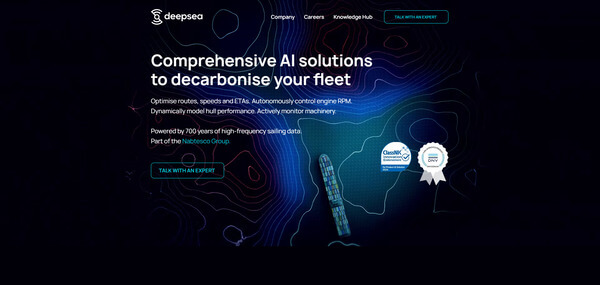
DeepSea
* Image source: DeepSea Official
Website
(https://www.deepsea.ai/)
(https://www.deepsea.ai/)
Core Capabilities
AI Fuel, CII &
Route Optimization
Route Optimization
- With the CII tracking feature, AI helps maintain and predict vessel performance.
- AI dynamically evaluates speeds and routes to suggest more fuel-efficient alternatives
- While complying with Europe-specific restrictions and regulations, it supports operations aimed at lower fuel consumption.
For Fleets with a Mix
of Older and Newly
Built Vessels
For Independent Ship
Management Companies
of Older and Newly
Built Vessels
For Independent Ship
Management Companies
Smart Ship Hub
* Image source: Smart Ship Hub Official
Website
(https://smartshiphub.com/)
(https://smartshiphub.com/)
Core Capabilities
Data integration across a mixed fleet
- Supports aggregation of vessel data across different manufacturers and standards, as well as data from multiple vessels.
- Visualizes information distributed across onboard systems and supports building an environment for centralized management.
- Supports information sharing between shore teams and fleets with older vessels, older equipment, newly built vessels and new equipment.