
Vessel Tide | A Guide to Essential Maritime Data Analytics Systems » Ship Management System Fundamentals » Open vs. Closed Data Platforms: Why Vendor Lock-In Matters in Ship Management
Open vs. Closed Data Platforms: Why Vendor Lock-In Matters in Ship Management
Index
View All
Ship management software can lock a fleet into a single vendor long after the system goes live. The risk isn't limited to the software contract itself — it can come from onboard hardware, data formats, metadata, APIs, applications and contract terms that are all tightly bound to that one vendor.
If historical sensor and operational data can't be exported in a usable format, switching systems can mean losing years of trend history, or paying heavily to preserve it. Depending on the architecture, a change can also require new hardware, reconfiguration, integration work, data migration and a period running both systems in parallel. Those exit costs are easy to miss when you're focused on the purchase price.
That's why vendor lock-in in ship management is as much a data-architecture and interoperability question as a contractual one. The goal isn't to eliminate proprietary components — most commercial systems have some. The more useful question is whether the data path stays open enough to change applications, add equipment or bring in another analytics provider without rebuilding the system from scratch.
Key Takeaways
- Data ownership alone doesn't prevent lock-in. A party can hold contractual rights to its data and still face technical or commercial barriers to actually accessing or exporting it.
- Lock-in can show up at any layer — onboard equipment, gateways, data servers, data models, storage, APIs, applications and contract terms. The onboard collection layer matters most when proprietary hardware is involved, but it shouldn't be evaluated in isolation.
- For procurement, judge an "open" or interoperable platform by one thing: can the data be accessed, interpreted and reused outside the vendor's own application, through documented formats, interfaces and metadata?
- Before signing, request a sample export of real operational data plus the metadata needed to interpret it, and lock in contract terms covering access, use, sharing, export, retention and data handling after the contract ends.
What Vendor Lock-In Actually Looks Like in Ship Management Systems
Vendor lock-in often comes down to how operational data is collected, stored and accessed. A system can pull data from sensors and shipboard equipment, then store or expose it through a proprietary structure that makes independent use difficult. And even when a contract grants an owner or operator rights to the data, those rights don't guarantee technically independent access to it.
That's why the distinction between data rights and data portability matters. Data rights determine who may access, use, share, or retain information under the contract. Data portability is a separate question: can that information actually be retrieved and reused in another system without unreasonable technical, contractual, or financial barriers?
Hardware is another common source of lock-in. If a proprietary gateway or data logger is required to collect information from onboard equipment, adding a new sensor or connecting a third-party system may depend entirely on what interfaces and hardware the vendor supports. That doesn't automatically make a system closed — but it's a dependency worth testing before you sign.
The application layer works the same way. A dashboard can depend on proprietary calculations, alarm logic, data models or APIs even when the underlying sensor data is technically exportable. An application stays relatively interoperable, on the other hand, when it exposes documented APIs and uses standardized or well-documented data structures.
Open and Interoperable Data Platforms: A Practical Definition for Vessel Operators
There's no single industry-wide definition of what makes a commercial ship management platform "open." For procurement purposes, though, you can evaluate an open or interoperable data architecture with three practical questions.
- Can the relevant data be accessed under clearly defined contractual rights? The contract should spell out who may access, use, share, retain and export each category of data.
- Can the data be exported without unreasonable barriers? Check the available export mechanisms, APIs, formats, costs, access procedures and any restrictions that apply during and after the contract.
- Can a third party interpret the exported data? Data should come with sufficient metadata or a data dictionary, including field definitions, units, timestamps, data sources, and other information needed to interpret the fields correctly.
This is a procurement framework, not an international standard. International maritime standards still offer useful reference points for interoperability: ISO 19847:2024 specifies requirements for shipboard data servers, and ISO 19848:2024 covers standardized approaches to data from sensors and shipboard machinery, equipment and operations, including how data items are named and described.
These standards matter because interoperability depends on more than the file extension used for an export. A CSV or JSON file can still be nearly unusable for another system if field definitions, units, timestamps, source information and other metadata are missing.
Cloud hosting and a modern interface don't determine whether a platform is open, either. A cloud-based system can still lock you in just as tightly as an on-premise one, or it can offer documented APIs and standardized data access. What matters is what happens underneath the interface: how data is collected, described, stored, accessed and exported.
Source: ISO 19847:2024 – Shipboard data servers for sharing field data at sea (ISO official page)
Source: ISO 19848:2024 - Standard data for shipboard machinery and equipment ([www.iso.org/standard/78262.html](https://www.iso.org/standard/78262.html))
Why the Entire Data Path Matters
Evaluate vendor lock-in across the entire data path, not just one layer. A typical architecture runs from onboard sensors and equipment through communication interfaces, gateways, a shipboard data server, data storage, metadata or data models, APIs and exports, and finally applications or analytics services.
ISO 19847:2024 speaks directly to the shipboard end of that architecture — it covers the data servers used to collect and share data from shipboard machinery and systems. ISO 19848:2024 covers how data items from shipboard sensors, machinery, equipment and operations are named and described.
So the real question isn't just whether a vendor's dashboard can be replaced — it's whether the underlying operational data stays accessible and interpretable once the application changes.
The onboard collection layer needs the closest look when proprietary gateways, data loggers or communication interfaces are involved. Once that hardware is installed across a fleet, replacing or reconfiguring it means real engineering work. But hardware is only one source of dependency. Proprietary data models, undocumented APIs, application-specific calculations and contractual restrictions can lock you in just as effectively.
The better procurement principle, then, is to weigh hardware dependency, data portability, interoperability, application dependency and contractual exit terms together — not one at a time.
Source: ISO 19847:2024 - Shipboard data servers for sharing field data at sea ([www.iso.org/standard/78260.html](https://www.iso.org/standard/78260.html))
Source: ISO 19848:2024 - Standard data for shipboard machinery and equipment ([www.iso.org/standard/78262.html](https://www.iso.org/standard/78262.html))
Questions to Ask Before You Sign: A Data-Openness Checklist
Raise these questions during procurement, not after the system is deployed — changing the architecture later almost always costs more.
- Request a sample export of actual operational data. Ask the vendor for representative sensor and operational data in a usable format before you sign, and review the real structure yourself rather than relying on a product demo.
- Request the metadata or data dictionary. Confirm the exported fields can be interpreted independently — at minimum, field definitions, units, timestamps, data source, reporting or sampling frequency, data type, and status or quality flags where applicable.
- Check the available data interfaces. Ask whether data can be retrieved through documented APIs, scheduled exports or relevant maritime data standards. CSV and JSON are useful formats, but the format alone doesn't make a system interoperable.
- Define data rights contractually. Confirm who can access, use, share, retain, and export the data. Don't treat "ownership" as the only contractual issue that matters. BIMCO's data-sharing provisions show how access, use, sharing, data sources, frequency, and security can all be addressed in the contract itself.
- Check hardware and integration dependencies. Ask whether third-party sensors, meters, gateways and analytics applications are technically supported, and find out what engineering, licensing or commercial charges apply to adding them.
- Define the exit process. Confirm what happens to historical data if you replace the system — export format, scope, delivery mechanism, retention period, fees, and what migration assistance is actually available.
- Weigh cybersecurity alongside interoperability. External access and data sharing shouldn't bypass the vessel's IT/OT security requirements. Design data portability together with proper authentication, access control and cybersecurity measures — not as an afterthought.
Source: BIMCO – Energy Efficiency Data Sharing Clause for Time Charter Parties 2025 (BIMCO official page)
Source: ISO 19848:2024 - Standard data for shipboard machinery and equipment ([www.iso.org/standard/78262.html](https://www.iso.org/standard/78262.html))
Source: BIMCO: Energy Efficiency Data Sharing Clause for Time Charter Parties 2025([www.bimco.org/contractual-affairs/bimco-clauses/current-clauses/energy-efficiency-data-sharing-clause/](https://www.bimco.org/contractual-affairs/bimco-clauses/current-clauses/energy-efficiency-data-sharing-clause/))
Source: BIMCO: Updated Guidelines on Cyber Security Onboard Ships([www.bimco.org/news-insights/bimco-news/2024/20241114-cyber-security-guidelines/](https://www.bimco.org/news-insights/bimco-news/2024/20241114-cyber-security-guidelines/))
What This Means When You Compare Systems
Real systems mix these approaches. One platform might collect data from multiple onboard systems, expose it through exports or APIs, and layer its own applications on top. Another might tightly couple the collection hardware, data model and application — which limits how easily that data can be reused anywhere else.
You can't judge either approach from marketing material. A platform billed as "open" can still restrict access at the metadata or contractual level, and a platform built around proprietary hardware can still offer reasonable export terms in its contract. The only way to know which you're actually getting is to check the real interfaces, metadata, contractual rights, export process and hardware dependencies for the specific deployment you're evaluating.
So don't ask a vendor whether they call their platform "open" — ask for evidence instead: a sample export, the metadata needed to interpret it, the available APIs or interfaces, the supported hardware connections, and the contract terms governing access to historical data.
Why Maritime Data Standards Matter
Interoperability is also becoming an explicit part of maritime digitalization at the regulatory level. The IMO Compendium on Facilitation and Electronic Business provides harmonized maritime data definitions and formats to support data exchange between different IT systems, and the IMO's Facilitation Committee approved an updated version in March 2026.
This kind of standardization matters because true data portability takes more than moving files from one system to another — the receiving system also has to understand what the data means. Standardized terminology, identifiers, units and data definitions cut down the semantic barriers that otherwise make technically exportable data hard to actually reuse.
Source: IMO: The IMO Compendium on Facilitation and Electronic Business([www.imo.org/en/ourwork/facilitation/pages/imocompendium.aspx](https://www.imo.org/en/ourwork/facilitation/pages/imocompendium.aspx))
Conclusion
Vendor lock-in in ship management isn't just a question of who legally owns the data. It's a question of whether that data stays accessible, interpretable and reusable when the application, hardware, analytics provider or software vendor changes.
Evaluate the whole data path — onboard equipment, gateways, shipboard data servers, data models, storage, APIs, applications and contract terms. Before you sign, test the actual export process, review the metadata needed to interpret the data, understand the hardware dependencies, and lock in clear exit terms for historical data.
Judge an "open" platform by evidence, not by the label. The practical test is simple: if the vendor's application disappeared tomorrow, could another system still access and make meaningful use of the operational data your fleet has built up?
For a broader vendor evaluation framework, see Ship Management Software Vendor Evaluation: 8 Criteria. To see how data architecture can affect total contract cost, see How Much Does a Ship Management System Cost?. To compare how different providers approach data collection, see the full list of marine fleet management software providers.
POINT
Find the Right System for Your Data Strategy
This site introduces vessel management systems by technical focus, including solutions that help reduce the risk of unexpected downtime and equipment damage, tools that support data-driven analysis of fuel use, CII status, and voyage planning, and platforms that bring fragmented fleet data together in one place.
[Advertisement]
3 Recommended
Marine Fleet Management Software
3 Recommended
Marine Fleet Management Software
Advertiser Disclosure:
We receive compensation from some of the companies listed below.This compensation may affect which companies are included and the order in which they appear.
For Frequent Hazardous
or Long-Distance
Voyages
For Marine Fleet
Management Companies
or Long-Distance
Voyages
For Marine Fleet
Management Companies
MaSSA-One

* Image source: BEMAC Official
Website
(https://www.massa-one.com/english/)
(https://www.massa-one.com/english/)
Core Capabilities
Condition monitoring and anomaly detection
- Enables early detection of anomalies using data-driven automatic thresholds and expert-defined multi-condition detection.
- In the event of a failure, real-time data helps speed up root-cause identification, reducing downtime.
- This supports the prevention of future accidents and issues, contributing to reduced damage and losses involving vessels and cargo.
For Companies with
Frequent Business
in the EU
For Marine Shipping
Companies
Frequent Business
in the EU
For Marine Shipping
Companies
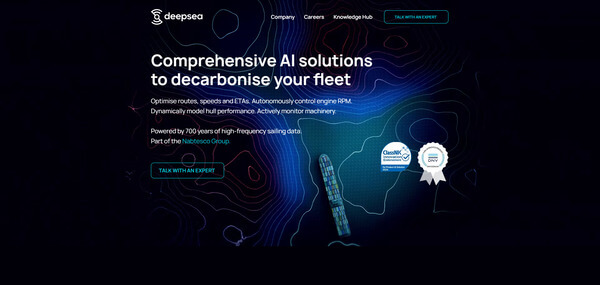
DeepSea
* Image source: DeepSea Official
Website
(https://www.deepsea.ai/)
(https://www.deepsea.ai/)
Core Capabilities
AI Fuel, CII &
Route Optimization
Route Optimization
- With the CII tracking feature, AI helps maintain and predict vessel performance.
- AI dynamically evaluates speeds and routes to suggest more fuel-efficient alternatives
- While complying with Europe-specific restrictions and regulations, it supports operations aimed at lower fuel consumption.
For Fleets with a Mix
of Older and Newly
Built Vessels
For Independent Ship
Management Companies
of Older and Newly
Built Vessels
For Independent Ship
Management Companies
Smart Ship Hub

* Image source: Smart Ship Hub Official
Website
(https://smartshiphub.com/)
(https://smartshiphub.com/)
Core Capabilities
Data integration across a mixed fleet
- Supports aggregation of vessel data across different manufacturers and standards, as well as data from multiple vessels.
- Visualizes information distributed across onboard systems and supports building an environment for centralized management.
- Supports information sharing between shore teams and fleets with older vessels, older equipment, newly built vessels and new equipment.