
Vessel Tide | A Guide to Essential Maritime Data Analytics Systems » Marine Fleet Management Software and Related Software Comparison » e-GICS Advance Alternatives Compared
e-GICS Advance Alternatives Compared
Start with the engines, not the software demos. Most direct alternatives to e-GICS Advance are tied to a specific OEM, so a long feature list matters little if the system does not support the engines already installed on your vessels.
Another source of confusion is how e-GICS Advance is categorized. It is sometimes grouped with ship management software, but its scope is much more specific: remote monitoring and condition diagnosis for electronically controlled ME-type main engines. Any meaningful comparison should stay focused on that role.
Key Takeaways
- Check the engine builder, model, control system, and sensor setup before comparing vendors.
- OEM-backed services provide manufacturer-specific diagnostics but typically support a limited range of engines.
- OEM-agnostic platforms may be a better fit for mixed fleets or operators that need to monitor equipment beyond the main engine.
- Ask each vendor to document its combustion-analysis capabilities, retrofit requirements, cybersecurity provisions, and U.S. support.
What e-GICS Advance Does and What Counts as an Alternative
e-GICS Advance collects data from the vessel's VDR, data logger, and main engine through an onboard computer. The data is then transmitted periodically to a shore-based database for analysis.
Mitsui E&S describes three main diagnostic functions:
- AI-based anomaly detection using sensor, weather, and sea-condition data
- Main-engine performance diagnosis
- Combustion diagnosis based on in-cylinder pressure waveforms from PMI Auto-tuning
The service also displays operating data and trends, including cylinder pressure and cylinder lubrication settings. Some inputs, including fuel properties and barometric pressure, still require manual entry.
These capabilities set a relatively high bar for a direct replacement. A planned maintenance system may manage work orders and equipment records without analyzing engine behavior. Similarly, a vessel data platform may collect and display sensor data without diagnosing performance or combustion issues.
For this comparison, a direct alternative must do at least one of the following well: detect abnormal engine behavior, assess engine performance, support condition-based maintenance, or give crews access to specialist diagnostic support.
How We Evaluated e-GICS Advance Alternatives
Engine compatibility received the greatest weight in this comparison. We then considered how each product collects and analyzes data, the type of diagnosis it provides, and whether it can support vessels already in service.
The main comparison criteria were:
- Supported engine makes and models
- Coverage of two-stroke, four-stroke, conventional, and electronically controlled engines
- Automatic data collection and ship-to-shore transmission
- AI, rule-based, or digital-twin analysis
- Performance and combustion diagnosis
- Onboard tools, shore-based access, and specialist support
- Retrofit requirements
- Cybersecurity, class approval, and data control
- Installation and service support in the United States
Public pricing is too limited to support a meaningful cost comparison. Vendors also report performance in different ways, so published results should not be treated as directly comparable benchmarks.
e-GICS Advance Alternatives at a Glance
| Alternative | Best fit | Engine scope | How it analyzes data | What to verify |
|---|---|---|---|---|
| Everllence PrimeServ Assist | Fleets with supported Everllence equipment | Primarily Everllence machinery | Connected monitoring, analytics, and remote OEM support | Exact engine eligibility and combustion-analysis coverage |
| MaSSA-One | Fleets seeking shared shipboard data and selectable CBM applications | Engines, cargo-handling equipment, navigation systems, and other connected sources | Standardized onboard data collection with onboard and shore-based applications | Available engine diagnostics, equipment interfaces, installation requirements, and U.S. support |
| Wärtsilä Expert Insight | Fleets already using Wärtsilä service agreements | Wärtsilä two-stroke and four-stroke engines | AI, diagnostic rules, and expert review | Covered equipment and service-agreement terms |
| ioCurrents MarineInsight | Mixed-OEM and U.S.-based fleets | Digitally connected equipment from multiple manufacturers | Machine learning and predictive alerts | Available interfaces and depth of engine diagnosis |
| WinGD WiDE | Fleets with supported WinGD engines | Supported WinGD engines, including retrofit applications for electronically controlled engines already in service | Digital-twin analysis comparing live operating data with engine-specific baseline data | Engine eligibility, retrofit hardware, connection requirements, subscription features, and U.S. support |
1. Everllence PrimeServ Assist: For Everllence-Powered Fleets
Reference: Everllence
https://www.youtube.com/watch?v=MYnvwUmP2XU
https://www.youtube.com/watch?v=MYnvwUmP2XU
For fleets operating supported Everllence equipment, PrimeServ Assist is a logical place to start. It uses the CEON platform to connect machinery with remote monitoring and technical support.
CEON manages operating data, dashboards, and real-time analysis, while PrimeServ Assist adds active monitoring by Everllence specialists. The company states that its remote operation centers provide 24-hour support and that its engineers contact customers when they identify an issue.
The key question is compatibility. A Mitsui-built licensed engine should not be assumed to qualify simply because it belongs to the same broader engine family. Provide Everllence with the engine builder, model, control-system version, and current data configuration. Buyers should also confirm whether the proposed service includes cylinder-pressure analysis and fuel-combustibility diagnosis comparable to the functions documented for e-GICS Advance.
Source: Everllence CEON Official Website (https://www.everllence.com/marine/solutions/digital-marine-products/ceon)
2. MaSSA-One: For Open Ship Data and CBM Applications
Reference: Japan Ship Machinery and Equipment Association
https://www.youtube.com/watch?v=m0iRFGepw-E
https://www.youtube.com/watch?v=m0iRFGepw-E
MaSSA-One collects engine, cargo-handling, navigation, and other vessel data through an onboard IoT Data Server. The server complies with ISO 19847 and ISO 19848 and can process data from CSV, Modbus, and IEC 61162-1/61162-2 sources. Users can view the data onboard or share it with shore-based offices.
The platform supports applications for equipment monitoring, troubleshooting, maintenance, and voyage operations. Published examples include MaSSA Insight WADATSUMI, which provides equipment monitoring and configurable alarms, as well as an application that analyzes generator faults and suggests possible causes and recovery steps following a blackout.
MaSSA-One covers a broader range of vessel data than e-GICS Advance, but its official website does not document equivalent main-engine performance or combustion-analysis capabilities. It is therefore more relevant to fleets looking for a shared shipboard data environment and condition-based maintenance applications across multiple systems.
Source: BEMAC Official Website (https://www.massa-one.com/)
3. Wärtsilä Expert Insight: For OEM-Backed Predictive Maintenance
Reference: Wärtsilä Corporation
https://www.youtube.com/watch?v=gBquJ95NVq0
https://www.youtube.com/watch?v=gBquJ95NVq0
Wärtsilä Expert Insight combines real-time operating data with AI, diagnostic rules, and review by Wärtsilä specialists. Instead of relying only on fixed alarm limits, the system compares engine behavior against the vessel's own operating profile.
When the software flags an anomaly, a Wärtsilä specialist reviews the case and recommends an action through an online application. Crew members and shore teams can track the case, communicate with the specialist, and review the relevant operating trends.
Expert Insight is available through service agreements for Wärtsilä two-stroke and four-stroke engines, making it particularly relevant to fleets already operating Wärtsilä machinery. Buyers should evaluate the service agreement alongside the software itself, including which engines and services are covered, the required data connection, and whether cylinder-pressure or combustion analysis is included.
Source: Wärtsilä Official Website (https://www.wartsila.com/insights/article/whats-the-number-one-thing-you-could-do-for-smarter-ship-maintenance)
4. ioCurrents MarineInsight: For Mixed-OEM and U.S.-Based Fleets
Reference: MarineInsight
https://www.youtube.com/watch?v=cROewA6Ch8o
https://www.youtube.com/watch?v=cROewA6Ch8o
MarineInsight differs from the OEM-backed services in this group. ioCurrents is a Seattle-based third-party provider, and its software is not tied to a single engine manufacturer.
The platform uses an onboard DataHub to collect and analyze data from equipment with digital interfaces, including engines, generators, transmissions, tanks, winches, and PLCs. Shore-based users can access the information through a cloud platform.
MarineInsight generates threshold, time-based, and predictive alerts. Its machine-learning models establish normal operating behavior for a vessel and flag unusual patterns that may indicate a developing failure.
This broader equipment coverage can be useful for mixed fleets, particularly when operators want a single view across multiple onboard systems. The tradeoff is diagnostic depth: general anomaly detection is not equivalent to OEM-specific thermodynamic diagnosis, cylinder-pressure analysis, or fuel-combustibility assessment.
Source: ioCurrents Official Website
https://iocurrents.com/fuel-optimization
https://iocurrents.com/fuel-optimization
5. WinGD WiDE: For Digital-Twin-Based Main Engine Monitoring
Reference: WinGD YouTube Channel
https://www.youtube.com/watch?v=SKNLp15HFG4
https://www.youtube.com/watch?v=SKNLp15HFG4
WinGD WiDE is built around a digital twin of the individual main engine. The model draws on engine configuration, tuning data, factory acceptance testing, and sea-trial results. WiDE compares the model with live operating data to identify deviations and signs of developing faults.
Crew members and shore teams can review the results, while WinGD specialists can use the same data to provide remote support. WinGD states that the service is available by subscription for new engines and can be retrofitted to electronically controlled engines already in operation. WiDE is therefore most relevant when the vessel is equipped with a supported WinGD engine.
It should not be treated as a software-only substitute for an ME-type engine from another manufacturer. For an existing vessel, ask WinGD to specify the required hardware and connection work, subscription features, applicable class or cybersecurity requirements, and the scope of its retrofit offering.
Source: WinGD Official Website (https://wingd.com/products-solutions/digital-optimisation/wide/)
POINT
Finding the Right
Solution for
Your Fleet
Solution for
Your Fleet
The right option depends first on the engines and equipment already installed across your fleet. OEM-backed services are most relevant when their supported machinery matches your vessels and you need manufacturer-specific diagnostic expertise. Broader platforms may be a better fit when you need visibility across multiple engine brands or onboard systems. Explore our recommendations below to compare vessel management solutions based on different operating needs.
Other Options When Your Requirements Are Broader
Some products overlap with parts of the e-GICS Advance use case without replacing the full service.
MITSUI E&S CMAXS LC-A
CMAXS LC-A covers a broader range of machinery monitoring and maintenance functions. Mitsui E&S lists automatic anomaly diagnosis, condition diagnosis, troubleshooting instructions, maintenance information, and monitoring of both main and auxiliary machinery.
Because it comes from the same group, CMAXS LC-A is better evaluated in a discussion with Mitsui E&S than in a conventional competitor ranking. Ask how it relates to e-GICS Advance on the specific vessel and whether the two systems can be integrated, combined, or used as part of a migration plan.
ABB Marine RDS and Cylmate
ABB Ability Marine Remote Diagnostic System collects and analyzes data from electrical and mechanical systems for condition monitoring and remote support.
Cylmate is a separate ABB product for large two-stroke engines. It uses cylinder-pressure and crank-angle measurements to monitor engine performance. Together, the two products address several parts of the e-GICS Advance use case, particularly on vessels using ABB power, automation, or propulsion equipment. Buyers should ask ABB to define how the two products would work together on a specific vessel.
Caterpillar Marine Engine Monitoring
Caterpillar's marine monitoring services cover engine health, remote diagnostics, inspections, maintenance tasks, and fleet performance for Cat equipment.
For a U.S. commercial vessel with Cat engines, these services may be more relevant than a system designed around large, low-speed ME-type main engines. Caterpillar's published materials do not document the same AI-based anomaly detection, cylinder-pressure analysis, or combustion diagnosis described for e-GICS Advance, so the two should not be treated as technically equivalent.
Kongsberg Vessel Insight
Kongsberg Vessel Insight collects and standardizes data from onboard sensors and systems, then makes that data available to fleet applications through a secure vessel-to-cloud connection.
Its primary role is data infrastructure. Vessel Insight can support fleet dashboards and third-party applications, but on its own it does not provide the engine-specific performance and combustion diagnosis documented for e-GICS Advance. It is more relevant as a shared data layer used alongside a diagnostic service.
How to Choose the Right Alternative for Your Fleet
Start by building an engine inventory. For each vessel, record the engine manufacturer, builder, model, control-system version, fuel type, sensors, data logger, VDR connections, and current shore connection.
Next, define what you actually need to replace. If the priority is manufacturer-specific fault diagnosis and direct access to engine specialists, start with the OEM. If you need one platform to cover multiple engine brands or other onboard equipment, consider the engine-agnostic options.
Evaluate combustion analysis separately. A vendor may offer predictive maintenance or anomaly detection without analyzing cylinder-pressure waveforms or fuel combustibility. Put those requirements in writing before comparing proposals.
Retrofit requirements can also change the economics of a project. Existing vessels may need a data-acquisition computer, additional sensors, network changes, or a cybersecurity review. Define that scope before comparing subscription fees.
Mixed fleets may ultimately use two layers: an OEM service for detailed main-engine diagnosis and a broader platform for fleet-wide data access. That is not necessarily redundant because the two systems serve different purposes.
Frequently Asked Questions
About e-GICS Advance Alternatives
Is e-GICS Advance a full ship management system?
No. Mitsui E&S describes e-GICS Advance as a remote monitoring and condition-diagnostics service for electronically controlled ME-type engines. It does not cover the full range of crewing, procurement, document control, inventory, and planned maintenance functions typically associated with ship management software.
Can e-GICS Advance alternatives work with any engine?
Usually not. Everllence PrimeServ Assist and Wärtsilä Expert Insight are closely tied to their respective manufacturers. MaSSA-One takes a broader data-platform approach, but compatibility still depends on the vessel's equipment, available interfaces, and selected applications.
Are engine-agnostic platforms equivalent to OEM diagnostics?
No. They address different requirements. An engine-agnostic platform can bring multiple equipment types and engine brands into a common monitoring environment. An OEM service may draw on manufacturer-specific models, design data, service information, and technical specialists. Compare the actual diagnostic output, not just the dashboard.
Can these systems be retrofitted to existing vessels?
Some can. Retrofit work may involve an onboard computer, additional sensors, access to the engine control system, network changes, and satellite or cellular connectivity. A vessel-specific survey is needed to determine the actual scope.
What sensors, hardware, and connectivity will be required?
Give each vendor a current list of sensors, control systems, data loggers, VDR connections, network equipment, and shore communications. The vendor should identify which data requires continuous collection, which inputs remain manual, and how the system behaves when connectivity is interrupted.
How should operators evaluate cybersecurity and data ownership?
Confirm where data is stored, who owns it, how long it is retained, and whether it can be exported when the contract ends. Cybersecurity reviews should cover encryption, user access, onboard network separation, software updates, incident response, and any applicable class requirements.
Do these systems integrate with existing PMS or fleet platforms?
A dashboard or API alone does not guarantee a working integration. Confirm whether alerts and maintenance recommendations can create tasks or exchange data with the existing planned maintenance system. The proposal should identify the interface, data format, implementation owner, and ongoing support responsibilities.
Is pricing publicly available?
Not in a form that supports a fair comparison. Hardware, installation, connectivity, subscriptions, expert services, and lifecycle agreements may be priced separately. Compare the total cost over a defined period rather than subscription fees alone.
POINT
Summary
Your engine inventory will narrow the field faster than a feature list. OEM-backed services are most relevant when the installed machinery falls within their supported range and the operator needs direct manufacturer expertise. Engine-agnostic platforms are better suited to bringing mixed equipment into a common monitoring environment, but they may not provide the same depth of combustion or performance diagnosis as an OEM-specific service.
[Advertisement]
3 Recommended
Marine Fleet Management Software
3 Recommended
Marine Fleet Management Software
Advertiser Disclosure:
We receive compensation from some of the companies listed below.This compensation may affect which companies are included and the order in which they appear.
For Frequent Hazardous
or Long-Distance
Voyages
For Marine Fleet
Management Companies
or Long-Distance
Voyages
For Marine Fleet
Management Companies
MaSSA-One

* Image source: BEMAC Official
Website
(https://www.massa-one.com/english/)
(https://www.massa-one.com/english/)
Core Capabilities
Condition monitoring and anomaly detection
- Enables early detection of anomalies using data-driven automatic thresholds and expert-defined multi-condition detection.
- In the event of a failure, real-time data helps speed up root-cause identification, reducing downtime.
- This supports the prevention of future accidents and issues, contributing to reduced damage and losses involving vessels and cargo.
For Companies with
Frequent Business
in the EU
For Marine Shipping
Companies
Frequent Business
in the EU
For Marine Shipping
Companies
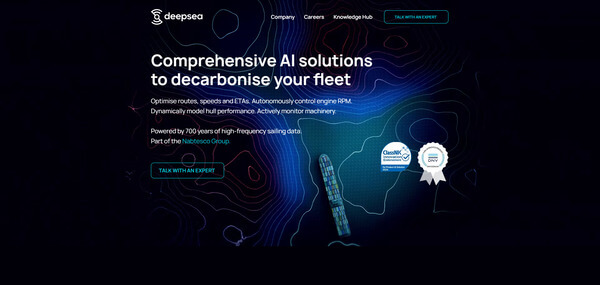
DeepSea
* Image source: DeepSea Official
Website
(https://www.deepsea.ai/)
(https://www.deepsea.ai/)
Core Capabilities
AI Fuel, CII &
Route Optimization
Route Optimization
- With the CII tracking feature, AI helps maintain and predict vessel performance.
- AI dynamically evaluates speeds and routes to suggest more fuel-efficient alternatives
- While complying with Europe-specific restrictions and regulations, it supports operations aimed at lower fuel consumption.
For Fleets with a Mix
of Older and Newly
Built Vessels
For Independent Ship
Management Companies
of Older and Newly
Built Vessels
For Independent Ship
Management Companies
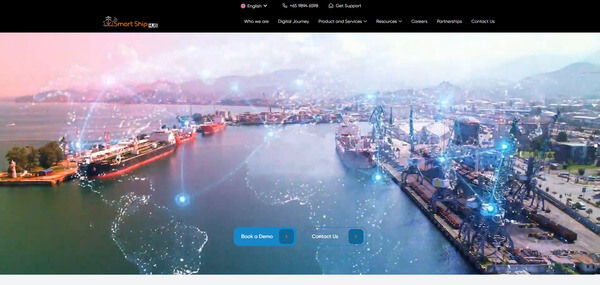
Smart Ship Hub
* Image source: Smart Ship Hub Official
Website
(https://smartshiphub.com/)
(https://smartshiphub.com/)
Core Capabilities
Data integration across a mixed fleet
- Supports aggregation of vessel data across different manufacturers and standards, as well as data from multiple vessels.
- Visualizes information distributed across onboard systems and supports building an environment for centralized management.
- Supports information sharing between shore teams and fleets with older vessels, older equipment, newly built vessels and new equipment.