
Vessel Tide | A Guide to Essential Maritime Data Analytics Systems » Ship Management System Fundamentals » How Much Does a Ship Management System Cost? A Budgeting Framework
How Much Does a Ship Management System Cost? A Budgeting Framework
The system your team wants is already agreed on — what's stalling the project is that nobody can put a defensible number in front of finance. Ship management software vendors rarely publish pricing, and the figures that do circulate vary so widely by fleet size, deployment model, and feature scope that quoting a single number to your approval committee invites the wrong question back: where did that number come from? Getting the budget approved starts with understanding how these systems are actually priced — not a specific dollar figure, but the cost structure underneath it — so you can build a range you can defend line by line.
Key Takeaways
- Vendors price ship management software by deployment model, fleet size, and module scope — not a single flat rate, so ask for a quote structure, not just a total number.
- The subscription or license fee is rarely the full cost — implementation, training, and hardware installation can add substantially to year-one spend.
- Comparing quotes only works if you compare the same scope: confirm what's included, what's billed separately, and what happens after the first renewal.
- Build your budget case around total cost of ownership and expected operational payback, not the license fee alone — that's what internal approval committees actually want to see.
What This Page Covers
This page walks through what actually drives ship management system pricing, since published rate cards are rare in this category and the range from a basic monitoring tool to a full enterprise platform is wide enough that a single figure isn't useful on its own. You'll get an overview of the common pricing models fleets encounter, what's typically bundled into a quote versus billed separately, how to compare quotes from different vendors on equal terms, and what to include when building the internal case for budget approval.
Types of Ship Management System Pricing Models
Per-Vessel or Flat-Rate Subscription Tools
Simpler, single-purpose tools — often covering one function like fuel monitoring or safety reporting — are typically priced as a flat monthly subscription per vessel, sometimes with a minimum vessel count. This tier suits fleets that need one specific capability rather than a full platform, and pricing is usually published or quoted quickly since the product itself doesn't vary much between customers.
Modular, Quote-Based Platforms for Growing Fleets
Broader platforms that bundle maintenance, performance monitoring, and reporting into one system usually move to quote-based pricing once a fleet passes a handful of vessels. The price depends on which modules you activate, how many users need access, and how much historical data or custom integration the rollout requires. Expect a proposal rather than a published rate card at this tier, and expect the number to shift based on negotiation and contract length.
Enterprise and Custom-Integrated Solutions
Large fleets or systems that function more like a shipping-specific ERP than a single monitoring tool are typically priced through a custom annual contract negotiated directly with the vendor's enterprise sales team. Pricing at this tier reflects not just the software but integration work, dedicated support, and often a multi-year commitment — which is also why two enterprise fleets can pay very different amounts for what looks like the same platform on paper.
What's Typically Included in the Price — and What Isn't
License or Subscription Fee
This is the number most quotes lead with, and it's the easiest one to compare on the surface — but confirm exactly what it covers. Some vendors price per vessel, others per user, and some bundle a fixed number of both before additional fees kick in.
Implementation and Installation
Getting the system running usually costs more than the software itself in the first year, especially if onboard hardware or sensors need installing. Ask whether the vendor's own technicians handle onboard setup or whether that work — and its cost — falls to the vessel's crew or a third-party contractor, since that determines whether installation is a line item on your quote or an unbudgeted surprise later.
Training and Ongoing Support
Confirm whether onboarding training is included in the initial fee or billed as a separate service, and check what tier of support comes standard versus what requires a premium support contract. A quote that looks cheaper on the license line can end up more expensive once mandatory training sessions or paid support escalation are added.
Costs That Don't Show Up on the Quote
The costs hardest to budget for are the ones no line item captures: the internal staff time spent on rollout and data migration, the productivity dip while crews learn a new system, and any customization needed to fit the vendor's data model to your existing reporting formats. None of these appear on the initial quote, but all of them show up in your actual first-year spend.
How to Compare Costs Correctly
Cloud vs. On-Premise Cost Structures
Cloud-based pricing is usually structured as an ongoing operating expense — a subscription that scales with usage but requires little upfront hardware spend. On-premise pricing front-loads cost into a larger initial license and hardware purchase, then adds a smaller ongoing maintenance fee your own IT team may need to support. Comparing a cloud quote to an on-premise quote on the first-year number alone favors on-premise; comparing them over a three-to-five-year horizon usually tells a different story.
Economies of Scale by Fleet Size
Per-vessel pricing rarely stays flat as a fleet grows — most vendors offer volume pricing once you cross certain vessel-count thresholds, so a quote based on your current fleet size may look different once you factor in planned expansion. Ask vendors directly how their pricing changes at larger vessel counts, rather than assuming your current quote scales linearly.
Compare Total Cost of Ownership, Not the Sticker Price
The vendor with the lowest headline subscription fee isn't necessarily the cheapest option once implementation, training, and multi-year support are added in. Build a like-for-like comparison across at least a three-year window before deciding, since a system with a higher year-one cost but lower ongoing fees can end up cheaper than one that looked less expensive up front.
Building the Budget Case for Internal Approval
Request Itemized Quotes From Multiple Vendors
Ask every vendor for the same breakdown — license, implementation, training, and support — rather than a single bundled total, so you can compare like-for-like rather than guessing what's included in a lower-looking number. A vendor unwilling to itemize a quote is itself a data point worth noting before you commit.
Pair the Cost Case With Expected Operational Payback
A budget request lands better when it's paired with the operational return the system is expected to deliver — reduced unplanned downtime, faster incident diagnosis, or fewer manual reporting hours — rather than presented as a cost in isolation.
Editorial Summary
Ship management system pricing rarely comes down to a single quoted number because it depends on deployment model, fleet size, and how much of the implementation work the vendor's own team takes on versus leaving to you. Rather than asking a vendor for "the cost," ask for the itemized structure — license, implementation, training, and support — and build your own total cost of ownership estimate across a multi-year horizon before taking a number to your approval committee. The strongest budget case pairs that itemized cost with the operational payback the system is expected to deliver, since that combination is what turns a vague price tag into a number finance can actually approve.
[Advertisement]
3 Recommended
Marine Fleet Management Software
3 Recommended
Marine Fleet Management Software
Advertiser Disclosure:
We receive compensation from some of the companies listed below.This compensation may affect which companies are included and the order in which they appear.
For Frequent Hazardous
or Long-Distance
Voyages
For Marine Fleet
Management Companies
or Long-Distance
Voyages
For Marine Fleet
Management Companies
MaSSA-One

* Image source: BEMAC Official
Website
(https://www.massa-one.com/english/)
(https://www.massa-one.com/english/)
Core Capabilities
Condition monitoring and anomaly detection
- Enables early detection of anomalies using data-driven automatic thresholds and expert-defined multi-condition detection.
- In the event of a failure, real-time data helps speed up root-cause identification, reducing downtime.
- This supports the prevention of future accidents and issues, contributing to reduced damage and losses involving vessels and cargo.
For Companies with
Frequent Business
in the EU
For Marine Shipping
Companies
Frequent Business
in the EU
For Marine Shipping
Companies
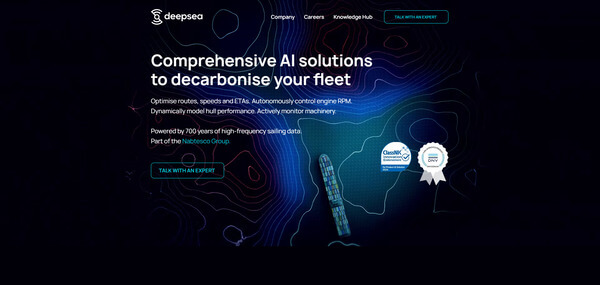
DeepSea
* Image source: DeepSea Official
Website
(https://www.deepsea.ai/)
(https://www.deepsea.ai/)
Core Capabilities
AI Fuel, CII &
Route Optimization
Route Optimization
- With the CII tracking feature, AI helps maintain and predict vessel performance.
- AI dynamically evaluates speeds and routes to suggest more fuel-efficient alternatives
- While complying with Europe-specific restrictions and regulations, it supports operations aimed at lower fuel consumption.
For Fleets with a Mix
of Older and Newly
Built Vessels
For Independent Ship
Management Companies
of Older and Newly
Built Vessels
For Independent Ship
Management Companies
Smart Ship Hub
* Image source: Smart Ship Hub Official
Website
(https://smartshiphub.com/)
(https://smartshiphub.com/)
Core Capabilities
Data integration across a mixed fleet
- Supports aggregation of vessel data across different manufacturers and standards, as well as data from multiple vessels.
- Visualizes information distributed across onboard systems and supports building an environment for centralized management.
- Supports information sharing between shore teams and fleets with older vessels, older equipment, newly built vessels and new equipment.