
Vessel Tide | A Guide to Essential Maritime Data Analytics Systems » Marine Fleet Management Software and Related Software Comparison » Marine Fleet Management Software vs Predictive Maintenance Software: Key Differences Explained
Marine Fleet Management Software vs Predictive Maintenance Software: Key Differences Explained
Marine fleet management software and predictive maintenance software both aim to keep a ship's machinery running without unplanned failures, which is why the two are sometimes presented as if they solve the same problem. They don't. Marine fleet management software runs the vessel's operations end to end — scheduling maintenance jobs, tracking crew and compliance, logging voyages — largely on a time-based or threshold-based maintenance calendar. Predictive maintenance software does one narrower thing: it analyzes sensor data over time to catch a specific piece of machinery degrading before it fails, often earlier than a simple threshold alarm would catch it.
The distinction matters because predictive maintenance is usually an input into a fleet management platform's maintenance schedule, not a system that replaces it.
Key Takeaways
- Predictive maintenance software analyzes sensor data trends to forecast a developing failure before it happens — a step beyond condition-based maintenance (CBM), which triggers maintenance based on the current condition of the equipment.
- Most fleet management platforms schedule maintenance using time-based maintenance (TBM) or condition-based maintenance (CBM), while genuine trend-based failure prediction is usually a separate, specialized layer.
- Predictive maintenance software is typically a data source feeding into a fleet management platform's PMS module, not a standalone replacement for maintenance scheduling, crew, compliance, and voyage management.
- Not every product marketed as "predictive maintenance" in the marine sector is trend-based failure forecasting — some are threshold-based anomaly detection rebranded as predictive. Ask the vendor whether the system predicts a failure trend or simply flags a reading that's already out of range.
What is Marine Fleet Management Software?
Marine fleet management software runs a shipping company's day-to-day vessel operations from a single system: it schedules planned maintenance jobs across every ship, manages crew rotations and certifications, handles compliance reporting under the ISM Code, SOLAS, and flag-state requirements, and tracks voyage and port call data instead of leaving it scattered across separate tools.
The maintenance module inside this software — the PMS — typically runs on time-based intervals (running hours, calendar dates) or fixed condition thresholds, flagging a job when a schedule comes due or a sensor reading crosses a set limit. That's usually as far as the built-in maintenance logic goes unless a specialized predictive layer is added on top.
What is Predictive Maintenance Software?
Predictive maintenance software analyzes sensor data — vibration, temperature, oil condition, acoustic signatures, running hours — over time to detect a developing failure trend before it crosses a critical threshold. Rather than waiting for a reading to breach a fixed limit the way condition-based maintenance (CBM) does, it uses statistical models or machine learning to recognize the pattern of degradation itself, giving maintenance teams more lead time to plan a repair around the vessel's schedule instead of reacting to an alarm.
This is a meaningful step beyond both time-based maintenance (fixed intervals regardless of actual condition) and CBM (a threshold alert once a value is already out of range): predictive maintenance is trend-based, aiming to catch the problem while it's still developing. Some classification societies recognize condition-based and predictive maintenance schemes for critical machinery, which may support adjustments to inspection scope or frequency where the equipment and operating history qualify.
Not every marine product labeled "predictive maintenance" delivers genuine trend-based forecasting — some are rule-based anomaly detection systems that flag a deviation from a normal range rather than modeling a failure trajectory. Both have value, but they're not the same capability, and it's worth asking a vendor directly which one their system provides.
Key Differences
A fleet management platform's PMS module can flag that a generator is due for its scheduled service or that a sensor reading has crossed a set limit, but it generally won't tell you that the same generator's vibration signature has been trending toward failure for the past three weeks — that's the specific gap predictive maintenance software is built to close.
| Dimension | Marine Fleet Management Software | Predictive Maintenance Software |
|---|---|---|
| Primary scope | Full vessel operation: maintenance scheduling, crew, compliance, voyage | Failure forecasting for specific machinery based on sensor trend analysis |
| Maintenance logic | Time-based intervals or fixed condition thresholds | Trend-based analysis using statistical models or machine learning |
| Typical output | Work orders, compliance filings, fleet-wide dashboards | Failure risk scores, degradation trends, early-warning alerts for specific components |
| Deployment | Centralized platform covering the whole operation | Usually a specialized layer feeding data into the PMS module |
| Typical user | Fleet managers, technical superintendents, crewing teams | Reliability engineers, technical superintendents monitoring critical machinery |
Overlapping Features
Both draw on the same onboard sensor infrastructure and share the same end goal: fewer unplanned breakdowns and less reactive repair work. Fleet management software's PMS module and a predictive maintenance system both consume running-hour and condition data, both feed work orders when a maintenance action is needed, and both contribute to the maintenance history a class surveyor reviews during inspection. The difference is what triggers that work order — a calendar date or fixed threshold on one side, a modeled failure trend on the other.
Which One Do You Need?
Choose marine fleet management software as your foundation regardless of your maintenance strategy — you need somewhere to schedule jobs, track crew certifications, file compliance reports, and manage voyages, whether your maintenance approach is time-based, condition-based, or predictive.
Add dedicated predictive maintenance software when a specific piece of critical machinery — main engines, generators, key auxiliary systems — has a history of costly unplanned failures, and catching a developing problem weeks earlier would meaningfully change your repair planning and downtime costs.
Before buying, confirm whether the vendor's "predictive maintenance" claim is backed by trend-based modeling or is really a threshold alarm with newer branding, and check whether the output can feed directly into your fleet management platform's PMS module rather than living in a separate, disconnected dashboard.
Most fleets that adopt predictive maintenance run it as a feed into their existing fleet management software rather than as a replacement — the predictive layer earns its value by triggering earlier, better-informed maintenance decisions inside the system that already manages everything else.
Conclusion
Marine fleet management software and predictive maintenance software aren't competing for the same job. One runs the vessel's full operation — maintenance scheduling, crew, compliance, voyage. The other exists to catch a specific machinery failure trend before it becomes a breakdown, feeding that insight into the maintenance schedule rather than replacing it. Before adding a predictive maintenance layer, confirm it delivers genuine trend-based forecasting rather than rebranded threshold alerts, and that it connects to the PMS module your team already relies on.
[Advertisement]
3 Recommended
Marine Fleet Management Software
3 Recommended
Marine Fleet Management Software
Advertiser Disclosure:
We receive compensation from some of the companies listed below.This compensation may affect which companies are included and the order in which they appear.
For Frequent Hazardous
or Long-Distance
Voyages
For Marine Fleet
Management Companies
or Long-Distance
Voyages
For Marine Fleet
Management Companies
MaSSA-One

* Image source: BEMAC Official
Website
(https://www.massa-one.com/english/)
(https://www.massa-one.com/english/)
Core Capabilities
Condition monitoring and anomaly detection
- Enables early detection of anomalies using data-driven automatic thresholds and expert-defined multi-condition detection.
- In the event of a failure, real-time data helps speed up root-cause identification, reducing downtime.
- This supports the prevention of future accidents and issues, contributing to reduced damage and losses involving vessels and cargo.
For Companies with
Frequent Business
in the EU
For Marine Shipping
Companies
Frequent Business
in the EU
For Marine Shipping
Companies
DeepSea
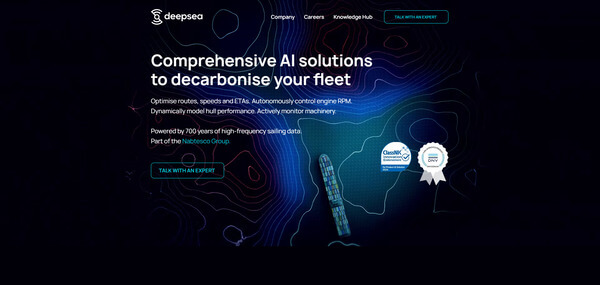
* Image source: DeepSea Official
Website
(https://www.deepsea.ai/)
(https://www.deepsea.ai/)
Core Capabilities
AI Fuel, CII &
Route Optimization
Route Optimization
- With the CII tracking feature, AI helps maintain and predict vessel performance.
- AI dynamically evaluates speeds and routes to suggest more fuel-efficient alternatives
- While complying with Europe-specific restrictions and regulations, it supports operations aimed at lower fuel consumption.
For Fleets with a Mix
of Older and Newly
Built Vessels
For Independent Ship
Management Companies
of Older and Newly
Built Vessels
For Independent Ship
Management Companies
Smart Ship Hub
* Image source: Smart Ship Hub Official
Website
(https://smartshiphub.com/)
(https://smartshiphub.com/)
Core Capabilities
Data integration across a mixed fleet
- Supports aggregation of vessel data across different manufacturers and standards, as well as data from multiple vessels.
- Visualizes information distributed across onboard systems and supports building an environment for centralized management.
- Supports information sharing between shore teams and fleets with older vessels, older equipment, newly built vessels and new equipment.