
Vessel Tide | A Guide to Essential Maritime Data Analytics Systems » Marine Fleet Management Software and Related Software Comparison » Marine Fleet Management Software vs TMS: Key Differences Explained
Marine Fleet Management Software vs TMS: Key Differences Explained
Marine fleet management software and a Technical Management System (TMS) both show up in the same conversation because a fleet platform's technical module is often, functionally, a TMS. The confusion is reasonable — vendors build them to interlock. The real distinction is departmental: a TMS covers the technical superintendent's job — planned and unplanned maintenance, defect reporting, dry-docking, and technical compliance for the vessel's machinery. Marine fleet management software covers that same technical scope plus the departments a TMS was never built to run: crew, procurement, commercial voyage operations, and fleet-wide reporting.
Before comparing the two as competing purchases, it's worth checking whether you're actually solving a technical-department problem or a whole-company one.
Key Takeaways
- A TMS covers the technical superintendent's scope: planned and unplanned maintenance, defect reporting, dry-docking, technical asset records, and class/flag technical compliance. Marine fleet management software covers that scope plus crew, procurement, commercial voyage operations, and fleet-wide reporting.
- Software vendors typically build a TMS as one module inside a larger fleet management suite — not as a standalone rival product.
- Planned maintenance (PMS), the core of a TMS, is mandatory under the ISM Code; the rest of a TMS's functionality (defect reporting, dry-docking, technical records) exists to support that same technical compliance obligation.
- If only the technical department needs a unified system, a standalone TMS may be enough; once crew, procurement, or commercial operations also need to sit in the same system, that's the job marine fleet management software is built for.
What is Marine Fleet Management Software?
Marine fleet management software runs a shipping company's day-to-day vessel operations from a single system, spanning more departments than the technical side alone. It typically brings together planned maintenance and technical asset management, crew rotations and certification tracking, procurement and spares coordination tied to maintenance and dry-docking schedules, compliance and safety management (QHSE) in accordance with the ISM Code and SOLAS, and fleet-wide KPI dashboards covering cost, uptime, and crewing metrics across every vessel.
Because these modules share one database, a technical superintendent's maintenance delay is visible to the crewing team scheduling the next rotation, and to the compliance team tracking survey deadlines — a connection a technical-only system can't provide.
What is TMS (Technical Management System)?
A Technical Management System (TMS) centralizes the work of the technical superintendent's office: planning and documenting planned and unplanned maintenance, logging defect reports as they come in from the vessel, managing dry-docking and repair projects, maintaining lifecycle records for every piece of onboard equipment, and tracking Inventory of Hazardous Material (IHM) documentation required under the Hong Kong Convention and EU Ship Recycling Regulation.
At the core of a TMS is the planned maintenance system (PMS), which the ISM Code requires shipping companies to maintain for their vessels and equipment. Everything else in a TMS — defect reporting, dry-docking, technical records — exists to support that same maintenance and technical compliance obligation, typically used day to day by onboard engineers and shore-based technical office staff rather than crewing, procurement, or commercial teams.
Vendors rarely sell a TMS as a standalone product to a multi-vessel operator; it's usually one module in a broader ship or fleet management suite, built to combine with crew, procurement, and compliance modules once an operator needs those departments unified too.
Key Differences
A TMS answers the technical superintendent's questions: is this equipment maintained, documented, and compliant. Marine fleet management software answers those same questions plus the ones crew, procurement, and commercial teams ask about the same vessel.
| Dimension | Marine Fleet Management Software | TMS (Technical Management System) |
|---|---|---|
| Primary scope | Technical, crew, procurement, commercial, and compliance operations | Technical department only: maintenance, defects, dry-docking, technical compliance |
| Core module | PMS as one module among several | PMS as the central function |
| Typical user | Fleet managers, technical superintendents, crewing teams, procurement staff | Technical superintendents, onboard engineers, technical office staff |
| Departments covered | Technical, crew, commercial, compliance, procurement | Technical only |
| Regulatory anchor | ISM Code, SOLAS, IMO reporting across departments | ISM Code planned maintenance requirement specifically |
| Deployment pattern | Central platform that integrates data from other departments | Often one module inside a larger ship management suite |
In practice, a TMS is rarely sold as competition to a fleet management platform — most vendors build the same technical module for both, then add crew, procurement, and commercial layers on top to form the full fleet management suite.
Overlapping Features
The overlap exists because a TMS's core logic is usually reused, not duplicated, inside marine fleet management software. Both typically include planned maintenance scheduling by running hours or calendar intervals, defect and unplanned maintenance reporting, technical asset registers with lifecycle and warranty records, dry-docking and repair project tracking, and class survey and technical compliance documentation. The difference isn't in how well either system handles this shared ground — it's in what sits alongside it. A TMS stops here; marine fleet management software adds crew, procurement, and commercial modules that draw on the same technical data.
Which One Do You Need?
Choose a standalone TMS if the technical department is the only one that needs a unified system — your crewing, procurement, and commercial operations already run adequately on separate tools or processes, and consolidating them isn't a current priority.
Choose marine fleet management software if crew rotations, procurement and spares, commercial voyage tracking, and fleet-wide compliance reporting all need to sit in the same system as maintenance — a standalone TMS won't extend into any of those departments.
If you're already running a TMS and considering an upgrade, ask the vendor whether your existing technical data (equipment registers, maintenance history, defect reports) can migrate directly into their fleet management platform's technical module, since most are built by the same vendors specifically to avoid a rebuild.
Before deciding, map out which departments currently work from separate systems and whether that separation is actually causing problems — like a maintenance delay the crewing team doesn't see, or a compliance deadline procurement isn't tracking — that are worth solving with one platform.
Conclusion
A TMS and marine fleet management software aren't really competing products — a TMS is usually the technical engine that fleet management software builds the rest of its platform around. The decision isn't which one does technical management better; it's how many departments beyond the technical office need to work from the same system. If it's just maintenance, defects, and dry-docking, a standalone TMS covers that scope. If crew, procurement, and commercial operations need to be unified too, marine fleet management software is built to bring all of it, including the TMS functionality, into one system.
3 Recommended
Marine Fleet Management Software
Marine Fleet Management Software
For Frequent Hazardous
or Long-Distance
Voyages
For Marine Fleet
Management Companies
or Long-Distance
Voyages
For Marine Fleet
Management Companies
MaSSA-One

* Image source: BEMAC Official
Website
(https://www.massa-one.com/english/)
(https://www.massa-one.com/english/)
Core Capabilities
Condition monitoring and anomaly detection
- Enables early detection of anomalies using data-driven automatic thresholds and expert-defined multi-condition detection.
- In the event of a failure, real-time data helps speed up root-cause identification, reducing downtime.
- This supports the prevention of future accidents and issues, contributing to reduced damage and losses involving vessels and cargo.
For Companies with
Frequent Business
in the EU
For Marine Shipping
Companies
Frequent Business
in the EU
For Marine Shipping
Companies
DeepSea
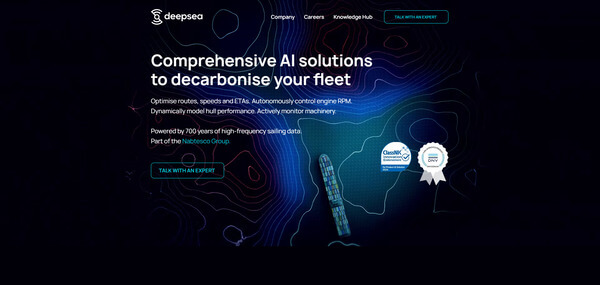
* Image source: DeepSea Official
Website
(https://www.deepsea.ai/)
(https://www.deepsea.ai/)
Core Capabilities
AI Fuel, CII &
Route Optimization
Route Optimization
- With the CII tracking feature, AI helps maintain and predict vessel performance.
- AI dynamically evaluates speeds and routes to suggest more fuel-efficient alternatives
- While complying with Europe-specific restrictions and regulations, it supports operations aimed at lower fuel consumption.
For Fleets with a Mix
of Older and Newly
Built Vessels
For Independent Ship
Management Companies
of Older and Newly
Built Vessels
For Independent Ship
Management Companies
Smart Ship Hub
* Image source: Smart Ship Hub Official
Website
(https://smartshiphub.com/)
(https://smartshiphub.com/)
Core Capabilities
Data integration across a mixed fleet
- Supports aggregation of vessel data across different manufacturers and standards, as well as data from multiple vessels.
- Visualizes information distributed across onboard systems and supports building an environment for centralized management.
- Supports information sharing between shore teams and fleets with older vessels, older equipment, newly built vessels and new equipment.