
Vessel Tide | A Guide to Essential Maritime Data Analytics Systems » Marine Fleet Management Software and Related Software Comparison » Marine Fleet Management Software vs EAM: Key Differences Explained
Marine Fleet Management Software vs EAM: Key Differences Explained
Marine fleet management software and enterprise asset management (EAM) systems often appear in the same RFPs for a simple reason: both claim to manage a shipping company's physical assets, and a vessel is a physical asset. The overlap stops there. Marine fleet management software is built around running a ship's operating life — maintenance, crew, compliance, and voyage tracking — for one industry with its own regulatory rulebook. EAM is built around the full lifecycle of any physical asset an enterprise owns, from acquisition through disposal, across whatever mix of vehicles, buildings, and machinery the enterprise operates.
Before comparing feature lists, the more useful question is what your organization is actually trying to manage: a fleet of vessels, or a broader portfolio of physical assets where vessels are just one category among several.
Key Takeaways
- Scope is what separates these two, not the number of features. Marine fleet management software runs vessel operations — maintenance, crew, compliance, and voyage management. EAM runs the full lifecycle of any physical asset the enterprise owns, from acquisition to disposal.
- If vessels are your organization's only major physical assets, marine fleet management software already covers that scope — EAM's enterprise-wide lifecycle and financial modules may add complexity you don't need.
- If you manage vessels alongside other asset classes — shore facilities, port equipment, vehicle fleets, production machinery — EAM's cross-asset lifecycle costing and ERP integration are built for that broader portfolio.
- A generic EAM rarely includes maritime-specific functionality out of the box — offline ship-to-shore sync, IMO/ISM Code reporting, class survey tracking — so confirm this gap before assuming it can replace fleet management software.
What is Marine Fleet Management Software?
Marine fleet management software centralizes the day-to-day work of operating a fleet of vessels: scheduling and tracking planned maintenance across every ship, managing crew rotations and certifications, preparing compliance reports for the ISM Code, SOLAS, and flag-state requirements, and logging voyage and port call data instead of chasing it across spreadsheets and separate systems.
These functions typically sit in connected modules — planned maintenance for servicing and inspections, crew management for rotations and certificates, compliance tracking for survey due dates and regulatory filings, and voyage reporting that pulls AIS and port data into fleet-wide dashboards. Because the platform is designed specifically for vessels, it usually handles offline, ship-to-shore data synchronization and maritime compliance reporting (IMO, ISM Code, class survey) as native capabilities rather than bolt-ons.
What is EAM?
Enterprise asset management (EAM) software manages the full lifecycle of an organization's physical assets — vehicles, machinery, buildings, or vessels — from acquisition and installation through maintenance, depreciation, and eventual disposal. Where a maintenance-focused system tracks upkeep once an asset is already in service, EAM also covers the planning and cost decisions before and after that stage.
Core EAM functionality typically includes asset lifecycle and total-cost-of-ownership tracking, support across multiple sites and departments, financial planning tied to procurement, depreciation, and disposal, condition monitoring and reliability analysis to inform replacement decisions, and integration with ERP, finance, and supply chain systems as a shared source of asset data.
EAM grew out of asset-intensive, regulated industries — oil and gas, utilities, mining, defense — where asset uptime and lifecycle cost carry enterprise-wide financial weight. A vessel can sit inside an EAM's asset registry alongside a warehouse or a delivery truck, but the platform isn't built around shipboard-specific requirements like flag-state reporting or class survey cycles unless a maritime-specific module is added on top.
Key Differences
Marine fleet management software goes deep on a single asset type inside one industry's regulatory reality. EAM goes wide across every physical asset an enterprise owns, with lifecycle and financial planning attached.
| Dimension | Marine Fleet Management Software | EAM |
|---|---|---|
| Primary scope | Vessel operations: maintenance, crew, compliance, voyage | Full lifecycle of any physical asset: acquisition to disposal |
| Asset range | Vessels and shipboard machinery specifically | Any asset type across the enterprise — vehicles, machinery, buildings, vessels |
| Regulatory alignment | Built-in support for IMO, ISM Code, SOLAS, class surveys, and flag-state requirements | General-purpose compliance; maritime requirements may require separate configuration or modules |
| Financial scope | Operational costs: maintenance, fuel, downtime, crew | Full lifecycle costing: acquisition, depreciation, total cost of ownership, disposal |
| Typical user | Fleet managers, technical superintendents, crewing teams | Asset managers, financial controllers, operations managers across departments |
| Deployment scale | A single shipping company's fleet | Large, asset-intensive enterprises across multiple sites and asset types |
A generic EAM can add vessels to its asset registry, but it won't natively track running-hour data from onboard systems, sync over intermittent satellite connectivity, or manage flag-state and class certificate renewals the way a maritime-built platform does.
Overlapping Features
The overlap between the two isn't just marketing overlap — some functions genuinely exist in both categories. Both typically include asset registries that track equipment details and maintenance history, preventive maintenance scheduling triggered by time, usage, or condition data, reporting and KPI dashboards summarizing asset performance and cost, and integration capability with ERP and other enterprise systems.
This shared ground is why EAM vendors sometimes list marine or fleet operations as a supported use case, and why some fleet management platforms add lifecycle or cost-reporting modules of their own. It doesn't make the categories interchangeable: an EAM's maintenance module is built to work across any asset type, while marine fleet management software's maintenance module is one piece of a suite built specifically around shipboard regulatory and connectivity requirements.
Which One Do You Need?
Choose marine fleet management software if vessels are your organization's core physical assets and the goal is running maintenance, crew, compliance, and voyages from one system built for shipboard conditions. EAM's added lifecycle and financial planning modules are unnecessary overhead when your asset portfolio doesn't extend beyond ships.
Choose EAM if you manage vessels alongside other major asset classes — shore facilities, port equipment, vehicle fleets, production machinery — and need lifecycle costing, depreciation, and asset investment decisions tied into enterprise finance and ERP systems across the whole portfolio, not just ships.
Some diversified operators end up running both, connected rather than duplicated: EAM handles enterprise-wide asset investment and financial planning, while marine fleet management software feeds it the vessel-specific operational data — maintenance status, crew certification, compliance filings — that a generic EAM was never built to capture directly.
Before deciding, confirm how many non-vessel asset classes your organization actually manages, whether lifecycle financial reporting needs to sit inside a shared ERP, and whether your fleet's regulatory obligations (IMO, ISM Code, class survey) can be met without adding a maritime-specific module to a generic EAM.
Conclusion
The decision here isn't about which system has more features — it's about which scope matches your organization. If vessels are the whole portfolio, marine fleet management software covers vessel operations without the enterprise-wide complexity EAM adds. If ships are one asset class among several, and asset investment decisions need to connect to enterprise finance, EAM is the system built for that wider scope. Either way, confirm the maritime-specific requirements — ship-to-shore sync, IMO and ISM Code compliance, class survey integration — before assuming a generic EAM can run vessel operations on its own.
3 Recommended
Marine Fleet Management Software
Marine Fleet Management Software
For Frequent Hazardous
or Long-Distance
Voyages
For Marine Fleet
Management Companies
or Long-Distance
Voyages
For Marine Fleet
Management Companies
MaSSA-One

* Image source: BEMAC Official
Website
(https://www.massa-one.com/english/)
(https://www.massa-one.com/english/)
Core Capabilities
Condition monitoring and anomaly detection
- Enables early detection of anomalies using data-driven automatic thresholds and expert-defined multi-condition detection.
- In the event of a failure, real-time data helps speed up root-cause identification, reducing downtime.
- This supports the prevention of future accidents and issues, contributing to reduced damage and losses involving vessels and cargo.
For Companies with
Frequent Business
in the EU
For Marine Shipping
Companies
Frequent Business
in the EU
For Marine Shipping
Companies
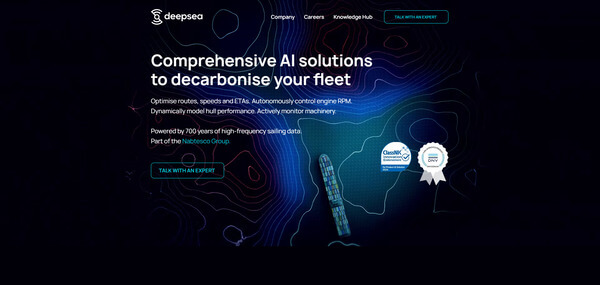
DeepSea
* Image source: DeepSea Official
Website
(https://www.deepsea.ai/)
(https://www.deepsea.ai/)
Core Capabilities
AI Fuel, CII &
Route Optimization
Route Optimization
- With the CII tracking feature, AI helps maintain and predict vessel performance.
- AI dynamically evaluates speeds and routes to suggest more fuel-efficient alternatives
- While complying with Europe-specific restrictions and regulations, it supports operations aimed at lower fuel consumption.
For Fleets with a Mix
of Older and Newly
Built Vessels
For Independent Ship
Management Companies
of Older and Newly
Built Vessels
For Independent Ship
Management Companies
Smart Ship Hub
* Image source: Smart Ship Hub Official
Website
(https://smartshiphub.com/)
(https://smartshiphub.com/)
Core Capabilities
Data integration across a mixed fleet
- Supports aggregation of vessel data across different manufacturers and standards, as well as data from multiple vessels.
- Visualizes information distributed across onboard systems and supports building an environment for centralized management.
- Supports information sharing between shore teams and fleets with older vessels, older equipment, newly built vessels and new equipment.