
ABS My Digital Fleet
ABS My Digital Fleet is a customizable risk management platform that integrates fleet data into one place and turns it into real-time insights for safer, more sustainable operations. It is offered by ABS Digital Solutions LLC, part of the classification society American Bureau of Shipping (ABS).
This webpage summarizes what ABS My Digital Fleet does, its core insight areas, how its Risk Rating works, and how to judge whether it fits your fleet.
What You Will Learn
on This Webpage
- Strengths of the tool:
It spans four risk areas in one platform, covering environmental, operational, machinery, and structural risk, and combines them into a single Risk Rating built on machine learning. - What implementation enables:
It connects scattered data sources and standalone applications so shipowners, ship managers, and charterers can see fleet health, performance, and emissions from one screen and act on AI-driven insights. - Best-fit companies:
It suits shipowners, ship managers, and charterers that want to manage operational risk and decarbonization together, rather than through separate point tools.
Key Features of ABS My Digital Fleet
A Single Risk Rating Built from
Four Insight Areas
The core of the platform is a tailored Risk Rating drawn from environmental, operational, machinery, and structural insights. According to ABS, the machine-learning model behind it is informed both by the fleet's own asset data and by third-party intelligence and technology providers connected through the My Digital Fleet Alliance Program.
For shore teams, this turns four separate risk views into one comparable score, making it easier to prioritize which vessels and issues need attention first instead of monitoring each domain in isolation.
Risk Management Backed by
a Classification Society
ABS My Digital Fleet fits organizations that treat operational risk and compliance as a single problem.
Because ABS is a classification society, the platform's structural insights draw on hull integrity under real wave and fatigue loads — an area that performance-only tools rarely cover. For fleets where structural risk and class compliance matter as much as fuel efficiency, that breadth is the main point of difference.
POINT
Finding the Ideal
Solution for
Your Organization
Solution for
Your Organization
The core focus of each system differs. Finding the right fit starts with your fleet's management goals and operational scale. To make the choice easier, we have grouped leading vessel management software by company type. Explore our recommendations to find the ideal fit for your organization.
Main Functions of ABS My Digital Fleet
The platform is organized into four insight areas. Each can be used on its own and feeds into the combined Risk Rating.
Environmental Insights
This area tracks how daily decisions affect a vessel's carbon footprint. It visualizes decarbonization KPIs such as CII, EEXI, Poseidon Principles, and the Sea Cargo Charter, tracks carbon intensity and emissions (CO₂, SOx, NOx) during a voyage, and streamlines MRV and DCS reporting by integrating with noon reports, high-frequency data, and electronic logbooks.
Operational Insights
This area targets fuel efficiency and voyage economics. It plans optimal routes and speeds based on weather, hull fouling, bunker prices, port costs, and required ETA, and monitors fuel consumption, speed, and engine power underway for charter-party purposes. It also tracks added resistance over time to help decide when to clean the hull or polish the propeller.
Machinery Insights
This area monitors machinery health and reliability by integrating with onboard sensors and maintenance systems. It shows live equipment status, uses AI-driven analytics to flag potential failures early, sends automated alerts when user-set thresholds are exceeded, and benchmarks reliability across similar equipment to support a Reliability Centered Maintenance approach.
Structural Insights
This area gives an asset-specific view of structural risk. It flags risk based on the wave conditions each vessel encounters, forecasts structural risk for planned voyages from route and weather data, and sends automated alerts for extreme load events or excessive fatigue, supporting proactive inspection and repair planning.
Scalability of ABS My Digital Fleet
The platform is designed to connect disparate data sources and standalone applications, so it can bring together the systems a fleet already runs rather than replacing them. It integrates with noon reports, high-frequency live data, electronic logbooks, and onboard machinery sensors, which lets fleets with different levels of instrumentation use the same platform.
The platform also connects with external providers through the My Digital Fleet Alliance Program, which feeds third-party intelligence and technology data into the same Risk Rating. As a fleet adds data sources or partners, the underlying model has more to draw on.
Regulatory Compliance of ABS My Digital Fleet
Compliance support is built into the Environmental insights covered above, which already track the KPIs and reporting data regulators require.
What's specific to compliance is voyage-level, waypoint-by-waypoint monitoring: crews can check allowed waste streams live during a voyage and stay informed on local and international discharge regulations at each port and waypoint, which keeps compliance tied to day-to-day routing decisions rather than handled only after the fact.
Implementation Costs and Pricing of ABS My Digital Fleet
ABS does not publish pricing for My Digital Fleet. Because the platform is configured around a fleet's data sources, chosen insight areas, and stakeholder views, costs are arranged directly with ABS. The official website offers a demo sign-up and a downloadable brochure, and lists a contact route for questions.
Examples of Utilizing
ABS My Digital Fleet
The official ABS My Digital Fleet page does not publish named customer results or specific savings figures, so the example below is illustrative rather than a documented case.
A typical use case is a fleet where environmental, operational, machinery, and structural data each sit in a separate system, which makes it hard to see which vessels carry the most risk. By connecting those sources into one platform and a single Risk Rating, a shore team can compare vessels on the same scale, act on early machinery or structural alerts, and keep emissions reporting aligned with routing decisions.
*This is an illustrative scenario, not a documented ABS case.
Support and Follow-up for ABS My Digital Fleet
ABS My Digital Fleet is provided by ABS Digital Solutions LLC, part of ABS. The website offers a guided demo, a product brochure, and a direct contact route. ABS also lists a general service desk by email and phone.
Before implementation, confirm the specific onboarding steps, support scope, and any service-level terms directly with ABS, as these are arranged per agreement.
Company Overview of ABS
- Provider: ABS Digital Solutions LLC, part of American Bureau of Shipping (ABS)
- Email: ABSServiceDesk@eagle.org
- Phone number: 1-281-877-6000
- Official website: https://ww2.eagle.org/
3 Recommended
Marine Fleet Management Software
Marine Fleet Management Software
For Frequent Hazardous
or Long-Distance
Voyages
For Marine Fleet
Management Companies
or Long-Distance
Voyages
For Marine Fleet
Management Companies
MaSSA-One

* Image source: BEMAC Official
Website
(https://www.massa-one.com/english/)
(https://www.massa-one.com/english/)
Core Capabilities
Condition monitoring and anomaly detection
- Enables early detection of anomalies using data-driven automatic thresholds and expert-defined multi-condition detection.
- In the event of a failure, real-time data helps speed up root-cause identification, reducing downtime.
- This supports the prevention of future accidents and issues, contributing to reduced damage and losses involving vessels and cargo.
For Companies with
Frequent Business
in the EU
For Marine Shipping
Companies
Frequent Business
in the EU
For Marine Shipping
Companies
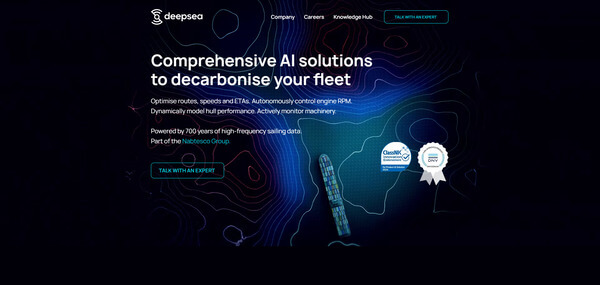
DeepSea
* Image source: DeepSea Official
Website
(https://www.deepsea.ai/)
(https://www.deepsea.ai/)
Core Capabilities
AI Fuel, CII &
Route Optimization
Route Optimization
- With the CII tracking feature, AI helps maintain and predict vessel performance.
- AI dynamically evaluates speeds and routes to suggest more fuel-efficient alternatives
- While complying with Europe-specific restrictions and regulations, it supports operations aimed at lower fuel consumption.
For Fleets with a Mix
of Older and Newly
Built Vessels
For Independent Ship
Management Companies
of Older and Newly
Built Vessels
For Independent Ship
Management Companies
Smart Ship Hub
* Image source: Smart Ship Hub Official
Website
(https://smartshiphub.com/)
(https://smartshiphub.com/)
Core Capabilities
Data integration across a mixed fleet
- Supports aggregation of vessel data across different manufacturers and standards, as well as data from multiple vessels.
- Visualizes information distributed across onboard systems and supports building an environment for centralized management.
- Supports information sharing between shore teams and fleets with older vessels, older equipment, newly built vessels and new equipment.