
Vessel Tide | A Guide to Essential Maritime Data Analytics Systems » What Is Vessel Management Software? How to Choose » Maritime Crew Management Software & VMS Integration
Maritime Crew Management Software & VMS Integration
Index
View All
The Essential Role of Maritime Crew Management Software
In the maritime industry, Maritime Crew Management Software is a vital digital framework designed to streamline complex tasks such as crew scheduling, credential renewals, and payroll. At its core, this software is far more than a basic human resources tool; it is an indispensable asset that directly supports the safe and efficient operation of the entire vessel.
Modern shipping operations can no longer rely on isolated systems. Instead, they require the seamless integration of hardware—such as GPS and onboard sensors—with advanced software components to ensure efficient and safe voyages. Crew management is a critical piece of this puzzle. It delivers its true value not by operating in a silo, but by working in tandem with the broader systems governing the ship's overall operations, paving the way for the advanced integrations discussed below.
Integration and Connectivity with Vessel Management Systems (VMS)
To unlock the full potential of crew management software, integration with a Vessel Management System (VMS) is essential. A VMS is a sophisticated digital platform that tracks and monitors vessel operations in real time. These systems vary based on their specific utility, ranging from comprehensive fleet management platforms to single-vessel setups. Within the VMS framework—which blends hardware and software to ensure safe, eco-friendly operations—the strategic management of human resources plays a pivotal role.
Real-Time Information Sharing and Operational Optimization
A VMS utilizes GPS and AIS (Automatic Identification System) to deliver highly accurate, real-time operational data, including a vessel's exact location and speed. By merging this live tracking capability with crew deployment and labor data from the crew management software, ship-to-shore communication becomes remarkably smooth and precise. This seamless information exchange empowers teams to make rapid, context-aware decisions, ultimately optimizing overall operations.
Enhancing Compliance and Maritime Safety
Drawing on the principles of a Regulatory VMS—which focuses on monitoring adherence to international maritime laws—companies can achieve a much higher standard of compliance management. VMS technology strictly enforces working hour regulations and crew qualification requirements. Furthermore, by pairing these compliance checks with proactive accident prevention protocols (such as monitoring environmental conditions and operational data), companies can simultaneously boost both fleet efficiency and maritime safety.
Key Implementation Benefits and Business Efficiency
The most significant advantage of integrating Maritime Crew Management Software with a VMS is the drastic reduction of manual errors through automation, which fundamentally transforms daily workflows. This system integration drives massive operational efficiencies, delivering tangible value to shipping companies.
Reducing Human Error and Optimizing Workflows
By automating traditionally manual tasks like crew paperwork and schedule adjustments, companies can eliminate human error and significantly lighten the administrative workload for both onshore staff and crew members. Specifically, businesses can expect the following efficiency gains:
- Drastic reductions in administrative hours through the automation of complex paperwork.
- Proactive risk management via automatic alerts for upcoming qualification and license renewals.
- Enhanced accuracy and compliance through the full digitization of working hour logs.
By removing these administrative bottlenecks, personnel are freed up to focus on more strategic, high-value responsibilities.
Mitigating the Risk of Maritime Accidents
Implementing these integrated systems directly contributes to mitigating the risk of maritime accidents. The real-time alerts provided by the VMS regarding navigational hazards and engine malfunctions are incredibly powerful. When coupled with the software's ability to manage crew fatigue and ensure appropriate personnel deployment, companies can continuously monitor operational performance from both a mechanical and human perspective. Ultimately, this dual approach ensures comprehensive navigational safety and helps prevent serious incidents.
Conclusion: Optimizing Crew Management in Conjunction with VMS
Maritime Crew Management Software is far more than a simple HR tool; it is a critical system that, when integrated with a VMS, elevates the safety, efficiency, and compliance of the entire maritime operation. To truly optimize fleet performance and build a safe, sustainable maritime business, adopting these integrated technological solutions is highly recommended.
POINT
Find the Right System for Your Data Strategy
This site introduces vessel management systems by technical focus, including solutions that help reduce the risk of unexpected downtime and equipment damage, tools that support data-driven analysis of fuel use, CII status, and voyage planning, and platforms that bring fragmented fleet data together in one place.
3 Recommended
Marine Fleet Management Software
Marine Fleet Management Software
For Frequent Hazardous
or Long-Distance
Voyages
For Marine Fleet
Management Companies
or Long-Distance
Voyages
For Marine Fleet
Management Companies
MaSSA-One

* Image source: BEMAC Official
Website
(https://www.massa-one.com/english/)
(https://www.massa-one.com/english/)
Core Capabilities
Condition monitoring and anomaly detection
- Enables early detection of anomalies using data-driven automatic thresholds and expert-defined multi-condition detection.
- In the event of a failure, real-time data helps speed up root-cause identification, reducing downtime.
- This supports the prevention of future accidents and issues, contributing to reduced damage and losses involving vessels and cargo.
For Companies with
Frequent Business
in the EU
For Marine Shipping
Companies
Frequent Business
in the EU
For Marine Shipping
Companies
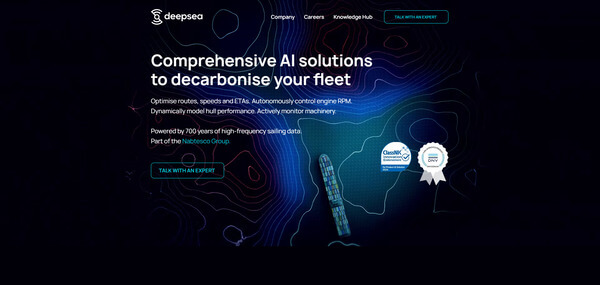
DeepSea
* Image source: DeepSea Official
Website
(https://www.deepsea.ai/)
(https://www.deepsea.ai/)
Core Capabilities
AI Fuel, CII &
Route Optimization
Route Optimization
- With the CII tracking feature, AI helps maintain and predict vessel performance.
- AI dynamically evaluates speeds and routes to suggest more fuel-efficient alternatives
- While complying with Europe-specific restrictions and regulations, it supports operations aimed at lower fuel consumption.
For Fleets with a Mix
of Older and Newly
Built Vessels
For Independent Ship
Management Companies
of Older and Newly
Built Vessels
For Independent Ship
Management Companies
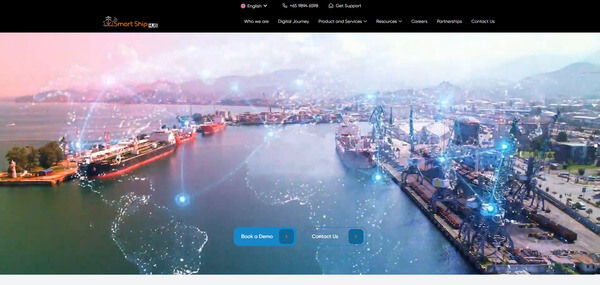
Smart Ship Hub
* Image source: Smart Ship Hub Official
Website
(https://smartshiphub.com/)
(https://smartshiphub.com/)
Core Capabilities
Data integration across a mixed fleet
- Supports aggregation of vessel data across different manufacturers and standards, as well as data from multiple vessels.
- Visualizes information distributed across onboard systems and supports building an environment for centralized management.
- Supports information sharing between shore teams and fleets with older vessels, older equipment, newly built vessels and new equipment.