
Vessel Tide | A Guide to Essential Maritime Data Analytics Systems » What Is Vessel Management Software? How to Choose » Marine Fleet Management Software for Marine Fuel Monitoring Software
Marine Fleet Management Software for Marine Fuel Monitoring Software
Index
View All
Selecting Marine Fuel Monitoring Software: FAQ Guide
About Marine Fuel Monitoring Systems
A marine fuel monitoring system continuously collects fuel consumption and engine performance data during vessel operations. By integrating sensor data with voyage and weather information, the system visualizes fuel efficiency trends, detects abnormal consumption patterns, and supports data-driven operational decisions.
Advanced systems can also analyze fuel usage by voyage segment, operating condition, or engine load, helping operators identify hidden inefficiencies across the fleet.
Benefits of Marine Fuel Monitoring Systems
The primary benefit is improved fuel efficiency and reduced operational costs. Real-time monitoring enables crews and shore-based operators to identify excessive fuel consumption early and optimize vessel speed and engine settings accordingly.
The system also supports compliance with environmental regulations such as CII and IMO DCS by automatically collecting accurate fuel and emissions data. In addition, continuous monitoring helps improve maintenance planning by detecting engine performance deterioration before major failures occur.
Accumulated fuel performance data can further support benchmarking between vessels and improve long-term fleet optimization strategies.
Challenges Solved by Marine Fuel Monitoring Systems
Marine fuel monitoring systems help solve operational challenges such as inaccurate manual reporting, fuel consumption visibility gaps, and delayed detection of performance degradation.
Without continuous monitoring, operators often rely on periodic noon reports or estimated consumption figures, which can obscure operational inefficiencies. By centralizing high-frequency operational data, the system enables both onboard crews and shore-based managers to monitor vessel performance in real time and make faster, evidence-based decisions.
The system can also help identify fuel losses caused by inappropriate routing, rough weather, improper trim, or suboptimal engine operation.
Choosing a Marine Fuel Monitoring System
A key selection criterion is measurement accuracy, especially whether the system supports high-precision fuel flow meters and reliable sensor integration. Compatibility with existing onboard systems—including engine monitoring platforms, AIS, and voyage management systems—is also important for seamless operation.
The platform should provide intuitive dashboards that clearly visualize fuel consumption trends, emissions performance, and operational anomalies. Scalability across mixed fleets and cloud-based data access are additional factors that support long-term operational use.
It is also important to evaluate cybersecurity measures and the system’s ability to maintain stable performance even in environments with limited communication bandwidth.
Use Cases for Marine Fuel Monitoring Systems
One common use case is optimizing vessel speed and engine output to minimize fuel consumption during long voyages. By analyzing fuel efficiency in real time, operators can determine the most economical operating profile under changing weather and sea conditions.
Another example is emissions monitoring, where fuel consumption data is automatically converted into CO₂ emissions data for CII and ESG reporting. The system can also support predictive maintenance by identifying abnormal fuel usage patterns that may indicate engine fouling or machinery deterioration.
In fleet operations, accumulated fuel data can be used to benchmark vessel performance and improve future voyage planning and fleet-wide fuel strategies.
Case Studies: Marine Fuel Monitoring Systems
The webpage editorial team investigated case studies of marine fuel monitoring systems, but no case studies were found.
Marine fuel monitoring systems are designed to continuously collect and analyze fuel consumption and operational performance data during vessel operations. By visualizing fuel usage trends and detecting inefficiencies early, these systems help reduce fuel costs, improve environmental compliance, and support more efficient vessel operations.
POINT
Find the Right System for Your Data Strategy
This site introduces vessel management systems by technical focus, including solutions that help reduce the risk of unexpected downtime and equipment damage, tools that support data-driven analysis of fuel use, CII status, and voyage planning, and platforms that bring fragmented fleet data together in one place.
3 Recommended
Marine Fleet Management Software
Marine Fleet Management Software
For Frequent Hazardous
or Long-Distance
Voyages
For Marine Fleet
Management Companies
or Long-Distance
Voyages
For Marine Fleet
Management Companies
MaSSA-One

* Image source: BEMAC Official
Website
(https://www.massa-one.com/english/)
(https://www.massa-one.com/english/)
Core Capabilities
Condition monitoring and anomaly detection
- Enables early detection of anomalies using data-driven automatic thresholds and expert-defined multi-condition detection.
- In the event of a failure, real-time data helps speed up root-cause identification, reducing downtime.
- This supports the prevention of future accidents and issues, contributing to reduced damage and losses involving vessels and cargo.
For Companies with
Frequent Business
in the EU
For Marine Shipping
Companies
Frequent Business
in the EU
For Marine Shipping
Companies
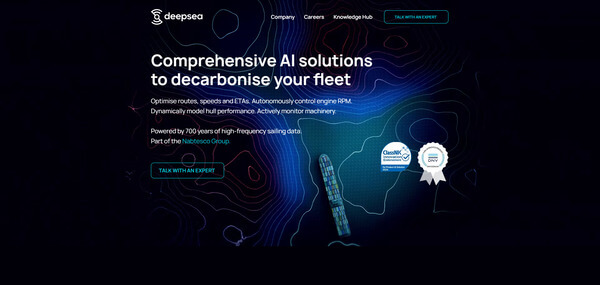
DeepSea
* Image source: DeepSea Official
Website
(https://www.deepsea.ai/)
(https://www.deepsea.ai/)
Core Capabilities
AI Fuel, CII &
Route Optimization
Route Optimization
- With the CII tracking feature, AI helps maintain and predict vessel performance.
- AI dynamically evaluates speeds and routes to suggest more fuel-efficient alternatives
- While complying with Europe-specific restrictions and regulations, it supports operations aimed at lower fuel consumption.
For Fleets with a Mix
of Older and Newly
Built Vessels
For Independent Ship
Management Companies
of Older and Newly
Built Vessels
For Independent Ship
Management Companies
Smart Ship Hub
* Image source: Smart Ship Hub Official
Website
(https://smartshiphub.com/)
(https://smartshiphub.com/)
Core Capabilities
Data integration across a mixed fleet
- Supports aggregation of vessel data across different manufacturers and standards, as well as data from multiple vessels.
- Visualizes information distributed across onboard systems and supports building an environment for centralized management.
- Supports information sharing between shore teams and fleets with older vessels, older equipment, newly built vessels and new equipment.