
Vessel Tide | A Guide to Essential Maritime Data Analytics Systems » What Is Vessel Management Software? How to Choose » Marine Fleet Management Software Specialized in Performance Monitoring
Marine Fleet Management Software Specialized in Performance Monitoring
Index
View All
Within marine fleet management software, performance monitoring is the area most directly tied to fuel efficiency management and compliance with environmental regulations. This webpage explains—through an FAQ format—the value of implementing marine fleet management software with performance monitoring capabilities and the key points to consider when selecting a system.
Choosing Vessel
Performance Monitoring
System: FAQ Guide
About Vessel
Performance Monitoring
It is a management area that collects and analyzes voyage and machinery data to make hull and main-engine efficiency visible. Rather than serving only as a record, it identifies gaps between design performance and actual operational data and quantifies the impact of hull fouling and age-related degradation. It helps operators understand in-service conditions and use that insight to consider improvement measures.
Benefits of Vessel
Performance Monitoring
To advance compliance with environmental regulations and cost optimization at the same time. As requirements such as CII ratings and EU ETS compliance increase, rising fuel costs are also having a major impact—making the quality of operational decisions directly tied to competitiveness. With performance monitoring, it becomes easier to make decisions based on data.
Challenges Solved by
Vessel Performance Monitoring
It can simultaneously reduce fuel-efficiency losses in daily operations and ease the workload of data aggregation and reporting in administrative teams. For example, it enables decisions on countermeasures based on projected CII rating trends and helps prevent rising fuel costs by detecting early signs of hull fouling. In addition, trend analysis of machinery data can detect early signs of abnormalities, helping reduce the risk of unexpected shutdowns.
Choosing a Vessel
Performance Monitoring System
Analysis accuracy and scalability are key. The reliability of the results depends heavily on whether the system can reliably collect high-frequency data and whether it normalizes data to account for weather and loading conditions. In addition to support for international standards such as ISO 19847/19848, confirm integration with operational planning, maintenance, and reporting functions, as well as whether third-party verification or certification is available.
Use Cases for
Vessel Performance Monitoring
Typical examples include improving fuel efficiency by optimizing routes and speed using weather data, and condition-based maintenance (CBM) supported by machinery monitoring. It is also used to predict CII ratings based on emissions records and operating conditions, supporting decisions on measures such as slow steaming and hull cleaning.
POINT
Find the Right System for Your Data Strategy
This site introduces vessel management systems by technical focus, including solutions that help reduce the risk of unexpected downtime and equipment damage, tools that support data-driven analysis of fuel use, CII status, and voyage planning, and platforms that bring fragmented fleet data together in one place.
Examples of Marine Fleet
Management Software with
Performance Monitoring
The webpage editorial team investigated case studies of marine fleet management software that supports performance monitoring. Please review how each solution is used in practice and the results achieved after implementation to help guide system selection.
Case Study:
METIS Cyberspace Technology's Marine Fleet Management Software
Contributing to Reduced Fuel Consumption and Emissions
As new environmental regulations increase the need for high operational efficiency, Neptune Lines implemented Metis's marine fleet management software as a technology to support optimization across the hull, machinery, electrical systems, and operations.
With Metis's marine fleet management software in place, real-time performance monitoring became possible, contributing to reduced fuel consumption and emissions.
*Source: METIS Cyberspace Technology Official Website (https://www.metis.tech/#quotes )
Case Study:
StormGeo's Marine Fleet Management Software
Supporting Compliance with Environmental Regulations Using Performance Data
Bergshav Management AS implemented StormGeo's marine fleet management software, Performance Center, to continuously monitor and manage vessel operational data and support compliance with IMO DCS and EU MRV.
This includes data review both onboard and ashore, as well as coordination with verifiers, using performance data to support regulatory compliance and reporting workflows.
*Source: StormGeo Official Website (https://stormgeo.com/products/s-insight )
Case Study:
MANTA Marine's Marine Fleet Management Software
Centralizing Fuel Consumption Data to Improve Efficiency Visibility
For many years, the company relied on manually entered fuel consumption data that was prone to errors. After implementing Manta Marine Technologies' marine fleet management software, FuelOpt, it can now manage vessel data—including fuel consumption—digitally on a single platform.
As a result, it can filter out variable factors and measure efficiency more accurately.
*Source: MANTA Marine Official Website (https://www.mantamarine.com/services/fuelopt )
Case Study:
Inmarsat's Marine Fleet Management Software
Real-Time Monitoring for
Performance & Efficiency
Mitsubishi Ore Transport implemented Inmarsat's Fleet Xpress to establish a stable communications environment between ship and shore. Through real-time data sharing and the use of Fleet Data, the company is improving operational efficiency and reducing fuel consumption, supporting both digitalization and decarbonization.
*Source: Inmarsat Official Website (https://www.inmarsat.com/perspectives/maritime/2023/case-study-mitsubishi-ore-transport/ )
3 Recommended
Marine Fleet Management Software
Marine Fleet Management Software
For Frequent Hazardous
or Long-Distance
Voyages
For Marine Fleet
Management Companies
or Long-Distance
Voyages
For Marine Fleet
Management Companies
MaSSA-One

* Image source: BEMAC Official
Website
(https://www.massa-one.com/english/)
(https://www.massa-one.com/english/)
Core Capabilities
Condition monitoring and anomaly detection
- Enables early detection of anomalies using data-driven automatic thresholds and expert-defined multi-condition detection.
- In the event of a failure, real-time data helps speed up root-cause identification, reducing downtime.
- This supports the prevention of future accidents and issues, contributing to reduced damage and losses involving vessels and cargo.
For Companies with
Frequent Business
in the EU
For Marine Shipping
Companies
Frequent Business
in the EU
For Marine Shipping
Companies
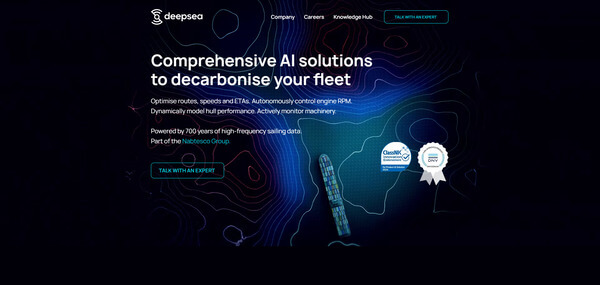
DeepSea
* Image source: DeepSea Official
Website
(https://www.deepsea.ai/)
(https://www.deepsea.ai/)
Core Capabilities
AI Fuel, CII &
Route Optimization
Route Optimization
- With the CII tracking feature, AI helps maintain and predict vessel performance.
- AI dynamically evaluates speeds and routes to suggest more fuel-efficient alternatives
- While complying with Europe-specific restrictions and regulations, it supports operations aimed at lower fuel consumption.
For Fleets with a Mix
of Older and Newly
Built Vessels
For Independent Ship
Management Companies
of Older and Newly
Built Vessels
For Independent Ship
Management Companies
Smart Ship Hub
* Image source: Smart Ship Hub Official
Website
(https://smartshiphub.com/)
(https://smartshiphub.com/)
Core Capabilities
Data integration across a mixed fleet
- Supports aggregation of vessel data across different manufacturers and standards, as well as data from multiple vessels.
- Visualizes information distributed across onboard systems and supports building an environment for centralized management.
- Supports information sharing between shore teams and fleets with older vessels, older equipment, newly built vessels and new equipment.