
Vessel Tide | A Guide to Essential Maritime Data Analytics Systems » List of Marine Fleet Management Software Providers » Arundo Maritime Suite (Arundo)
Arundo Maritime Suite (Arundo)
Index
View All
Arundo Maritime Suite is an integrated solution that consolidates operational and maintenance-related data collected both onboard and onshore and enables its use for visualization and analytics. Built on DNV’s Veracity platform, it provides an environment for organizing and utilizing data.
This webpage summarizes Arundo Maritime Suite’s key features, main functions, and examples of utilizing it.
What You Will Learn on This Webpage
- Strengths of the tool:
It can build a reliable foundation for integrating onboard data on the Veracity platform and using it for analytics. - What implementation enables:
It can provide an environment where data can be visualized both onboard and onshore, enabling consideration from KPI analysis through to applying machine-learning models. - Best fit companies:
Companies operating multiple vessels that want to standardize diverse sensor data and use it for operations and maintenance analytics.
Key Features of Arundo Maritime Suite
Integrate Onboard Data and Organize It
for Onshore Use
It collects data from onboard control systems and various sensors, and is configured to transmit it to the data platform even when communications are constrained.
When sensor data is fragmented, understanding conditions and conducting assessments from shore can take time. By enabling centralized sharing of data, it becomes easier to grasp operational and machinery status onshore and to prepare inputs for considering support actions and response policies.
Suitable for Companies Seeking
to Organize Data
Across Multiple Vessels
It is suited to companies operating multiple vessels with many sensors on each vessel, where data is fragmented by vessel. By having a common data infrastructure onboard and onshore, it becomes easier to establish a shared basis for information sharing.
It can also be used as a foundation for evaluating and analyzing KPIs such as fuel efficiency, OPEX, and port operations. It also fits companies considering a phased digital transformation approach, starting with data aggregation and visualization.
POINT
Finding the Ideal
Solution for
Your Organization
Solution for
Your Organization
As explored above, the core strengths and focus of each system vary significantly. Finding the right solution starts with assessing your fleet's specific management goals and operational scale. To simplify your choice, we have categorized top-tier vessel management software by company type. Explore our recommendations below to find the ideal fit for your organization.
Main Functions of Arundo Maritime Suite
*No images were available to include for the functions.
- Data collection from onboard control systems and other sources (Arundo Edge Agent)
- Store and organize sensor data on Veracity in line with technical asset models
- Querying, visualization, and analytics (including KPI monitoring on dashboards)
- Execution and application of a wide range of analytics, from KPIs to machine-learning models
Scalability of Arundo Maritime Suite
Running on DNV’s Veracity ecosystem, Arundo Maritime Suite has a foundation that can integrate with a wide range of data and service providers.
Veracity also offers mechanisms (for example, the Integrated Partner Program) that make it easier for data providers to connect with Veracity, which could broaden options for data integration.
Regulatory Compliance and Certification
of Arundo Maritime Suite
For compliance with IEC 62443 (a security standard for industrial control systems) and ISO 19847/19848 (data standards), specific requirements should be confirmed at implementation.
Implementation Costs and Pricing
of Arundo Maritime Suite
Implementation costs vary depending on the number of target vessels, the volume of data points collected, and the scope of integration with other systems. For specific conditions and pricing, please contact the provider.
Examples of Utilizing Arundo Maritime Suite
One expected use scenario is when operational data across multiple vessels is dispersed and the drivers behind rising fuel costs have not been fully organized. By implementing Arundo Maritime Suite, onboard and onshore data can be organized through centralized management, creating a foundation for visualizing operating conditions.
Based on this data, it is expected to be used as inputs for analyzing fuel-consumption trends and operating conditions and for considering areas for improvement.
*The above is purely an intended use scenario and does not represent an actual implementation case.
Support and Follow-up
for Arundo Maritime Suite
Demos are provided to deepen product understanding, and contact channels are available for implementation-related inquiries.
Details such as the SLA (Service Level Agreement), support hours, and the scope of configuration and training support during implementation need to be confirmed individually based on contract terms.
Company Overview of Arundo,
the Provider of Arundo Maritime Suite
- Company name:Arundo
- Address:Oslo / Stockholm / Heidelberg / Houston
- Phone number: Not publicly available (inquiries via email or web form)
- Official website:https://www.arundo.com/
3 Recommended
Marine Fleet Management Software
Marine Fleet Management Software
For Frequent Hazardous
or Long-Distance
Voyages
For Marine Fleet
Management Companies
or Long-Distance
Voyages
For Marine Fleet
Management Companies
MaSSA-One

* Image source: BEMAC Official
Website
(https://www.massa-one.com/english/)
(https://www.massa-one.com/english/)
Core Capabilities
Condition monitoring and anomaly detection
- Enables early detection of anomalies using data-driven automatic thresholds and expert-defined multi-condition detection.
- In the event of a failure, real-time data helps speed up root-cause identification, reducing downtime.
- This supports the prevention of future accidents and issues, contributing to reduced damage and losses involving vessels and cargo.
For Companies with
Frequent Business
in the EU
For Marine Shipping
Companies
Frequent Business
in the EU
For Marine Shipping
Companies
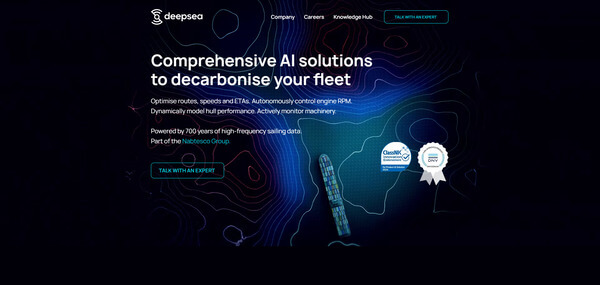
DeepSea
* Image source: DeepSea Official
Website
(https://www.deepsea.ai/)
(https://www.deepsea.ai/)
Core Capabilities
AI Fuel, CII &
Route Optimization
Route Optimization
- With the CII tracking feature, AI helps maintain and predict vessel performance.
- AI dynamically evaluates speeds and routes to suggest more fuel-efficient alternatives
- While complying with Europe-specific restrictions and regulations, it supports operations aimed at lower fuel consumption.
For Fleets with a Mix
of Older and Newly
Built Vessels
For Independent Ship
Management Companies
of Older and Newly
Built Vessels
For Independent Ship
Management Companies
Smart Ship Hub
* Image source: Smart Ship Hub Official
Website
(https://smartshiphub.com/)
(https://smartshiphub.com/)
Core Capabilities
Data integration across a mixed fleet
- Supports aggregation of vessel data across different manufacturers and standards, as well as data from multiple vessels.
- Visualizes information distributed across onboard systems and supports building an environment for centralized management.
- Supports information sharing between shore teams and fleets with older vessels, older equipment, newly built vessels and new equipment.