
Eniram (Wärtsilä)
Index
View All
Eniram is software that combines real-time operational data with post-voyage analysis to continuously improve overall voyage efficiency. This webpage outlines Eniram’s key features, main functions, and expected use scenarios.
What You Will Learn
on This Webpage
- Strengths of the tool:
By leveraging high-frequency data and digital twins, Eniram enables quantitative identification of operational inefficiencies and opportunities for improvement. - What implementation enables:
It connects voyage planning, in-voyage operations, and post-voyage analysis, helping improve fuel efficiency and arrival management. - Best-fit companies:
It is suitable for companies that operate fleets under complex operating conditions and want to standardize decision-making on fuel efficiency and arrival times.
What Eniram Can Do
Optimize Voyage Planning, Execution, and Post-Voyage Review
in an Integrated, End-to-End Process
In voyage planning, appropriate routes are selected with safety and compliance with environmental regulations in mind. During execution, Eniram supports adjustments to trim (the vessel’s fore-and-aft attitude), speed, and engine settings according to conditions. After the voyage, benchmark analysis is conducted to identify deviations from the plan and areas for improvement.
Recommended for Companies Operating Under Complex Conditions
It is suitable for operators—such as cruise ships and ferries—where arrival times and operating conditions are complex and there is significant room for improvement through optimization.
It is also effective for companies that want to unify operational decisions across the fleet and reduce dependence on individual judgment. As the need to respond to fuel-price volatility and emissions regulations grows, it also fits organizations seeking to analyze voyage-by-voyage data and run a steady improvement cycle. It is also well-suited when management-level efficiency decisions are required.
POINT
Finding the Ideal
Solution for
Your Organization
Solution for
Your Organization
As explored above, the core strengths and focus of each system vary significantly. Finding the right solution starts with assessing your fleet's specific management goals and operational scale. To simplify your choice, we have categorized top-tier vessel management software by company type. Explore our recommendations below to find the ideal fit for your organization.
Main Functions of Eniram
Eniram Route
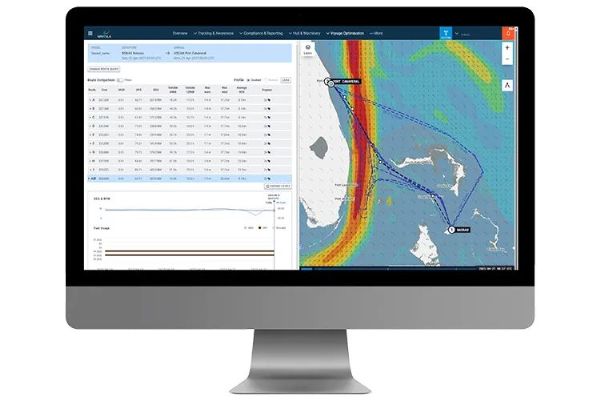
Source HP: Wärtsilä Official Website
https://www.wartsila.com/marine/products/eniram-by-wartsila-fleet-optimisation-solution
https://www.wartsila.com/marine/products/eniram-by-wartsila-fleet-optimisation-solution
Eniram Speed & Engine
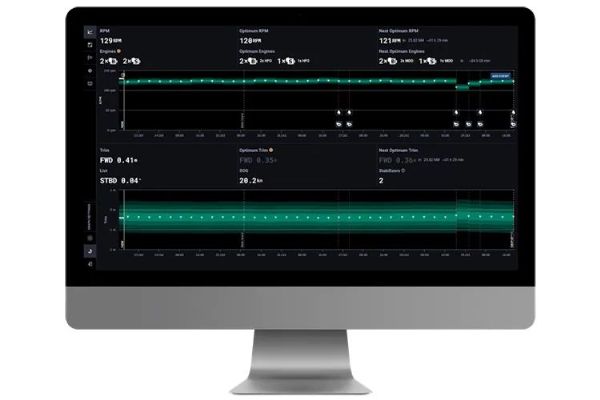
Source HP: Wärtsilä Official Website
https://www.wartsila.com/marine/products/eniram-by-wartsila-fleet-optimisation-solution
https://www.wartsila.com/marine/products/eniram-by-wartsila-fleet-optimisation-solution
Scalability of Eniram
Eniram is delivered as a suite of cloud-based tools, designed to handle the full workflow—from voyage planning through post-voyage analysis—as a single, continuous process. Because it assumes the use of high-frequency data, integration with onboard sensors and onboard systems is important. In principle, it is positioned as part of Wärtsilä’s Fleet Optimisation Solutions. By using it in combination with surrounding systems, the range of operational decision-making can be expanded.
Regulatory Compliance and Certification of Eniram
For indicators such as CII, where operational performance affects the rating, Eniram provides inputs for reviewing fuel efficiency and arrival management through voyage planning, in-voyage decision-making, and post-voyage analysis. On the other hand, because EEXI is primarily a technical requirement, Eniram should be positioned only as a tool that supports consideration of operational improvements. It is safer to confirm the compliance method itself separately.
In addition, for compliance with environmental regulations and various reporting requirements (for example, measures related to schemes within the EU), it can be helpful to consider Eniram together with the compliance/reporting functions provided by Wärtsilä’s Fleet Optimisation Solutions (FOS), as this makes it easier to clarify role allocation.
From a cybersecurity perspective, Wärtsilä has established a PSIRT (Product Security Incident Response Team) and provides responses to vulnerabilities and mitigation measures. Because the status of compliance with standards and certifications such as ISO may vary depending on the product configuration and contract scope, requirements should be confirmed with the vendor in advance where applicable.
Implementation Costs and Pricing
Costs vary depending on the plan, vessel type, number of vessels, and functional configuration, so an inquiry is required for details.
Examples of Utilizing Eniram
A typical use scenario for Eniram is when a company faces rising fuel costs or when operational decision-making tends to depend on individuals. By visualizing and analyzing voyage data, it becomes easier to review individual decisions and obtain inputs for reassessing operational practices. Over time, this makes it easier to consider a stable, data-driven marine fleet management framework.
*The above is purely an intended use scenario and does not represent an actual implementation case.
Support and Follow-up for Eniram
During the evaluation phase, a company can confirm functions and an operational picture through demos and individual consultations. After operations begin, Wärtsilä provides technical assistance and 24/7 operational support as part of its services. In addition, security arrangements are in place, including incident response and vulnerability management by a dedicated team (PSIRT).
Company Overview of Wärtsilä,
the Provider of Eniram
- Company name: Wärtsilä Corporation
- Headquarters address:Hiililaiturinkuja 2, FI-00180 Helsinki, Finland
- Phone number:+358 10 709 0000
- Official website:https://www.wartsila.com
[Advertisement]
3 Recommended
Marine Fleet Management Software
3 Recommended
Marine Fleet Management Software
Advertiser Disclosure:
We receive compensation from some of the companies listed below.This compensation may affect which companies are included and the order in which they appear.
For Frequent Hazardous
or Long-Distance
Voyages
For Marine Fleet
Management Companies
or Long-Distance
Voyages
For Marine Fleet
Management Companies
MaSSA-One

* Image source: BEMAC Official
Website
(https://www.massa-one.com/english/)
(https://www.massa-one.com/english/)
Core Capabilities
Condition monitoring and anomaly detection
- Enables early detection of anomalies using data-driven automatic thresholds and expert-defined multi-condition detection.
- In the event of a failure, real-time data helps speed up root-cause identification, reducing downtime.
- This supports the prevention of future accidents and issues, contributing to reduced damage and losses involving vessels and cargo.
For Companies with
Frequent Business
in the EU
For Marine Shipping
Companies
Frequent Business
in the EU
For Marine Shipping
Companies
DeepSea
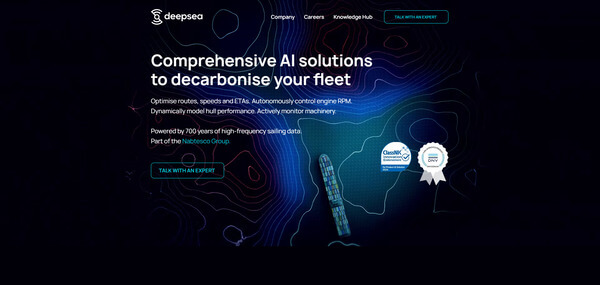
* Image source: DeepSea Official
Website
(https://www.deepsea.ai/)
(https://www.deepsea.ai/)
Core Capabilities
AI Fuel, CII &
Route Optimization
Route Optimization
- With the CII tracking feature, AI helps maintain and predict vessel performance.
- AI dynamically evaluates speeds and routes to suggest more fuel-efficient alternatives
- While complying with Europe-specific restrictions and regulations, it supports operations aimed at lower fuel consumption.
For Fleets with a Mix
of Older and Newly
Built Vessels
For Independent Ship
Management Companies
of Older and Newly
Built Vessels
For Independent Ship
Management Companies
Smart Ship Hub
* Image source: Smart Ship Hub Official
Website
(https://smartshiphub.com/)
(https://smartshiphub.com/)
Core Capabilities
Data integration across a mixed fleet
- Supports aggregation of vessel data across different manufacturers and standards, as well as data from multiple vessels.
- Visualizes information distributed across onboard systems and supports building an environment for centralized management.
- Supports information sharing between shore teams and fleets with older vessels, older equipment, newly built vessels and new equipment.